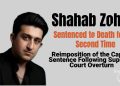
Shahab Zohdi, a detainee from the January 2026 nationwide protests held in Ghezel Hesar Prison in Karaj, has been sentenced to death for a second time by Branch 15 of the Tehran Revolutionary Court under Judge Abolqasem Salavati, following the initial reversal of his death sentence by the Supreme Court.

Iran Human Rights Society, Friday, October 30, 2026 – Shahab Zohdi, detained during the nationwide protests of January 2026, has been handed a second death sentence. This verdict was issued following a retrial before Branch 15 of the Tehran Revolutionary Court, presided over by Judge Abolqasem Salavati.
A source close to Shahab Zohdi’s family confirmed the reissuance of the capital sentence. He is currently incarcerated in Ghezel Hesar Prison in Karaj.
Reimposition of Shahab Zohdi’s Death Sentence After Supreme Court Reversal
Shahab Zohdi was first sentenced to death in February 2026 by Branch 15 of the Tehran Revolutionary Court. In August 2026, Branch 9 of the Supreme Court overturned the verdict and remanded the case back for retrial.
The Iran Human Rights Society previously highlighted Shahab Zohdi’s situation alongside two other detainees in a report covering the quashing of death sentences for three January protest arrestees and the ongoing risk of re-sentencing.
With the reissuance of the death sentence, the threat of execution once again directly looms over this prisoner.
The Basij Base Fire Case in East Tehran
Shahab Zohdi was arrested by security forces on January 8, 2026, during the nationwide protests. His case is linked to an arson incident at the “185th Martyr Mahmoud Kaveh” Basij base in East Tehran on the evening of the same day.
Four other co-defendants—Mohammad-Amin Biglari, Shahin Vahedparast Kelor, Amir-Hossein Hatami, and Ali Fahim—were also prosecuted under the same case.
A trial hearing addressing their charges took place on February 7, 2026, in Branch 15 of the Tehran Revolutionary Court, with capital sentences issued the following day.
Trial Without Legal Counsel and Security Charges
A knowledgeable source previously reported that the court hearing concerning Shahab Zohdi’s charges was conducted without the presence of his attorney.
The formal charges brought against him include “assembly and collusion against national and international security” and “Moharebeh (Enmity against God) and Efsad-e-fil-Arz (Corruption on Earth) through the destruction and arson of public property and facilities.”
His interrogation session took place on January 10, 2026, at the Tehran Security Prosecutorial Office (known as the Shahid Moghaddas Prosecution Office).
Reports confirming that his trial proceeded without defense representation raise grave international concerns regarding the total violation of his fundamental rights of defense.

Execution of Four Co-Defendants in the Same Case
The death sentences of Mohammad-Amin Biglari, Shahin Vahedparast Kelor, Amir-Hossein Hatami, and Ali Fahim were carried out in April 2026.
Shahab Zohdi is currently the sole surviving individual among the five co-defendants remaining in prison based on available reports.
The execution of his four co-defendants drastically escalates concerns regarding his fate and highlights the urgent necessity of evaluating his judicial proceedings.
Legal Analysis of Shahab Zohdi’s Case Under Domestic Frameworks
The legislative framework imposed by the ruling dictatorship faces continuous criticism for violating due process standards. Examining this case under domestic law does not imply endorsement of these statutes; rather, it serves to demonstrate that the regime fails to observe even its own legal codes.
Procedural Ambiguities
Holding a capital trial without defense counsel and reissuing a death sentence after a Supreme Court reversal raise critical questions regarding the legitimacy of the judicial review.
Relevant Statutory Articles
Article 35 of the Iranian Constitution explicitly guarantees the right to legal representation. Furthermore, Article 279 of the Islamic Penal Code establishes strict statutory conditions required to substantiate a charge of Moharebeh.
Procedural Violations
Denying effective legal defense and failing to clarify how the legal elements of the charges were proven fundamentally undermine the validity of the judicial process.
Human Rights Assessment
Articles 3, 10, and 11 of the Universal Declaration of Human Rights (UDHR) uphold the right to life, fair trial guarantees, and the presumption of innocence. Article 14 of the International Covenant on Civil and Political Rights (ICCPR) explicitly guarantees the right to effective legal defense.
Issuing a capital punishment sentence within a judicial framework completely lacking core fair-trial protections constitutes a severe threat of arbitrary deprivation of the right to life.
See also the below articles:
- Mai Sato at the UN: Repression Has Not Stopped the People of Iran from Protesting
- Alexis Anagnostakis, ECBA Human Rights Chair Joins “No to Executions Tuesdays”
Follow Iran Human Rights Society on social networks:
Telegram /Twitter /Instagram / YouTube / Facebook
Join Iran Human Rights Society on Twitter