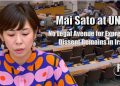
Mai Sato, the UN Special Rapporteur on the situation of human rights in Iran, stated in her second address to the Third Committee of the General Assembly that—highlighting severe restrictions on the freedom of assembly and protest, the issuance of death sentences, pre-trial televised confessions, and ongoing domestic repression—”no legal avenue for expressing dissent” remains in Iran.
Iran Human Rights Society, Friday, October 30, 2026 – On Wednesday, October 28, 2026, during the Third Committee at the 32nd plenary meeting of the 81st session of the UN General Assembly, Ms. Mai Sato once again addressed the human rights situation in Iran.

Responding to statements made by state representatives, she underscored the necessity of transparency regarding execution statistics and protester fatalities, adherence to fair trial rights, and an immediate halt to the execution of death sentences.
Mai Sato’s latest remarks follow her previous address to the Third Committee weeks prior, where she warned of escalating repression and a surge in executions in Iran. In her new speech, alongside reiterating these warnings, she focused specifically on the restriction of peaceful protest, the broadcasting of pre-trial forced confessions, and the vital need for a formal moratorium to halt executions.
Mai Sato: Human Rights Apply Under All Circumstances
Addressing representatives of the Iranian regime at the outset of her speech, Mai Sato acknowledged that Iranian authorities do not recognize the legitimacy of her mandate, yet noted that they have engaged with her office regarding wartime conditions over the past two years and recent months.
While welcoming this engagement, she simultaneously emphasized that human rights apply under all circumstances, and a state of war cannot justify setting aside human rights obligations.
Sato stated that while Iranian authorities have published statistics regarding wartime casualties, they continue to refuse to release data concerning executions and individuals killed by security forces. She noted that official casualty figures for protests remain vastly lower than independent estimates.
She stressed that the responsibility for publishing this data rests directly with the government, and until this obligation is fulfilled, civil society and the families of executed and killed individuals will remain the primary source of information for her mandate.
“No Legal Avenue for Expressing Dissent Remains”
A significant portion of Mai Sato’s address was dedicated to domestic repression and nationwide protests. She stated that the rights driving people into the streets—including freedom of peaceful assembly and association—have been severely restricted in Iran, both in law and in practice.
According to the Special Rapporteur, constitutional restrictions, mandatory permit requirements, and the sweeping weaponization of national security charges mean that virtually any form of protest is deemed illegal.
Describing the outcome of this situation, Mai Sato stated: “No legal avenue for expressing dissent remains.”
She added that protesters are either met with lethal violence or, following arrest, are sentenced to death and executed. At the same time, the UN Special Rapporteur emphasized that four decades of repression have demonstrated that crackdowns have failed to deter the people of Iran from protesting. She noted that this cycle only deepens the grievances that drive people into the streets in the first place.
Mai Sato urged Iranian authorities to recognize peaceful dissent not as a threat, but as an essential component of a healthy society.
Reaffirming the Necessity of a Visit to Iran
In another part of her address, Mai Sato renewed her call for an official country visit to Iran, stating that this request is now more critical than ever.
Addressing her responsibility toward the people of Iran, she noted that her mandate encompasses all citizens—including victims of human rights abuses and even those individuals alleged to have caused harm to others.
These statements come as the UN Special Rapporteur has repeatedly called for direct access to Iran to evaluate human rights conditions firsthand.
Televised Confessions: A “Grave Human Rights Violation”
A major focus of Mai Sato’s remarks was the broadcasting of pre-trial televised confessions.
Responding to a question regarding confessions aired on state television, she maintained her firm stance that broadcasting pre-trial confessions constitutes a serious human rights violation.

Mai Sato emphasized that publicizing confessions prior to any trial undermines the presumption of innocence, regardless of whether those statements were extracted through torture.
She stated that such confessions must be entirely excluded from judicial proceedings and should not be used as public evidence. According to Sato, a court proceeding held in the wake of such propaganda cannot constitute a fair trial, and any death sentence resulting from such a process amounts to an arbitrary deprivation of the right to life.
Mai Sato: Opposition to the Death Penalty Originates from Inside Prisons
Mai Sato announced that her mandate will maintain a special focus on the death penalty, stressing that the necessity of establishing a formal legal moratorium on executions is felt more urgently than ever.
She noted that calls for the abolition of the death penalty are resonating deeply within Iranian society, and this opposition is not confined to those outside prison walls.
According to Mai Sato, for over two years and eight months, prisoners have undertaken weekly hunger strikes every Tuesday to protest executions across all offenses.
This was a direct reference to the “No to Executions Tuesdays” campaign—a movement initiated from within Iran’s prisons that has evolved over recent years into one of the most sustained prisoner protests against capital punishment.
Mai Sato urged Iranian authorities to establish an official legal moratorium on carrying out all death sentences with the ultimate goal of abolishing capital punishment.
Concerns Regarding Kolbars and Souhtbars
Continuing her address, Mai Sato turned to the situation of Iran’s ethnic minority regions, expressing ongoing concern over reports of extrajudicial killings targeting Kurdish Kolbars and Baluch Souhtbars (fuel couriers).

She also highlighted economic and environmental pressures in provinces such as Khuzestan, Sistan and Baluchestan, and Hormozgan, stating that these hardships severely impact communities already marginalized by systemic neglect.
She noted that the challenges in these regions extend beyond security issues, requiring urgent attention to the economic, environmental, and public health needs of the populace.
Forced Hijab and Pressure on Women
The enforcement of mandatory hijab policies formed another key section of Mai Sato’s speech.
She stated that mandatory hijab enforcement continues unabated in practice, with numerous reports of the closure of cafes, restaurants, and shops for non-compliance, alongside the arrest of individuals.
Mai Sato also expressed alarm over the plight of women trapped in cases of domestic violence and child marriage, noting that women continue to face execution in connection with such circumstances. Furthermore, she pointed to ongoing reports of femicide, calling for heightened international attention to violence against women.
Domestic Courts and the Crisis of Accountability
In another segment of her address, Mai Sato observed that her report is one of three recently published assessments concerning human rights in Iran, joining reports from other UN mechanisms and the UN Secretary-General.
She identified the primary obstacle as the total absence of effective domestic accountability.
Mai Sato stated that the courts tasked with addressing these cases are the very tribunals that issue death sentences in flagrant disregard of due process.
She explained that international mechanisms are vital precisely because internal avenues for justice are sealed, allowing these bodies to document and pursue human rights violations when domestic remedies fail. She urged states to provide the necessary resources for international mechanisms and to support civil society.
State Responsibility for Accountability
Concluding this section, Mai Sato emphasized that states which established international mechanisms to document human rights violations now bear the responsibility of utilizing those findings to pursue accountability.

She stated that this responsibility extends beyond issuing statements and can include integrating human rights considerations into bilateral agreements, aid frameworks, and the exercise of universal jurisdiction.
She asserted that when domestic pathways to justice are blocked, states must forge alternative avenues to protect victims and prevent the recurrence of human rights abuses.
Human Rights in a Post-War Settlement
In her concluding remarks, Mai Sato called upon the United States, Israel, and mediating nations to prioritize human rights in any agreement aimed at ending military conflict.
She emphasized that UN human rights mechanisms—including the special procedures comprising her own mandate—must be fully integrated into this process.
Mai Sato’s renewed remarks before the Third Committee paint a broad picture of profound concern regarding human rights in Iran—spanning executions and unfair trials to protest suppression, televised confessions, women’s rights, the plight of minorities, and the absence of effective accountability.
These statements further underscore that, from the Special Rapporteur’s perspective, the surge in executions and the crackdown on protests cannot be compartmentalized or excused by security and wartime conditions, as human rights apply universally and state obligations to preserve life, dignity, and fundamental rights remain absolute.
See also the below articles:
- Alexis Anagnostakis, ECBA Human Rights Chair Joins “No to Executions Tuesdays”
- Mai Sato at UN Third Committee: Repression & Executions Escalated Under Cover of War
Follow Iran Human Rights Society on social networks:
Telegram /Twitter /Instagram / YouTube / Facebook
Join Iran Human Rights Society on Twitter