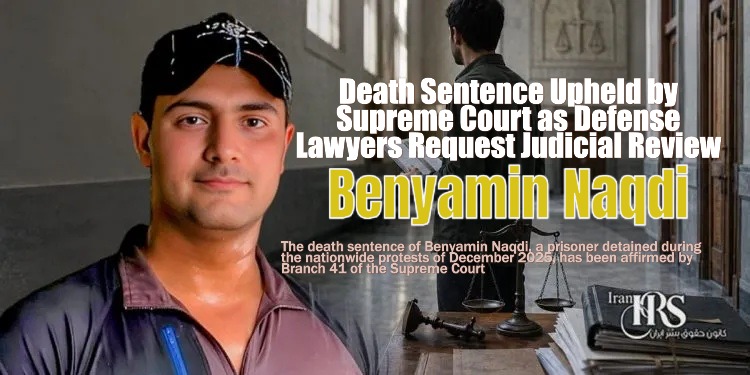
The death sentence of Benyamin Naqdi, issued by Branch 1 of the Shiraz Revolutionary Court under the charge of “Corruption on Earth” (Efsad-fil-Arz), has been upheld by Branch 41 of the Supreme Court. The prisoner’s defense attorney announced that a petition for judicial review (E’ade-ye Dadrasi) will be submitted shortly, expressing hope that its acceptance will allow the case to be re-examined by a parallel judicial branch.
Iran Human Rights Society, Thursday, July 30, 2026 – The death sentence of Benyamin Naqdi, a prisoner detained during the nationwide protests of December 2025, has been affirmed by Branch 41 of the Supreme Court. Mostafa Nili, a human rights

attorney and defense counsel in the case, announced that the Supreme Court’s decision was officially communicated to the legal team, who will file a petition for judicial review in the coming days. Nili noted that given the total absence of physical harm to any individual in this case, there is hope that grounds for a retrial will be established.
What You Will Read in This Report
- Supreme Court upholds Benyamin Naqdi’s death sentence
- Request for judicial review filed by defense attorneys
- Arrest background and shifting charges
- Details of the indictment and Revolutionary Court ruling
- Legal review of the case under domestic legislation
- Analysis of international human rights violations
Supreme Court Upholds Benyamin Naqdi’s Death Sentence
Attorney Mostafa Nili confirmed that Branch 41 of the Supreme Court upheld the death sentence passed down against Benyamin Naqdi on the charge of “Corruption on Earth.”
In an interview with the Emtedad media outlet, Nili stated that the decision was communicated to the defense team yesterday. He added that the legal team will submit a formal request for judicial review to the Supreme Court in the near future.
Commenting on the substance of the case, Nili stated: “Given that no physical harm was inflicted on anyone, we hope that by accepting the petition for judicial review, the Supreme Court will allow the case to be re-examined in a parallel court branch.”
The affirmation of this verdict comes amid heightened scrutiny from legal experts and human rights activists regarding shifting charges and due process irregularities since the case’s inception.
Fact Box | Benyamin Naqdi
| Field | Details |
| Name | Benyamin Naqdi |
| Case Status | Death sentence upheld by Branch 41 of the Supreme Court |
| Final Charge | Corruption on Earth (Efsad-fil-Arz) |
| Sentencing Court | Branch 1 of the Shiraz Revolutionary Court |
| Reviewing Judicial Body | Branch 41 of the Supreme Court |
| Defense Attorney | Mostafa Nili |
| Date of Arrest | January 3, 2026 |
| Location of Arrest | Shiraz |
| Alleged Reason for Arrest | Discharging a fire extinguisher toward law enforcement officers |
| Initial Charges | Attempted murder; later altered to Moharebeh (enmity against God), membership in groups disrupting national security, assembly and collusion, and propaganda against the state |
| Dismissed Charges | Inflicting physical injury on officers, carrying a cold weapon (Dismissal of Prosecution issued) |
| Current Status | Defense attorneys preparing petition for judicial review |
When and Under What Charges Was Benyamin Naqdi Arrested?
Benyamin Naqdi was arrested on the evening of January 3, 2026, in the city of Shiraz during a widespread wave of detentions following nationwide protests.
According to statements by his defense attorney, the cited cause for his arrest was “discharging a fire extinguisher toward law enforcement officers.”
His detention took place within the context of extensive roundups by security and judicial bodies targeting protesters, civil activists, and citizens following the December 2025 protests, leading to heavy security charges against many detainees.
Shifting Charges in Judicial Proceedings
According to Mostafa Nili, during initial interrogations, Benyamin Naqdi was formally charged with “attempted murder.” However, as proceedings advanced, this charge was upgraded to Moharebeh (enmity against God).
Upon completing preliminary investigations, the prosecutor’s office issued an indictment containing charges of Moharebeh, “membership in groups disrupting national security,” “assembly and collusion to commit crimes against national security,” and “propaganda against the state.”
Conversely, a formal Dismissal of Prosecution (Qarar-e Men’-e Ta’aqqob) was issued for two charges: “inflicting physical injury on officers” and “carrying a cold weapon.” This official dismissal indicated that the prosecution lacked sufficient evidence to pursue criminal charges on those specific counts.
Despite this, Branch 1 of the Shiraz Revolutionary Court combined the remaining charges, framed them as falling under the umbrella of “Corruption on Earth” (Efsad-fil-Arz), and passed down a capital sentence—a ruling now affirmed by Branch 41 of the Supreme Court.
Petition for Judicial Review: The Final Legal Recourse
Following the Supreme Court’s ruling, Benyamin Naqdi’s legal team announced they are filing for judicial review.
As outlined by Mostafa Nili, the central defense argument rests on the fact that no physical harm was caused to any individual throughout the incident. Consequently, the defense hopes the Supreme Court will accept the petition and remand the case to a parallel branch for a complete retrial.
Judicial review (E’ade-ye Dadrasi) represents an extraordinary legal remedy within the Iranian judicial system for reviewing final judgments. If granted, the case will undergo full judicial re-examination.
Legal Review of the Case Based on Domestic Laws
Iran’s judicial practices in security cases have drawn persistent criticism from legal scholars and human rights monitoring organizations over ambiguous proceedings, broad interpretations of capital offenses such as Moharebeh and Efsad-fil-Arz, and extensive applications of the death penalty. Benyamin Naqdi’s case raises severe legal questions regarding due process compliance and the rights of the accused.
Legal Ambiguities in the Case
As reported by defense counsel, Benyamin Naqdi initially faced charges of “attempted murder,” which were subsequently altered to Moharebeh. The final indictment combined Moharebeh, membership in security-disrupting groups, assembly and collusion, and anti-state propaganda.
However, the Shiraz Revolutionary Court issued a single death sentence based on the blanket classification of “Corruption on Earth,” rather than sentencing individual charges independently.
Furthermore, issuing a Dismissal of Prosecution for “inflicting physical injury” and “carrying a weapon” underscores that initial physical assault claims lacked factual support. Proceeding to issue a capital sentence based on the remaining charges creates severe legal discrepancies regarding charge proportionality, evidentiary sufficiency, and whether the alleged acts legally constitute Efsad-fil-Arz.
Emphasizing that “no one suffered physical harm,” defense attorneys argue that the facts do not meet the legal threshold for capital punishment under domestic statutory codes.
Relevant Domestic Statutory Provisions
- Article 32 of the Constitution: Mandates strict adherence to legal procedure during detention and requires immediate notice of charges.
- Article 35 of the Constitution: Recognizes the fundamental right of all defendants to chosen legal counsel.
- Article 36 of the Constitution: Requires that sentences be imposed strictly through a competent court in according with statutory law.
- Article 37 of the Constitution: Guarantees the presumption of innocence until guilt is legally proven in a competent court.
- Article 38 of the Constitution: Strictly prohibits torture or coercion to extract confessions or statements.
- Code of Criminal Procedure: Assures defense rights, effective access to counsel, impartial trial standards, rigorous evidence evaluation, and procedural compliance.
Highlighted Procedural Violations
Key legal deficiencies identified in this case include:
- Repeated alteration of charges throughout the judicial process;
- Issuance of a death sentence under the sweeping offense of Efsad-fil-Arz after dismissing core assault charges;
- Disproportion between the alleged act (using a fire extinguisher) and capital punishment;
- Failure to observe strict fair trial guarantees during security court proceedings;
- Proceeding toward sentence enforcement while extraordinary legal appeals remain pending.
Human Rights Violations Regarding Benyamin Naqdi
Under international human rights norms, Benyamin Naqdi’s trial and sentence raise critical concerns. Issuing and affirming capital punishment in a case explicitly lacking physical harm directly violates international limitations governing the use of the death penalty.
International human rights bodies consistently maintain that in capital cases, any failure of defense rights, evidence evaluation, or due process renders the execution an arbitrary deprivation of life. Guaranteeing independent judicial review, access to counsel, and rigorous fair trial standards are non-negotiable legal imperatives.
Relevant International Legal Instruments
- Article 3 of the Universal Declaration of Human Rights: The right to life, liberty, and security of person.
- Article 10 of the Universal Declaration of Human Rights: The right to a fair and public hearing by an independent and impartial tribunal.
- Article 6 of the International Covenant on Civil and Political Rights: Recognizes the inherent right to life and restricts capital punishment strictly to the “most serious crimes” following rigorous due process compliance.
- Article 14 of the International Covenant on Civil and Political Rights: Guarantees comprehensive fair trial standards, adequate defense facilities, access to counsel, and review by a higher tribunal.
- UN General Assembly Resolutions on Capital Punishment: Urge states to observe the highest procedural safeguards and work toward limiting and abolishing the death penalty.
The Supreme Court’s decision to uphold Benyamin Naqdi’s death sentence while a petition for judicial review is being submitted places the case at a critical juncture. His fate now rests on whether the Supreme Court will accept the defense petition for a retrial, as human rights organizations continue to highlight the severe due process flaws and broad application of capital offenses in his case.
See also the below articles:
- 12 Sunni Arab Citizens Arrested in Abadan and Mahshahr Crackdown
- Abolfazl Sepahi Public Execution: Two Protesters Hanged in Isfahan
Follow Iran Human Rights Society on social networks:
Telegram /Twitter /Instagram / YouTube / Facebook
Join Iran Human Rights Society on Twitter