
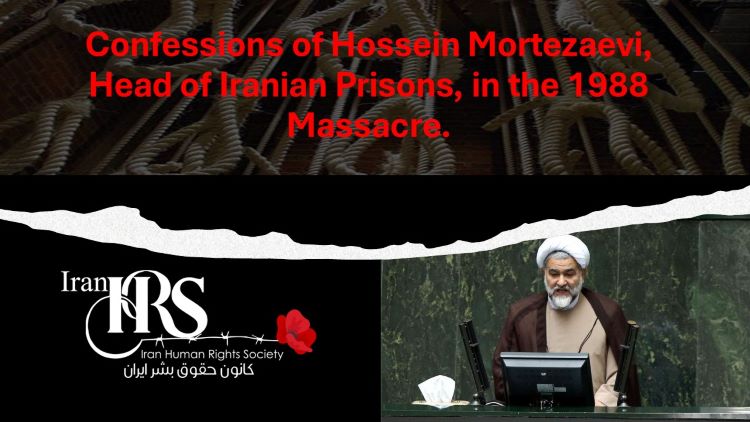
Confessions of Hossein Mortezaevi , the head of Iranian prisons in the 1980s and one of the key figures involved in the 1988 massacre of political prisoners, a name frequently associated with this tragic event.
The mass executions, carried out following a fatwa by Ayatollah Khomeini and the orders of a committee known as the “Death Commission,” claimed the lives of thousands of political prisoners. Mortezaevi, as a senior prison official, accused of overseeing the executions and committing gross human rights violations.
Confessions of Hossein Mortezaevi, Head of Iranian Prisons, in the 1988 Massacre.
I was aware of the executions, and the reason for that was my strong connection with Mr. Raisi.
At that time, he was the Deputy Prosecutor, not the Prosecutor. I became informed through him when he came to my office and said, “We went to see Khomeini today and obtained an order from him to execute the prisoners.” I shocked, but I didn’t say anything. We trying to open the doors, and the prisoners thought they would be released soon.
My words should not be interpreted as an attempt to absolve or exonerate ourselves from the injustice that wrongfully inflicted upon the people and prisoners. Never. I even feel it’s necessary to mention that at one point, I considered resigning and went to see Mr. Khoeiniha, who was the Chief Prosecutor of the Revolution, and pleaded with him, saying, “Just as you grant freedom to the repentant prisoners, grant me freedom too.”
The reason that we truly couldn’t do anything because decisions made elsewhere, and the executions carried out. For example, one night, I saw the late Najafabadi, and the next morning, I was told that he had been hanged.
The reason I’m speaking out now may be that much of this is old news, and everyone is already aware of it, making it seem pointless. But what I do know for sure is that the Islamic Republic under no circumstances is willing to have these matters revealed, and it will do everything it can to prevent the exposure of these crimes.
Those of us who participated in the revolution and are aware of these events must confess. Not repent, because repentance is something metaphysical, a spiritual matter where one tries to soothe their own conscience after committing any crime or wrongdoing and then repents. But that doesn’t solve anything.
The Japanese are admirable for declaring their shame in the face of their mistakes and doing so publicly. Today, I am ashamed as I speak, not repenting. What repentance? They’ve killed children and brought grief to families.
Ladies and gentlemen, know this: Do not accept any of my words that might seem like a defense of the Islamic Republic. Let me be clear: They are neither a republic nor Islamic.
I was told that executions would solve the prison problems. I asked, “What problem is supposed to be solved?” From the beginning, he dealt with me very guardedly because he thought I was unaware of the issues.
Another question is why these executions took place in 1988. It was because this was the only way to solve the issue of the prisoners while Khomeini was still alive, in his name. Whether this fatwa written by Khomeini himself or by Ahmad Khomeini, I don’t know. I know it reflected Khomeini’s view, but perhaps the wording was different! If it wasn’t his view, maybe I would have stayed in the government.
They wanted to erase the problem entirely and claim that there were no more political forces or political prisoners. I must say that when they carried out the executions in 1988, they were very successful in completely silencing and quelling the internal environment.
It’s true that the executed prisoners transported by truck. And as for where they buried, most people have heard that they buried in Khavaran. But we had no role in their burial because the prosecution office handled these matters.
Even if they were to wash Mortazavi with Zamzam water and cleanse him, he would not be purified. Because we had this responsibility, and the prisoners were in our custody. Although I wasn’t involved in their sentencing, but we were the ones holding them.
Write this down: I, Mortazavi, was wrong. I should have resigned and left at that very moment. I should have left that place. But I was there until the last minute.
**The figures they announce, like 5,000 people executed in Evin, are not accurate. The reality is that the total number includes prisoners from other cities as well; they’ve added them all together. Yes, executions took place in other cities and provinces too, not just in Tehran.
A committee was traveling to different provinces to carry out the sentences. However, regardless of whether it was ten people, a thousand, or 5,000, innocent people were killed. These individuals sentenced and given prison terms. But when someone is sentenced and then executed after the fact, that is a crime.**
This committee came and held a meeting in my office while I was still the prison warden. They began discussing these matters, and no one dared to go against the flow. But as we Azeris say, we speak bluntly, and it was the same during the Shah’s time. That’s why I resisted and said that this is not Khomeini’s decree. However, Mr. Nayyeri, Pourmohammadi, and Eshraghi were all present. Mr. Shoushtari, the head of the prison organization, was there too, and I told him that I didn’t agree with this. As a result, Mr. Shoushtari removed me from my position as prison warden and replaced me with a war veteran.
**At that point, I had no further information about the number of people who taken and killed. However, from my office, which overlooked the prison exit, I could see trucks parked there, and they were loading the bodies onto them and taking them away. But I don’t know how many there were today.
At that time, this coincided with the Mersad Operation, and within the prison, some individuals who remained steadfast in their positions were preparing to escape. This is the truth. But to say that there was a fire inside the prison or that there was an attack by the prisoners is a lie; there was no conflict between the prisoners and the guards. I was alone in my office, completely unaware of what was happening. **
**Then a few people from the broadcasting organization came by, and one of them, who will surely hear this one day, came into my office and asked why I was sitting here. That was brother Hossein Alamalhoda, whom I knew. They asked why I was sitting there. I replied, ‘Well, what should I do? Where should I go?’ They asked if I was aware of the executions. I said, ‘Yes, but I can’t do anything about it!’
They told me to at least come inside with them. I thought they might not let us in, but I said I didn’t mind. So, I went down with them, and a truck was parked there. They asked what it was. I said, ‘Open it and see for yourselves.’ They opened it and found a large number of executed bodies inside. They asked what this meant. I replied, ‘This is what they’re doing.’**
Instead of taking them through the medical exit, I led them through the back door, which was an iron gate. We went there, and I knocked on the door. Someone inside, who was busy with the executions and taking the wills, looked through the window. I told him that I was Mortazavi and wanted to come inside. He said it wasn’t possible. I kicked the iron door, and someone else came out. He showed me respect and didn’t realize that I was no longer the prison warden. I told him I wanted to go upstairs. He said okay, but only the cleric could go upstairs, not the others. I said fine. And opened the first door and saw that about six or seven people were hanging there. I passed by.
There was a young woman sitting there. They had brought everyone there and were writing their wills. She stopped me and said she was among the repentant, but they still wanted to execute her. I asked if she had confessed, and she said yes, but they still brought her there. She began to swear. I told her to sit there and wait for me to come back. This was an excuse for me to go upstairs, and I went straight to the committee’s room and started shouting.
I said, ‘Didn’t you say that only those who remain steadfast in their positions would be executed? But now that girl downstairs says she’s repented, yet you still want to kill her!’ Pourmohammadi said, ‘See what the Seyed (cleric) saying.’ Then one of the security forces came down with me. When I returned to where the girl was sitting on the chair, I saw that they had taken her and hanged her, and someone else was sitting in her place.
**Unaware of the situation, I went to see that girl, and the person with me asked her, “Do you deny the Mojahedin-e Khalq Organization?” The girl started swearing at me and told him to get lost. I stunned, wondering what had happened. With no other option, I had to leave, but on my way back, I took a different route through another ward where leftists and some Kurds preparing for execution. One of the Kurds stopped me and said they were killing him just because he was Kurdish. I told him, “I swear to God, I have no power here.”
Later, I saw others on the upper floor prepared for execution. For a long time after, I kept asking myself, “God, what happened there?” Then, during a meeting with Mr. Shoushtari, Mr. Raisi, and the same man, he said, “This Seyed Mortazavi is so naive. He wanted to save the life of a hypocrite, but I went and hanged that person and replaced them with someone who was steadfast in their position.”
I have many years of experience at the front, am a war veteran, and a martyr’s brother. I have held various key positions, including coordinating between the government and the clergy during Rajai’s time. But I am not willing to meet with him (Khamenei) because I was part of the Islamic religious enforcement committee and have been in many positions.
Khamenei is a man of particular traits and will never, ever move from point A to point B. He has no idea what he’s doing. He doesn’t understand. Killing is as easy as drinking water for him, and I don’t accept anyone who defends him. They can kill me so that I can be at peace, and it can all end. He won’t back down under any circumstances. And he didn’t even accept the referendum. He will continue the killings and increase them. What we are saying now is just talk, stories, and tales.
Those who supposed to sacrifice their lives have done so. Also, those who supposed to confine to their homes now confined. Those who lost their parents, children, or family left behind. Now we are talking like intellectuals. But Khamenei will never move from point A to point B. Anyone who thinks that Khamenei will back down is mistaken. Khamenei will behead and execute everyone, and he will do even more.
Let’s all shout together, and you write a letter. I have never been willing to write a request to him in my life. But now, as the head of Evin Prison, write that I, Mortazavi, head of Evin Prison, and Gohardasht Prison, given false information to the people, but their goal is to kill the people.
Mr. Rafsanjani, at that time, was completely different from the Rafsanjani at the end of his life. I have no doubt that he was aware of all the executions at that time. To say that he was against the executions is not true because if he was, he could have easily stopped them. It would have made a difference. If he was against them, he would have sided with Ayatollah Montazeri and would have even met with him when he went to Qom. But no one dared to bring it up, and no one dared to oppose it. You know, at that time, if Khomeini said yogurt was black, without question, yogurt was black.
I shouted there that if you want to bury them, at least bury them individually, but they were burying the executed in groups.
There’s another point: some Sharia judges believed that these girls shouldn’t leave this world unmarried. This additional injustice to those who already sacrificing their lives and now also had to endure being raped. The father of one of the executed girls, and I know he wasn’t lying, told me that what pains and torments me in life is not my daughter’s death, but when they came to the door, gave me some money, and said, ‘This is the dowry for your daughter’s religious marriage.’ That was worse and more painful for me than the death of my child. **
Follow Iran Human Rights society on social networks:
Telegram / Twitter / Instagram / YouTube / Facebook
Follow the Iranian Human Rights Society on social networks:
Join Iran Human Rights Society on Twitter








Discussion about this post