
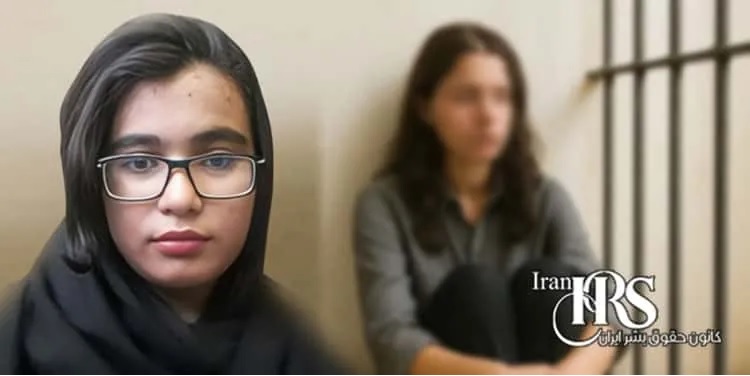
One of the most pressing concerns regarding Arghavan Fallahi is her physical condition and lack of access to vital medications. According to reports, she suffers from a specific medical condition requiring continuous medication.
Iran Human Rights Society, Thursday, 12 June 2025 – More than four months have passed since the re-arrest of Arghavan Fallahi, a Tehran resident, yet she remains detained under uncertain conditions in Evin Prison. No formal charges have been announced against her, and there is no clear judicial process for her case.
According to information from a source close to Arghavan Fallahi’s family, the political prisoner, who was arrested by security forces in early February 2025, stated in a brief contact with her family that she is being held in the Ministry of Intelligence’s security ward (Ward 209) of Evin Prison. She also emphasized that she is not in good physical health and urgently needs medication, but has been denied any medical treatment.
Lack of Clarity on Legal Status and Continued Detention Without Judicial Ruling
Despite months since her arrest, no official information has been provided regarding potential charges against Arghavan Fallahi. This is despite Iran’s domestic laws and fair trial principles requiring that a detained individual be informed of the reasons for their detention within days. However, in Fallahi’s case, not only has there been no clear communication, but there are also no indications that the prosecution or court is prepared to address her case.
History of Political Arrests and Previous Conviction
Arghavan Fallahi was previously arrested in November 2022 alongside her father, Nasrollah Fallahi, and transferred to Evin Prison. In that case, she was sentenced to two years in prison by Branch 26 of the Tehran Revolutionary Court, presided over by Judge Iman Afshari, on charges of “assembly and collusion” and “propaganda against the state.”
After serving her sentence, she was released on bail in March 2024. However, just weeks after her release, she was re-arrested without any clear or documented reason provided by security authorities.
Father and Daughter, Both Imprisoned
Currently, Nasrollah Fallahi, Arghavan’s father, is also serving his sentence in Evin Prison. The simultaneous imprisonment of father and daughter has imposed a heavy psychological burden on the family. Sources close to the Fallahi family report that they are in a state of severe emotional distress and deeply concerned about Arghavan’s fate and health.
Denial of Medication and Medical Services: A Direct Threat to the Right to Life
One of the most pressing concerns regarding Arghavan Fallahi is her physical condition and lack of access to vital medications. According to reports, she suffers from a specific medical condition requiring continuous medication. However, since her detention in Ward 209, she has been denied proper medical care and medication.
International human rights organizations, including Amnesty International, have previously warned about the systematic use of “denial of medical care” in Iranian prisons. This practice constitutes a clear form of torture and a violation of Article 7 of the International Covenant on Civil and Political Rights (ICCPR).
Widespread Human Rights Violations in Arghavan Fallahi’s Case
The arbitrary detention and ongoing uncertainty surrounding Arghavan Fallahi are part of a growing trend of human rights violations in Iran. Based on available documentation, the following principles and articles have been violated in her case:
Article 37 of Iran’s Constitution: The principle of presumption of innocence, completely disregarded in this case.
Article 9 of the ICCPR: Prohibition of arbitrary detention and the right to be informed of the reasons for detention.
Article 10 of the ICCPR: The obligation to treat all detained individuals humanely.
Article 12 of the International Covenant on Economic, Social and Cultural Rights: The right to the highest attainable standard of physical and mental health.
Prohibition of torture under Article 7 of the ICCPR: Denial of medication and medical care can be considered a form of indirect torture.
Arghavan Fallahi: A Case That Demands Attention
Arghavan Fallahi’s case is one of hundreds of instances of arbitrary detentions and suppression of individual and political freedoms in Iran, conducted without legal transparency, credible evidence, or fair trial. While her family remains in distress and uncertainty, human rights organizations and international bodies must emphasize the urgent need for her immediate and unconditional release.
As numerous similar cases have been reported in recent months, addressing the situation of prisoners like Arghavan Fallahi is an unavoidable necessity to uphold human dignity and defend fundamental rights.
Follow Iran Human Rights Society on social networks:
Telegram /Twitter /Instagram / YouTube / Facebook
Join Iran Human Rights Society on Twitter




Discussion about this post