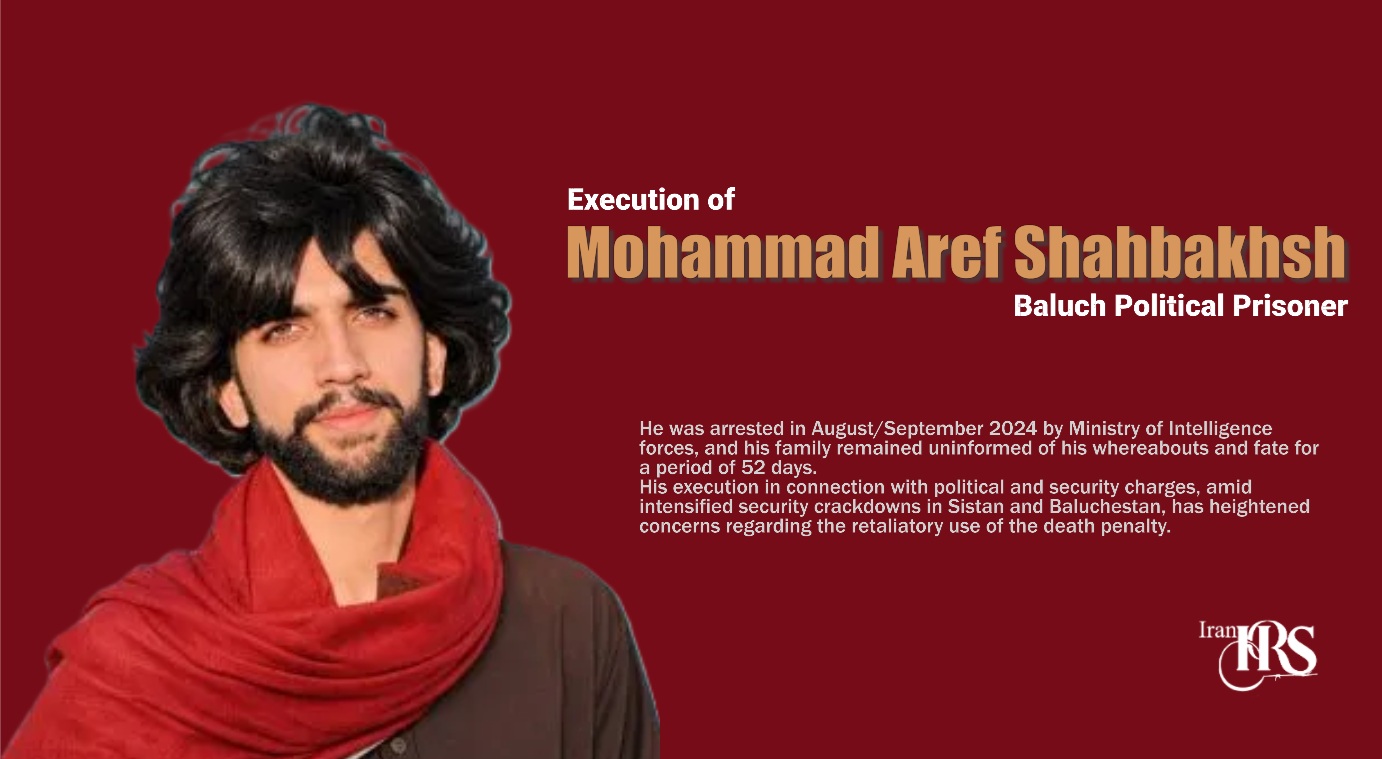
Fresh details have been published regarding the case of Mohammad Aref Shahbakhsh, the Baluch political prisoner executed on November 7, 2026. This 27-year-old citizen was arrested in August/September 2024 by Ministry of Intelligence forces, and his family remained uninformed of his whereabouts and fate for a period of 52 days. His execution in connection with political and security charges, amid intensified security crackdowns in Sistan and Baluchestan, has heightened concerns regarding the retaliatory use of the death penalty.

Iran Human Rights Society, Saturday, November 7, 2026 – The death sentence of Mohammad Aref Shahbakhsh, a Baluch political prisoner from Zahedan, was executed on the morning of Saturday, November 7.
The Judiciary had sentenced him to death on charges of “Baghy” (armed rebellion) and “Moharebeh” (enmity against God) in connection with an armed attack on the Qaleh-Bid police station in Khash County.
Fresh information regarding this case shows that Mohammad Aref Shahbakhsh, since the time of his arrest in August/September 2024, had endured a long period of his family’s lack of information and ambiguity surrounding his detention conditions.
Arrest of Mohammad Aref Shahbakhsh on the Route from Zahedan to Iranshahr
Mohammad Aref Shahbakhsh, approximately 27 years old, son of Akbar and a resident of Qaleh-Bid village in the outskirts of Zahedan, was a Baluch citizen.
According to received information, on August 29, 2024, as he intended to travel to Iranshahr, he was arrested by Ministry of Intelligence forces after leaving the city of Zahedan.
Following his arrest, agents transferred him to an unknown location.
The family of this Baluch political prisoner, during the initial weeks of detention, were unaware of his status, location of detention, and physical condition for a period of 52 days.
This prolonged period of lack of information heightens concerns regarding Mohammad Aref Shahbakhsh’s access to legal rights and his condition during the interrogation phase.
Execution on Political and Security Charges Related to the Qaleh-Bid Police Station
The Judiciary announced that Mohammad Aref Shahbakhsh was tried and sentenced to death on charges of participation in an armed attack on the Qaleh-Bid police station in Khash County.
According to the claims of judicial officials, this attack led to the death and injury of a number of law enforcement officers.
Judicial officials also alleged his affiliation with the Jaish al-Adl group. These charges constitute the official narrative of the Judiciary, and no independent information regarding the evidence of conviction or the defendant’s defense statements has been published.
According to official reports, investigations initially began in the Iranshahr Prosecutor’s Office and were subsequently transferred to Branch 6 of the Zahedan Prosecutor’s Office.
52 Days of Lack of Information and Ambiguity Regarding Judicial Proceedings
The arrest of Mohammad Aref Shahbakhsh en route and the 52-day lack of information for his family are among the most significant newly raised matters regarding this case.
Sufficient information has not been published regarding his access to chosen legal counsel, interrogation conditions, manner of obtaining statements, and the court’s handling of the trial.
The official execution report also did not provide specific details regarding the timing of the court session and the prisoner’s defense statements.
Given the implementation of the death penalty, transparency regarding these matters holds fundamental importance for evaluating compliance with fair trial requirements.
Execution of Baluch Political Prisoners and Concerns over Retaliatory Actions
The execution of Mohammad Aref Shahbakhsh occurred within the context of security tensions and state crackdowns against dissidents in Sistan and Baluchestan.
Previously, other Baluch prisoners faced execution on political and security charges; including Abdoljalil Shahbakhsh, whose death sentence was executed in April/May 2026.
Under such conditions, concern is raised that the execution of Baluch political prisoners is turning into a tool for instilling fear and delivering retaliatory responses to the resistance and protests of the people of Sistan and Baluchestan against repressive forces.
Nonetheless, to prove a retaliatory motive in the specific case of Mohammad Aref Shahbakhsh, independent evidence regarding the objective of judicial and security decision-makers is essential.
Legal Review of Mohammad Aref Shahbakhsh’s Case Based on Domestic Laws
The laws of the ruling dictatorship in Iran have always been criticized due to restricting human rights and contradicting fair trial standards. Reviewing this case does not mean endorsing these laws, but rather serves to demonstrate non-compliance with even these very regulations.
Legal Ambiguities of the Case
The family’s 52-day lack of information, the unspecified status of access to legal counsel, and the non-publication of the defendant’s defense statements are major ambiguities in the case.
Related Legal Articles
Articles 32, 35, and 37 of the Constitution pertain to notification of charges, the right to a lawyer, and the presumption of innocence. Article 50 of the Code of Criminal Procedure also provides for the right to inform the family.
Instances of Law Violation
The long-term deprivation of the family from information regarding the arrest and the lack of judicial transparency heighten concerns regarding compliance with defense rights.
Review of the Case from a Human Rights Perspective
Articles 3, 9, 10, and 11 of the Universal Declaration of Human Rights emphasize the right to life, prohibition of arbitrary arrest, fair trial, and the presumption of innocence.
Articles 6, 9, and 14 of the International Covenant on Civil and Political Rights also set forth specific guarantees regarding the right to life and judicial proceedings.
The implementation of a death sentence in a case with serious ambiguities regarding detention conditions and judicial proceedings highlights concerns regarding compliance with these guarantees.
See also the below articles:
- Amnesty International: 6 Prisoners at Risk of Execution in Iran
- Execution of 5 Prisoners in Khorramabad and Ghezel Hesar Prisons
Follow Iran Human Rights Society on social networks:
Telegram /Twitter /Instagram / YouTube / Facebook
Join Iran Human Rights Society on Twitter