
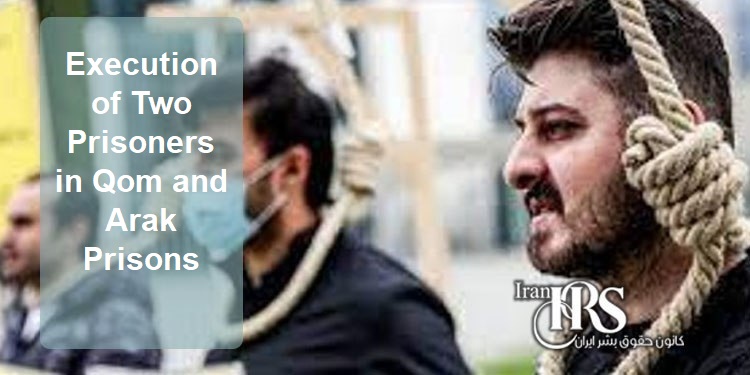
The number of executions in the month of Khordad (May-June) has reached at least 140 prisoners, meaning nearly five prisoners have been executed daily.
Iran Human Rights Society-Thursday (June 26, 2025)- Two prisoners were executed in Qom and Arak prisons. The regime’s leaders, fearing the outbreak of popular protests, are attempting to suppress and intimidate the public to prevent social unrest by intensifying security measures through checkpoints and coordinated executions.
Execution of Azim Mohammadi in Qom Prison
On the morning of Tuesday, 3 Tir 1404 (June 24, 2025), Azim Mohammadi was executed in Qom Prison. He had been arrested four years ago on charges of murder and sentenced to death.
Execution of Habib Soleimani in Arak Prison
At dawn on Monday, 2 Tir 1404 (June 23, 2025), Habib Soleimani was executed in Arak Prison. He had previously been arrested on murder charges and sentenced to death.
The number of executions in the month of Khordad has reached at least 140 prisoners, equating to nearly five executions per day.
Contradiction of the Death Penalty with the Universal Declaration of Human Rights
Article 3 of the Universal Declaration of Human Rights explicitly states: “Everyone has the right to life.” This right is not subject to any deprivation except by a verdict issued by a competent court for a crime recognized as such under the law.
The death penalty, as the ultimate punishment, directly contradicts this article of the Universal Declaration of Human Rights because:
Right to Life: The right to life is recognized as a fundamental and inalienable right. The death penalty deprives individuals of this right.
Irreversibility: Once a death penalty is carried out, there is no possibility of correcting judicial errors.
Torture and Inhuman Treatment: Some methods of execution are considered torture and inhuman treatment, which violate the provisions of the Universal Declaration of Human Rights.
Violation of Human Rights Obligations Regarding the Death Penalty
According to Article 6 of the International Covenant on Civil and Political Rights, to which Iran is a signatory, the issuance and execution of the death penalty are only permissible with full guarantees of a fair trial and for the most serious crimes. In many similar cases, lack of transparency, restrictions on the defendant’s legal rights, and issuance of verdicts in courts lacking necessary independence are considered violations of this fundamental human rights principle.
Follow Iran Human Rights Society on social networks:
Telegram /Twitter /Instagram / YouTube / Facebook
Join Iran Human Rights Society on Twitter






Discussion about this post