
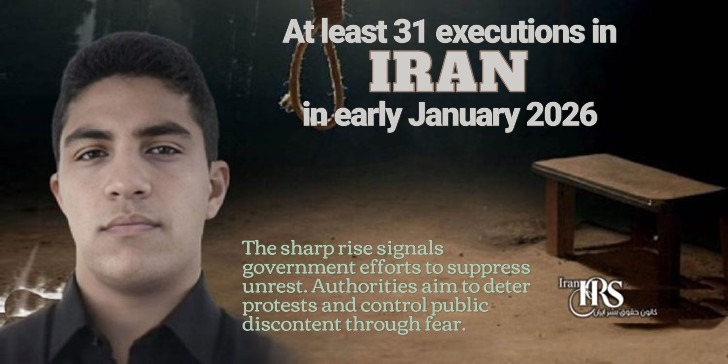
The upward trend in executions in Iran is a political response to social uprisings and a sign of the government’s efforts to contain public discontent
Iran Human Rights Society, Wednesday, January 7, 2025 – Seventeen prisoners were executed in Qezl-e-Hsar prisons in Karaj, Kerman, Mahabad, Yazd, Mashhad, Shiraz, Kashmar, Shahrekord, Bushehr, Chabahar, Damghan, Malayer and Sabzevar. Including security prisoner Ali Ardestani, the number of executions on Wednesday, January 7, reaches 16.
On Wednesday, January 8, 2026 at least 14 prisoners were executed in various prisons in Iran:
Yazd Prison: Kaveh Panahi and Ali Nirang (charge: Moharebeh)
Ghezel Hesar Prison: Yazdan Allahyari, Omid Nobakht and a prisoner with the surname Hosseini (charge: murder)
Vakilabad Prison, Mashhad: Soheila Azizi (female) and another prisoner (name under review; charge: drug-related)
Chabahar Prison: Mosayeb Chamani (charge: murder)
Busheh Prison: Davood Bagherzadeh (charge: murder)

Shahrekord Prison: Behzad Alipour (charge: murder)
Kashmar Prison: Khodamorad Hemmati (charge: drug-related)
Adelabad Prison, Shiraz: Sobhan Yeganeh (charge: drug-related)
Sabzevar Prison: Almas Mehdizadeh (charge: drug-related)
Malayar Prison: Bagher Bazvand (charge: drug-related) Drugs)
Damghan Prison: Bahman Yarbeigi (Charge: Murder)
Also on Tuesday, January 7, 2026 , Ruhollah Aghapour was executed in Mahabad Prison and Amir Hamzeh Palangi in Kerman Prison on charges of murder.
The conflict of the death sentence with the Universal Declaration of Human Rights
Article 3 of the Universal Declaration of Human Rights explicitly states: Everyone has the right to life. This right shall not be subject to any deprivation except by virtue of a judgment issued by a competent court as a result of the commission of a crime that is considered a crime according to law. The death sentence, as the highest punishment, directly contradicts this article of the Universal Declaration of Human Rights. Because:
The right to life: The right to life is presented as a fundamental and inalienable right. The death sentence deprives this right.
Irreversibility: If the death sentence is carried out, there is no possibility of compensating for a miscarriage of justice.
Torture and inhuman treatment: Some methods of execution are considered to be torture and inhuman treatment, which is contrary to the provisions of the Universal Declaration of Human Rights.
Violation of human rights obligations in relation to the death penalty
According to article 6 of the International Covenant on Civil and Political Rights, to which Iran is a signatory, the issuance and execution of the death penalty is permitted only if there are full guarantees of a fair trial and for the most serious crimes. In many similar cases, the lack of transparency, legal restrictions on the accused, and the issuance of sentences in courts lacking the necessary independence are considered contrary to this fundamental principle of human rights.
See also the below articles:
- UN Secretary-General Expresses Concern Over Protester Deaths in Iran Nationwide Protests
- EU expresses deep concern over suppression of nationwide protests and killing of at least 19 protesters
Follow Iran Human Rights Society on social networks:
Telegram /Twitter /Instagram / YouTube / Facebook
Join Iran Human Rights Society on Twitter







Discussion about this post