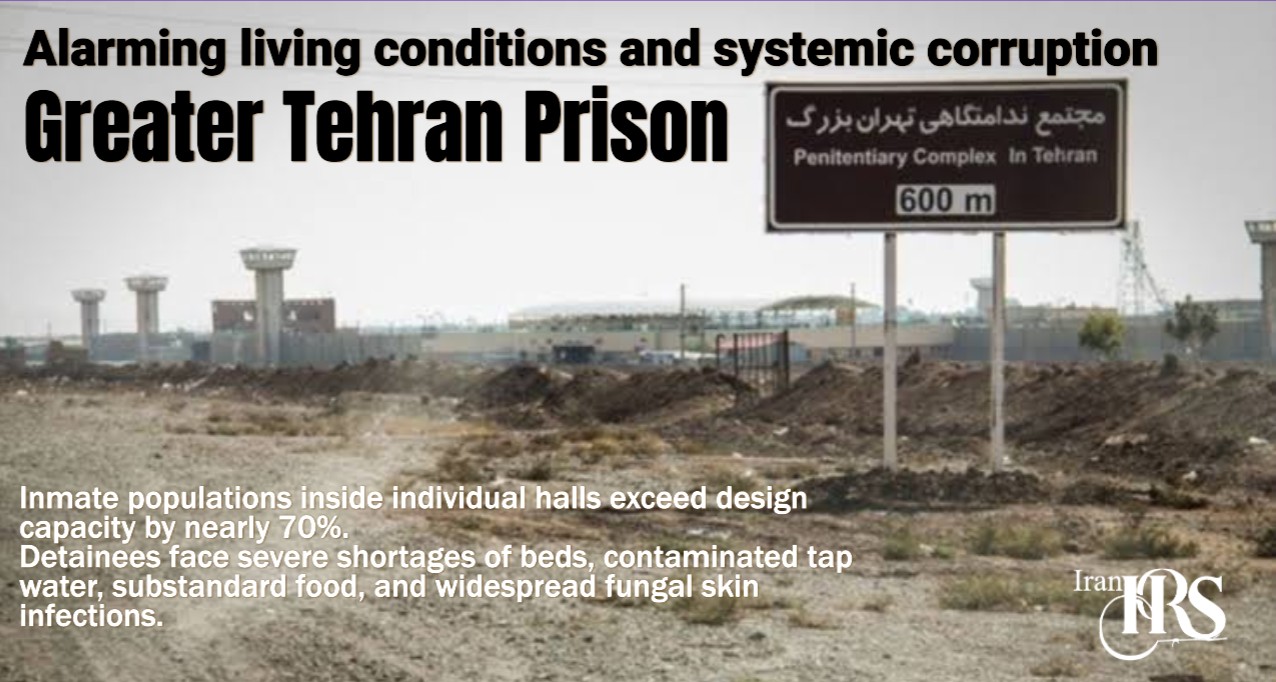
Reports originating from Brigade 5 of Greater Tehran Prison detail populations of roughly 400 inmates per hall, widespread sleeping on the floor, unfit water, skin conditions, low-quality food, high pricing on substandard store items, the establishment of so-called “VIP” rooms, and severe restrictions on family visits.
Iran Human Rights Society, Wednesday, August 12, 2026 – Information received from Brigade 5 of Greater Tehran Prison offers a concerning picture of detention conditions. Overcrowding reaching approximately 400 prisoners in halls equipped with only 240 beds, large numbers of inmates sleeping in hallways and prayer halls (Hosseiniyeh), poor water quality, outbreaks of fungal and skin infections, sub-par food and bread quality, and forcing inmates to purchase bottled drinking water represent only a portion of reported grievances. Concurrently, sources report the allocation of specific rooms to wealthy inmates, the circulation of narcotics and large financial sums within the facility, and three-to-four-month waiting periods for in-person family visits.
Key Information Box | Brigade 5, Greater Tehran Prison
| Subject | Reported Situation |
| Population per Hall | Approximately 400 prisoners per hall |
| Bed Capacity | 16 rooms, 15 beds per room; total capacity of 240 beds |
| Floor Sleeping | Around 160 individuals over bed capacity; prisoners sleeping in hallways and prayer rooms |
| Drinking Water | Saline and poor-quality tap water; prisoners forced to purchase bottled water out-of-pocket |
| Sanitary Condition | Reports of fungal and skin diseases linked to unsanitary spaces and poor bath water quality |
| Food and Bread | Poor food quality leading many to discard meals; reports of digestive issues from low-quality bread |
| Prison Canteen | High prices for substandard goods; reports of foul odors in some bottled water |
| “VIP” Rooms | 4 out of 16 rooms in certain halls reserved for financially capable inmates |
| Narcotics | Reports of organized networks smuggling/selling drugs with significant financial turnover inside |
| In-Person Visits | 3 to 4 months wait time for visits; prolonged delays and abusive treatment of families |
| Official Accountability | According to reports, prison officials provide no effective response to these issues |
Overcrowding: Around 400 Prisoners in Brigade 5 Halls
According to reports received, each hall in Brigade 5 of Greater Tehran Prison consists of 16 rooms, with each room holding 15 beds. Consequently, total bed capacity per hall is approximately 240.
However, the population of each hall is reported to be around 400 prisoners—roughly 160 individuals above the available bed count.
The direct outcome of this overcrowding is the proliferation of floor sleeping (Kaf-Khvabi). Numerous prisoners without assigned beds are forced to sleep in hallways and the prison prayer hall under harsh conditions.
This crowding extends beyond a mere shortage of resting space. Housing hundreds of inmates in a confined environment—especially alongside weak hygiene and ventilation—heightens the risk of contagious disease transmission. Sources note that if an inmate falls ill, close contact and high density increase the likelihood of others becoming infected.
Saline and Unfit Water: Inmates Forced to Buy Drinking Water
Another fundamental problem reported in Greater Tehran Prison is the water condition.
According to received information, the water in Brigade 5 is described as salty and poor-quality, considered unsuitable by inmates even for bathing.
Sources report outbreaks of fungal and skin conditions among inmates, citing unsanitary surroundings and bad bath water quality as contributing factors.
The drinking water crisis carries additional dimensions. Brigade 5 prisoners must purchase bottled water at their own expense for their daily needs.
This bottled water is used not only for drinking, but also for making tea and culinary preparation. As a result, access to one of the most basic daily necessities has become contingent on a prisoner’s financial capacity to purchase from the prison canteen.
Reports of Foul Odors in Purchased Bottled Water
Despite prisoners being effectively forced to buy water, the quality of goods sold at the canteen is also subject to heavy complaint.
Reports indicate that bottled water and many other items offered in the prison shop are of low quality. Certain products with little market demand outside are sold to inmates at elevated prices.
Sources even report cases where water purchased from the canteen carried a foul, sludge-like odor.
This situation traps prisoners in a difficult cycle: on one hand, prison tap water is unfit for consumption, while on the other, the water they are forced to buy out-of-pocket is not consistently acceptable in quality.
Food in Greater Tehran Prison: Significant Portions Discarded
Food quality represents another major issue in Brigade 5.
Based on information received, many prisoners refuse to consume distributed meals, discarding them directly into garbage bins—a reflection of deep dissatisfaction with the prison’s food quality.
Bread quality is similarly described as poor. Sources state that distributed bread is of such low quality that consuming it causes digestive distress for several inmates.
The combination of inedible meals, poor bread, and the necessity to buy water and food from the canteen places heavier burdens on inmates with limited financial means.
Under these circumstances, an inmate’s economic standing directly dictates their nutritional quality and access to clean drinking water.
Four “VIP” Rooms Out of 16 Per Hall
Another segment of the report touches on room management and the creation of unequal amenities for wealthy prisoners.
According to this data, room representatives (Vakil-Bands) in certain halls—cooperating with and supervised by brigade officials—have converted 4 out of 16 rooms into so-called “VIP” or exclusive quarters.
Sources state these rooms are allocated to prisoners who can afford to pay for them.
While large numbers of prisoners sleep on floors in hallways and prayer rooms due to bed shortages, the reservation of private rooms for financially privileged inmates highlights severe inequality in space distribution and facility access.
According to reports, these rooms feature prohibited items and amenities, including mobile phones, and narcotics can also be found within them.
Reports of Drug Smuggling and Distribution Networks
One of the most severe allegations from Brigade 5 of Greater Tehran Prison involves the trafficking and distribution of narcotics.
Reports indicate an active drug ring operating within the prison, generating substantial financial turnover.
Sources highlight the involvement of certain inmate representatives (Vakil-Bands) alongside cooperation from several prison personnel, noting that profits from drug trafficking inside reach extraordinarily high amounts.
This network and the VIP rooms operate while average prisoners struggle to secure basic needs, from clean drinking water to edible food.
The financial scope of this network and individual participation levels warrant independent investigation; nevertheless, received data points to an informal structure governed by money and unequal access inside Brigade 5.
Three to Four Months Waiting Period for Family Visits
Visitation arrangements present another layer of reported difficulty.
Prisoners must sometimes wait three to four months to secure an in-person visitation slot with their families.
Even when a visitation date arrives, families face additional hardships. Reports indicate families are kept waiting for hours during each visit.
Furthermore, search procedures and staff conduct toward visiting family members are described as humiliating and abusive.
Sources note that the severity of this treatment leaves some families facing emotional distress and hesitation regarding future visits. Thus, a process meant to maintain family ties functions instead as another tool of pressure.
Absence of Official Accountability Regarding Brigade 5
The report concludes by highlighting that prison officials offer no clear answers or solutions regarding these cumulative issues.
Overcrowding, floor sleeping, poor water and food quality, skin diseases, high prices for low-grade canteen items, VIP rooms, drug rings, and visitation limits form an interconnected web of hardship in Brigade 5 of Greater Tehran Prison.
The lack of an independent mechanism to record and investigate prisoner grievances allows these conditions to persist unchecked.
Legal Review of Brigade 5 (Greater Tehran Prison) Under Domestic Laws
Iran’s judicial laws have faced repeated criticism over the years for failing to align with fair trial standards, poor prison conditions, and violating the rights of detainees. Reviewing the situation in Greater Tehran Prison under domestic law does not imply endorsement of these statutes; the goal is to demonstrate where existing regulations are routinely violated by prison authorities.
Legal Ambiguities
Information from Brigade 5 raises serious questions regarding the Prisons Organization’s responsibility to maintain minimal living standards for detainees.
Housing ~400 people in a space built for 240 beds, widespread floor sleeping, lack of clean water, health hazards, low-grade food, and restricted family contact directly conflict with the legal duties of prison administrators.
Reports of allocating rooms to wealthy prisoners and permitting forbidden items underline the need to audit official conduct and internal prison management.
Relevant Legal Articles
- Article 22 of the Constitution: Holds individual life, rights, and dignity immune from violation.
- Article 39 of the Constitution: Strictly forbids any affront to the dignity and honor of detainees and prisoners.
- Executive Regulations of the Prisons Organization: Mandates that authorities provide basic needs, including adequate housing, hygiene, nutrition, medical care, and family contact.
- Prison Healthcare Regulations: Assigns direct responsibility for prisoner health and physical well-being to the Prisons Organization.
Instances of Law Violation
- Population density far exceeding existing bed capacity;
- Widespread sleeping on floors (Kaf-Khvabi);
- Inadequate access to clean drinking water;
- Outbreaks of skin and fungal infections due to unsanitary conditions;
- Substandard food and bread quality;
- Severe restrictions on family visitations;
- Abusive treatment of visiting family members;
- Lack of official responsiveness to inmate complaints;
- Unequal access to facilities based on financial status.
Human Rights Perspective and Potential Violations of International Standards
Incarceration should not strip individuals of fundamental rights unrelated to their legal deprivation of liberty. Clean water, adequate food, proper sleeping spaces, sanitary conditions, and family contact are non-negotiable requirements for humane treatment.
Human Rights Ambiguities
Extreme overcrowding, floor sleeping, contaminated water, poor nutrition, and disease-ridden conditions severely undermine prisoners’ rights to health and human dignity.
Furthermore, three-to-four-month delays for in-person visits combined with abusive behavior toward visiting relatives infringe upon prisoners’ rights to maintain family relationships.
Relevant International Documents
- Article 5 of the Universal Declaration of Human Rights: Prohibition of cruel, inhuman, or degrading treatment.
- Article 10 of the International Covenant on Civil and Political Rights: Mandates that all persons deprived of liberty be treated with humanity and respect for inherent dignity.
- Nelson Mandela Rules: Require that prisoner accommodation meet basic health, space, ventilation, and sleeping standards.
- Nelson Mandela Rules: Emphasize the provision of clean drinking water, nutritious food, medical care, and regular family contact.
Human Rights Violations Summary
Floor sleeping caused by overcrowding, lack of clean water, poor food/hygiene, health risks, financial discrimination, prolonged visitation limits, and abusive treatment of families represent the chief human rights concerns in Brigade 5 of Greater Tehran Prison.
These conditions highlight the urgent need for an independent inspection of Brigade 5, audits of water and food quality, relief of overcrowding, and official investigations into VIP quarters, financial exploitation, and drug trafficking networks inside the facility.
See also the below articles:
- 32 Countries Condemn Iran Executions of Protesters
- Evin Prison Crisis: Extreme Heat, Bedbugs, and Increased Pressure
Follow Iran Human Rights Society on social networks:
Telegram /Twitter /Instagram / YouTube / Facebook
Join Iran Human Rights Society on Twitter