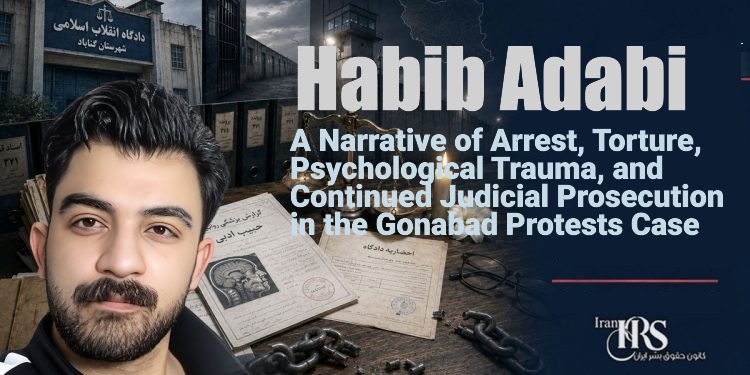
Following the conclusion of the preliminary investigations into the case of Habib Adabi, a detainee from the December 2025/January 2026 nationwide protests in Gonabad, the Public and Revolutionary Prosecutor’s Office of this county has issued an indictment (Gharar-e Jalb be Dadrasi) on three security charges. Concurrently, accounts released by sources close to the case describe severe torture, intense psychological pressure, physical injuries, total disregard for statutory interrogation protocols, and ongoing harassment targeting both him and his family.
Iran human rights Society, Saturday, July 11, 2026 – The case of Habib Adabi, arrested during the December 2025/January 2026 nationwide protests in Gonabad, has drawn significant attention from human rights defenders. This interest stems not only from the security charges leveled against him but also from numerous reports detailing his violent arrest, subsequent torture, harassment of his family, severe psychological trauma, and continuous judicial pressure.
According to the final ruling issued by the Public and Revolutionary Prosecutor’s Office of Gonabad, while some initial charges were dismissed due to a lack of sufficient evidence (Gharar-e Man-e Taghib), the case has been forwarded to the Revolutionary Court under three active counts. Furthermore, informed sources highlight the direct role of Dashtban, the Prosecutor of Gonabad, in steering the judicial proceedings and orchestrating pressure against Habib Adabi and his relatives.
Information Box | Habib Adabi at a Glance
| Title | Information |
| Name | Habib Adabi |
| Place of Arrest | Gonabad |
| Time of Arrest | Nationwide protests of December 2025/January 2026 |
| Current Case Status | Preliminary investigation concluded; indictment issued |
| Active Charges | Assembly and collusion against national security, membership in a group aiming to disrupt national security, and propaganda against the regime |
| Documented Violations | Severe torture, psychological trauma, extortion and harassment of family, ongoing unlawful seizure of personal property |

Conclusion of Preliminary Investigations and Referral to Court
Based on the final decision issued by the Public and Revolutionary Prosecutor’s Office of Gonabad, the preliminary investigation phase has officially concluded, and the case has been transferred to the Revolutionary Court. While the prosecutor dropped several initial charges due to a lack of proof, an indictment was sustained for three specific offenses: assembly and collusion against national security, membership in a group with the intent to disrupt national security, and propaganda against the regime. Official court summonses indicate that he has been ordered to appear before Branch 1 of the Gonabad Revolutionary Court.
Arrest Accompanied by Assault and Forced Disappearance
According to accounts from sources close to the case, after Habib Adabi’s image was identified by security forces during the nationwide protests in January 2026, masked agents carried out his arrest.
Sources state that the arrest involved severe physical beatings. Following his apprehension, he was blindfolded and transferred to an undisclosed location where he was subjected to violent interrogations. These reports indicate that interrogators repeatedly beat him with batons and whips, causing him to lose consciousness at one point due to the severity of the blows.
The Role of Prosecutor Dashtban in Extortion and Retaliation
The name of Gonabad’s Prosecutor, Dashtban, appears prominently across multiple stages of this file. Sources state that following Habib Adabi’s arrest, his family approached the judiciary to determine his whereabouts, only to be told that his release was conditional upon paying financial “damages.”
To secure his release, his mother, Tahereh Faghanzadeh, managed to gather 250 million Tomans using personal savings, public donations, and aid from a local benefactor. Despite the payment, authorities refused to release her son. Furthermore, under explicit orders from Prosecutor Dashtban, court security subsequently barred his mother and other family members from entering the judiciary building, completely blocking them from following up on his legal status through standard channels.
Torture and Long-Term Physical and Psychological Repercussions

Chronic Psychological Trauma
The immense pressure inflicted upon Habib Adabi was not confined to his interrogation room; its severe effects have persisted long after his temporary release. Informed sources note that he faced constant psychological manipulation, threats against his family’s safety, and harsh detention conditions. These practices have caused deep psychological trauma. Habib Adabi currently battles severe insomnia, night terrors, acute anxiety, and chronic post-traumatic stress.
Medical Evaluation
A specialist in neurology and psychiatry submitted an official medical report to the Gonabad Revolutionary Court, explicitly declaring that Habib Adabi’s psychological state renders him entirely unfit to endure imprisonment or undergo punitive sentencing.
Physical Injuries and Subsequent Surgeries
Prior to his arrest, Habib Adabi had a pre-existing fracture in one of his arms, which had been surgically repaired with an orthopedic metal plate. Sources state that during his interrogation and beatings, security agents repeatedly struck that specific arm, severely damaging the old surgical site. Due to the trauma inflicted, he was forced to undergo an emergency surgical procedure roughly one month ago to remove the damaged hardware. His medical rehabilitation is ongoing, and his recovery remains complicated by post-surgical side effects.
Arrest of Inmate’s Mother to Force a Counter-Narrative
In a highly retaliatory move, security forces targeted the detainee’s mother, Tahereh Faghanzadeh. Following extensive media exposure and public outcry on social networks regarding Habib Adabi’s torture and medical state, judicial authorities rushed his temporary release to mitigate criticism. Immediately afterward, however, Prosecutor Dashtban ordered the arrest of his mother.
During her detention, she was subjected to intense threats and coercive interrogation. Her release was made strictly conditional upon her performing forced public relations tasks in the digital sphere. Specifically, she was compelled to post daily comments underneath online news reports discussing her son’s torture, falsely claiming that her son had been released, faced no issues, and that all reports of abuse were untrue. Additionally, she was ordered to monitor her own social media and turn over copies of all her online communications to security officials for a week following her release.
Continued Harassment via Property Seizure
Despite several months passing since Habib Adabi’s temporary release, the Gonabad Intelligence Department continues to hold his personal belongings. Sources close to the case state that his mobile phone, watch, bank cards, and other personal property have not been returned to his family. Human rights activists point out that the prolonged withholding of personal property serves no legal purpose and is used solely as a tool to sustain psychological and financial pressure on the family.
Legal Review of the Case Based on Domestic Laws
Introduction
Before initiating a legal analysis, it must be noted that international human rights bodies routinely condemn the judicial framework within the ruling dictatorship—especially regarding security files linked to public protests—for systematically denying fair trials, freedom of expression, and immunity from torture. However, even under domestic frameworks, security agents and judicial officials are bound by strict statutory obligations regarding the treatment of suspects and procedural protocols.
Legal Ambiguities
The use of violence during arrest, holding a suspect in an undisclosed location, extracting confessions through torture, harassing and detaining family members, extorting money, and ignoring expert medical testimonies regarding a defendant’s mental instability constitute severe procedural and statutory violations in this case.
Related Legal Articles
- Article 22 of the Constitution: Inviolability of life, property, rights, and dignity.
- Article 32 of the Constitution: Strict prohibition of arbitrary detention or holding individuals outside formal legal procedures.
- Article 38 of the Constitution: Absolute prohibition of torture for the purpose of extracting confessions. Statements obtained under duress are legally void.
- Article 39 of the Constitution: Absolute prohibition of insulting or violating the honor of detainees.
- Code of Criminal Procedure: Mandates the preservation of the defendant’s rights during preliminary investigations and the immediate return of seized personal property once it is no longer required as evidence.
Violations of Law
- Executing an arrest accompanied by severe physical assault.
- Enforced disappearance and interrogation at an undisclosed location.
- The documented use of torture (whips and batons) during investigations.
- Coercing and arbitrarily detaining the defendant’s mother.
- Withholding personal property without legal justification.
- Refusing to halt legal proceedings despite official psychiatric warnings regarding the defendant’s inability to endure punishment.
Human Rights Violations Indicated in Habib Adabi’s Case
From a human rights standpoint, this file presents clear violations of the right to physical security, freedom from torture, and the right to a fair trial. The weaponization of a suspect’s family members, extracting statements under threat, and subjecting a traumatized individual to continued prosecution directly contradict global human rights standards.
Violated Articles
- Article 3 of the Universal Declaration of Human Rights: The right to life, liberty, and security of person.
- Article 5 of the Universal Declaration of Human Rights: Absolute prohibition of torture or cruel, inhuman, or degrading treatment or punishment.
- Article 9 of the Universal Declaration of Human Rights: Absolute ban on arbitrary arrest and detention.
- Article 14 of the International Covenant on Civil and Political Rights: The right to an effective defense and a fair, impartial trial.
- The Nelson Mandela Rules: Mandates the protection of the physical and mental health of all individuals deprived of their liberty and strictly forbids cruel or degrading disciplinary actions.
Call for Action: Submission of Documentation
The Iran Human Rights Society calls upon all citizens, attorneys, former detainees, and individuals possessing verifiable information, judicial documents, medical records, or audio-visual evidence regarding the case of Habib Adabi, the actions of Gonabad Prosecutor Dashtban, or other complicit security officials, to securely share their documentation.
Accurate documentation serves as a critical mechanism to uncover the truth, challenge state impunity, and build verifiable cases for future independent accountability in both domestic and international tribunals.
Secure Communication Channels:
- Email: info@iranhrs.org
- Contact Form: https://iranhrs.org/contact-us/
- WhatsApp: +31 6 17325233
- Telegram: @MaryamHashemai
- Instagram: maryamhashemie2020
See also the below articles:
- Fashafuye Prison: More Than 500 Open-Prison Inmates Stranded in Extreme Heat
- Farhad Baranzehi: Threatened with Execution After 482 Days of Detention
Follow Iran Human Rights Society on social networks:
Telegram /Twitter /Instagram / YouTube / Facebook
Join Iran Human Rights Society on Twitter