
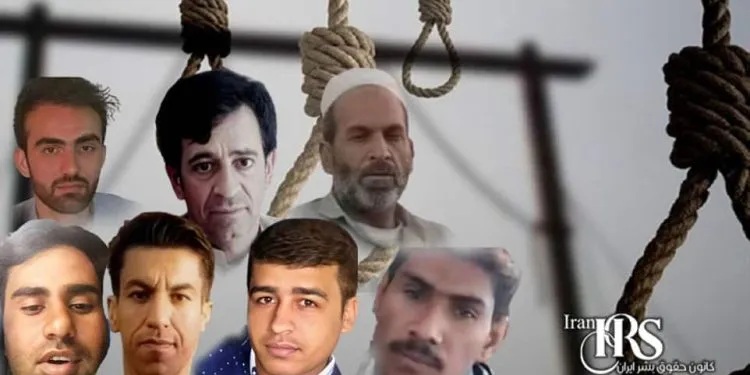
Iran executions surge with 11 prisoners killed in Bandar Abbas, Iranshahr, Kerman, Beyram, and Arak on August 19, 2025, violating human rights norms.

Iran Human Rights Society, Tuesday, August 19, 2025 – Iran executions have surged alarmingly, with 151 prisoners killed in August 2025 alone. On August 19, 2025, authorities executed 11 individuals across Bandar Abbas, Iranshahr, Kerman, Beyram, and Arak prisons. This translates to over five executions daily, or one every five hours, signaling a profound human rights crisis. Such frequent executions violate the fundamental right to life, drawing global condemnation. This article explores these executions, their charges, and their conflict with international human rights standards, emphasizing the urgent need for reform.
Six Afghan Prisoners Executed in Bandar Abbas
On August 19, 2025, Bandar Abbas Prison authorities executed six Afghan prisoners for drug-related charges. Three identified individuals include:
- Allah Nazar Tajik, around 30, married, with one child, from Farah Province, living in Nimruz Province.
- Abdulraouf Noorzahi, 50, married, with six children, from Nimruz Province.
- Abdulrahman Eshaqzahi, 50, married, with seven children, from Farah Province.
Arrested 2–3 years ago in separate cases, they received death sentences without family notification or final visits. Authorities are still verifying the identities of the other three prisoners, highlighting ongoing transparency issues in Iran’s judicial system.
Majid Pourasahaq Executed in Bandar Abbas
On the same day, officials executed Majid Pourasahaq in Bandar Abbas Prison. A local resident, he faced murder charges and received a death sentence. His execution proceeded without prior notice to his family, underscoring the lack of due process in Iran executions.
Milad Narouei Executed in Kerman Prison
On August 19, 2025, Kerman Prison authorities executed Milad Narouei, 29, from Zahedan. Arrested in 2022 for drug-related charges, his death sentence had previously been overturned, making his execution unexpected. His family expressed shock, as they believed he would be spared, pointing to inconsistencies in judicial rulings.
Hafiz Siahkhani Executed in Iranshahr Prison
At dawn on August 19, 2025, Iranshahr Prison officials executed Hafiz Siahkhani, 38, from Shahdraz village. Arrested in 2011 for murder, he faced execution without family notification or a final visit. This lack of communication further illustrates the opaque nature of Iran’s execution processes.
Public Execution of Sajjad Molaei Hakani in Beyram
On August 19, 2025, authorities publicly executed Sajjad Molaei Hakani in Beyram, Laristan. Convicted on murder charges, his public execution aimed to deter crime but instead sparked outrage over its inhumane nature and lack of judicial fairness.
Behzad Zeinali Executed in Arak Prison
On the same morning, Arak Prison officials executed Behzad Zeinali for murder charges. His death sentence was carried out without additional details on family notification, reflecting a pattern of limited transparency in Iran executions.
Iran Executions Violate Fundamental Human Rights
Iran executions directly challenge the universal right to life, a cornerstone of human rights. This inalienable right faces violation through the death penalty, which allows no room for correcting judicial errors. Furthermore, certain execution methods, such as hanging, often qualify as torture, breaching international standards. These practices raise ethical concerns and fuel global calls for Iran to halt executions.
Unfair Trials Undermine Iran’s Human Rights Obligations
As a signatory to international human rights agreements, Iran must ensure fair trials for death penalty cases. However, many Iran executions lack transparency, restrict defendants’ legal rights, and occur under courts without independence. For instance, defendants often lack access to adequate legal representation, and verdicts frequently stem from rushed or biased proceedings. Such practices violate obligations to reserve death penalties for only the most serious crimes with rigorous judicial oversight. Consequently, the international community continues to criticize Iran’s judicial system for its failure to uphold fair trial standards.
Global Call for Action Against Iran Executions
The alarming frequency of Iran executions demands urgent global attention. Human rights organizations advocate for stronger oversight and pressure on Iran to align with international standards. By addressing these violations, the global community can push for reforms to protect the right to life and ensure fair judicial processes in Iran.
Follow Iran Human Rights Society on social networks:
Telegram /Twitter /Instagram / YouTube / Facebook
Join Iran Human Rights Society on Twitter
See also the below articles:





Discussion about this post