
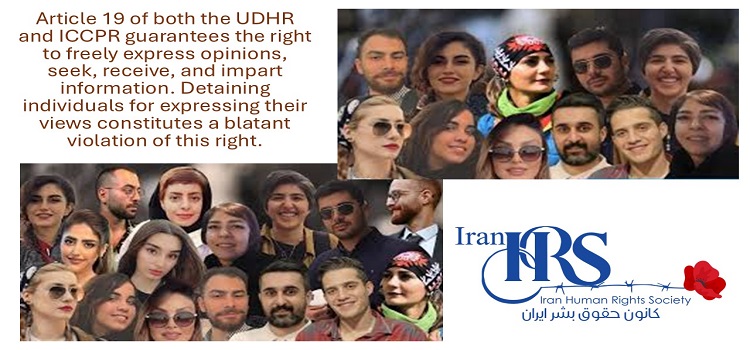
According to the Iran Human Rights Society on Friday, November 15, 2024, 22 political prisoners sentenced to a total of 161 years in prison, along with additional penalties, by the Revolutionary Court of Isfahan.
The First Branch of the Revolutionary Court, presided over by Judge Tavakoli, issued harsh sentences. For instance:
Samaneh Amooshahi: 23 years imprisonment.
Marjan Beshtam and Mino Heidari: 11 years each.
Shamim Baharzadeh: 8 years.
Other defendants:
Other defendants, including individuals like Bahar Soleimani, Kian Talebi, and Parisa Haji Aghai, sentenced to six years each, plus two years of travel bans and restrictions from online activity.
Eighteen individuals, including Mahshad Kashani, Kian Talebi, Hoda Sadeghi, Erfan Khalilian, Mehrshad Barjian, Pouya Talebian, Maryam Farhang, Pouya Dana, Roozbeh Dana, Mohammadreza Ghotbizadeh, Sima Torkian, Zeinab (Maryam) Parandeh, Mohammad Sokhanvar, Mina Nedaei, Amir Ajmian, Amir Salari, Bahar Soleimani, and Parsa Haji Aghaei, have each been sentenced to six years in prison. Additionally, they face two-year bans on travel and online activities.
Due to insufficient space, the trial was held in the courthouse prayer room, violating standard legal procedures.
Many of the defendants, including Bahar Soleimani, Maryam Parandeh, Mina Nedaei, and Roozbeh Dana, arrested in mid-July 2023. Others, like Mehrshad Barjian and Pouya Dana, were detained on August 2, 2023, while Maryam Farhang and Pouya Talebian were arrested on August 6, 2023.
Background:
Many arrested mid-2023 under harsh conditions involving physical and psychological torture, reportedly by an interrogator referred to as “Doctor.” Female prisoners faced additional abuses.
The lack of proper trial facilities led to hearings being held in a prayer room, a violation of legal procedures. This sentencing reflects systematic suppression of dissenting voices, violating basic human rights principles.
UN Rights Violation:
This violates Article 9 (protection from arbitrary detention) and Article 19 (freedom of expression) of the Universal Declaration of Human Rights.
Human Rights Violations in the Arrest of Protesters
The detention of protesters in Iran violates multiple provisions of international human rights law. These laws, explicitly outlined in documents such as the Universal Declaration of Human Rights (UDHR) and the International Covenant on Civil and Political Rights (ICCPR), include:
Freedom of Expression:
Article 19 of both the UDHR and ICCPR guarantees the right to freely express opinions, seek, receive, and impart information. Detaining individuals for expressing their views constitutes a blatant violation of this right.
Right to Peaceful Assembly:
Articles 20 of the UDHR and 21 of the ICCPR emphasize the right to peaceful assembly. The suppression and arrest of peaceful demonstrators contravene these provisions.
Prohibition of Torture and Inhumane Treatment:
Article 5 of the UDHR and Article 7 of the ICCPR prohibit torture or degrading treatment. Numerous reports of torture and ill-treatment of detainees highlight a breach of this principle.
Right to a Fair Trial:
Article 10 of the UDHR and Article 14 of the ICCPR ensure the right to a fair, public trial by an impartial tribunal. Many detainees in Iran are denied access to legal representation and fair judicial processes.
Right to Life, Liberty, and Personal Security:
Article 3 of the UDHR safeguards every individual’s right to life, liberty, and security. Arbitrary arrests and detentions directly violate this fundamental right.
Conclusion:
The crackdown and imprisonment of protesters in Iran represent a clear violation of multiple international human rights standards and have drawn widespread condemnation from global human rights organizations.
Follow Iran Human Rights society on social networks:
Telegram / Twitter / Instagram / YouTube / Facebook
Follow the Iranian Human Rights Society on social networks:
Join Iran Human Rights Society on Twitter





Discussion about this post