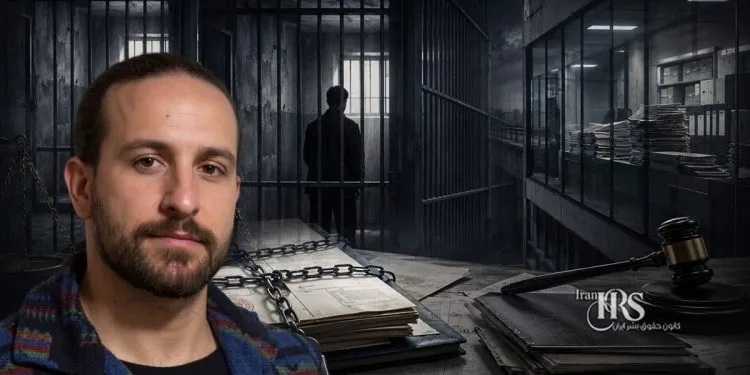
Armin Nourmohammadi, an architecture student from Eslamshahr, has been sentenced to execution on the charge of “Moharebeh” in connection with damage to an ATM device during the 2025-2026 protests. His father and lawyer, by referring to the details of the case, have spoken about the existence of serious legal ambiguities in the trial process, the failure to send the appeal to the Supreme Court, and the non-observance of some legal formalities.
Iran Human Rights Society, Sunday, June 14, 2026 – The case of Armin Nourmohammadi, a student born in 1998 and one of those arrested in the nationwide 2025-2026 protests, has entered a sensitive stage after the issuance of the execution sentence by Branch 15 of the Tehran Revolutionary Court. His family and lawyer believe that there is no proportionality between the actions attributed to this prisoner and the determined punishment, and the trial process has also been accompanied by numerous legal ambiguities. Now, while the objection to the sentence has been registered, concerns about the fate of this case and the non-observance of some legal requirements have increased.
To what charge has Armin Nourmohammadi been sentenced to execution?

Based on the statements of Armin Nourmohammadi’s father, the main issue of the case goes back to minor damage to an ATM device of Sepah Bank in Eslamshahr. According to him, this device was not completely destroyed and only part of its buttons had been burned. Armin Nourmohammadi was first arrested by security forces on March 30, 2023. He spent about 40 days in detention, part of it in solitary confinement, and was then released on bail. However, in December 2025 he was arrested again and after holding a court session, he faced the charge of “Moharebeh”; a charge that ultimately led to the issuance of an execution sentence. The father of this prisoner says that the family, in addition to providing bail, has also paid 184 million tomans for the damage determined by Sepah Bank.
Why does the lawyer of the case object to the trial process?
Ali Sharifzadeh Ardakani, Armin Nourmohammadi’s lawyer, has announced that he has filed an appeal against the issued sentence within the legal deadline. However, he says that the branch issuing the verdict has not sent the objection file to the Supreme Court. According to this lawyer, Branch 9 of the Supreme Court also, in contact with Branch 15 of the Revolutionary Court, faced the response that the appeal has not been registered; while the lawyer of the case emphasizes that the objection was registered on time and has an official registration number. This issue is considered one of the most important ambiguities of the case; because in cases where the death penalty is involved, review in the Supreme Court is considered an essential part of the trial process.
Can damage to an ATM alone be considered an instance of Moharebeh?
One of the most important and controversial legal questions in Armin Nourmohammadi’s case is the conformity of the charge title “Moharebeh” with the behavior attributed to him. According to Article 279 of the Islamic Penal Code, Moharebeh is realized when a person draws a weapon with the intention of endangering the life, property, or chastity of people or for the purpose of creating public fear and terror; in such a way that public security of the society is disrupted. As a result, the element of “use of a weapon” and also “creating public insecurity” are among the main pillars of the realization of the crime of Moharebeh. However, based on the statements of Armin Nourmohammadi’s father and also the matters raised by the lawyer of the case, the issue attributed to him relates to minor damage to an ATM device during the protests. Even his family has emphasized that the said device was not completely destroyed and the damage determined by the bank has also been paid. In the narratives published from this case so far, there has been no reference to the use of a weapon, threatening the lives of citizens, creating public fear and terror, or the occurrence of an armed conflict.
What role does the principle of narrow interpretation of criminal laws play in this case?
From a legal perspective, this issue raises an important question of whether the attributed behavior, even if fully proven, possesses the legal elements of the crime of Moharebeh or not. Many jurists believe that in crimes whose punishment is deprivation of life, the principle of narrow interpretation of criminal laws must be observed with complete precision, and the court can only apply the title of Moharebeh when all legal elements of this crime have been established without doubt. In addition, the principle of proportionality of crime and punishment, which is one of the recognized principles in criminal law, requires that there be a logical and proportionate relationship between the attributed behavior and the determined punishment. Also, in accordance with the fundamental principles of criminal procedure, any doubt about the conformity of the defendant’s behavior with the criminal title must be interpreted in favor of the defendant, especially when the outcome of the case can lead to deprivation of life. For this reason, issuing an execution sentence in a case whose core, based on the available information, is titled as damage to an ATM device, faces serious legal questions and ambiguities from a legal perspective; ambiguities that are expected to be examined precisely in the stage of review by the Supreme Court.
What does the principle of narrow interpretation of criminal laws say?
The principle of narrow interpretation of criminal laws is one of the most important principles of criminal law and in simple language says: No individual can be recognized as a criminal or punished based on an extensive interpretation, broad interpretation, or ambiguity in the law. In criminal law, because the result may lead to imprisonment, lashing, or even execution, the judge is obligated to interpret the law in favor of the defendant and in a limited and precise manner, not extensively and expansively.
From where in the laws of the Judiciary does this principle originate?
This principle arises from several legal foundations:
- The principle of legality of crime and punishment (Principle 36 of the Constitution)
- The principle of innocence (Principle 37 of the Constitution)
- Article 2 of the Islamic Penal Code
- Accepted rules of criminal law in various legal systems
Based on these principles, if there is doubt about the inclusion of a criminal title, it cannot be interpreted to the detriment of the defendant.
Why does this principle have more importance in execution cases?
The heavier the punishment, the greater the necessity of observing this principle. In cases leading to execution, the Supreme Court and courts must examine with double precision that:
- All legal elements of the crime exist.
- No ambiguity remains in matching the behavior with the criminal title.
- Existing doubts are interpreted in favor of the defendant.
For this reason, many jurists believe that in cases whose punishment is deprivation of life, the slightest doubt in the realization of the elements of the crime must prevent the application of the most severe punishment.
Examination of the legal case based on domestic laws Legal ambiguities of the case
The first legal ambiguity is the manner of matching the charge of Moharebeh with the subject of the case. Based on the available information, the action attributed to Armin Nourmohammadi relates to damaging an ATM device and the question is raised whether the legal elements of the crime of Moharebeh have been established in this case or not. The second ambiguity relates to the appeal process. According to the lawyer’s statements, the legal objection has been registered but the file has not been sent to the Supreme Court. In a case where an execution sentence has been issued, such a situation can affect the defendant’s defense rights.
Related legal articles
Based on Article 279 of the Islamic Penal Code, the realization of the crime of Moharebeh requires the existence of specific conditions including the use of a weapon and creating public insecurity. Also, Article 385 of the Code of Criminal Procedure stipulates that in important crimes subject to Article 302, the defendant has the right to use a maximum of three lawyers. On the other hand, the note to Article 296 and also the note to Article 207 of the Code of Criminal Procedure emphasize the observance of special formalities for proceedings in cases that have the punishment of deprivation of life. These regulations have been predicted with the aim of guaranteeing more precision in issuing heavy sentences.
Instances of violation of the law
Ambiguity in matching the legal elements of the crime of Moharebeh with the attributed behavior. Failure to send the registered appeal to the Supreme Court on the scheduled date. The possibility of limiting the defendant’s right to effective defense. The necessity of examining the complete observance of formalities related to cases leading to execution. Question about the proportionality between the amount of damage caused and the most severe punishment predicted in the law.
What does Armin Nourmohammadi’s family say?
Armin Nourmohammadi’s father says that the family has been in a difficult emotional state since the issuance of the execution sentence. According to him, Armin’s mother has faced severe worry and anxiety since the issuance of the verdict and the family hopes that in the stage of review by the Supreme Court, the case will be examined with more precision. He also, by referring to the payment of the determined damage and the initial recommendations of the case’s officers regarding dealing with leniency, says that he expected a lighter punishment to be considered for his son.
Violation of human rights; Concerns about fair trial in cases leading to execution
Armin Nourmohammadi’s case has also created concerns from a human rights perspective about the observance of fair trial standards in cases with the death penalty. Human rights institutions have always emphasized that in cases of deprivation of life, the highest level of judicial guarantees must be observed.
Violated articles
Article 3 of the Universal Declaration of Human Rights: The right to life; issuing and executing an execution sentence directly affects this fundamental right.
Article 10 of the Universal Declaration of Human Rights: The right to enjoy a fair and independent trial; any defect in the trial process can undermine this right.
Article 14 of the International Covenant on Civil and Political Rights: The right to effective access to the review process and fair judicial proceedings.
Article 6 of the International Covenant on Civil and Political Rights: In cases leading to execution, complete observance of trial guarantees is necessary and any defect in the trial process gains double importance.
Armin Nourmohammadi’s case is now awaiting final determination while his family and lawyers demand complete review of the registered objections and utilization of all legal capacities predicted for cases with the death penalty.
See also the below articles:
- Prison of Langarud Qom; Call for Information Dissemination about Women Detainees of Nationwide Protests
- Amnesty International Warns of Execution Risks for Iran Political Prisoners
Follow Iran Human Rights Society on social networks:
Telegram /Twitter /Instagram / YouTube / Facebook
Join Iran Human Rights Society on Twitter