
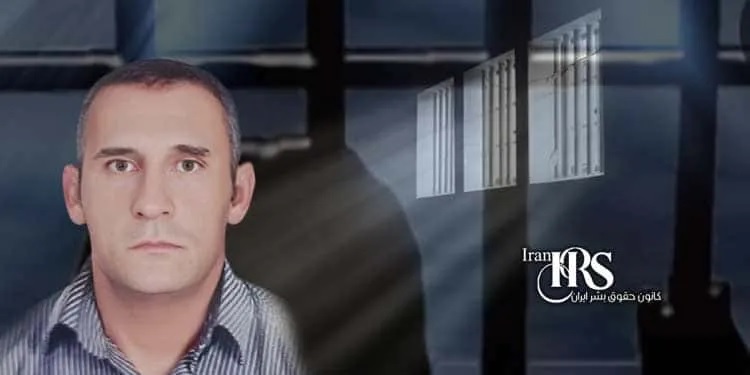
Currently, Mansour Jamali is detained in Ward 17 of Choubindar Prison in Qazvin. Despite over 20 months of detention, no verdict has been issued, and no court hearing has been held.
Arbitrary Arrest and Delayed Charges
Iran Human Rights Society, June 7, 2025 – Mansour Jamali, a political prisoner from Urmia, has been held in temporary detention in Qazvin’s Choubindar Prison for over 20 months, languishing in uncertainty. Without a final verdict, he is imprisoned under the grave charge of “moharebeh” (enmity against God), while being deprived of the most basic human and judicial rights.
Mansour Jamali, born in 1970 and a resident of Urmia, was arrested in October 2023 by security forces in Bueinzahra, a county in Qazvin province. Informed sources report that several of his relatives were also detained during the arrest but were later released on bail. However, Jamali remains in temporary detention without a final judicial ruling.
What makes his situation even more alarming is the delayed imposition of the severe “moharebeh” charge, which was leveled against him approximately 15 months after his initial arrest by the prosecutor of Branch 6 of Qazvin’s Public and Revolutionary Court, named “Hekmi,” without following legal procedures. According to judicial principles, charges must be promptly announced and judicial proceedings initiated soon after an arrest.
Uncertainty, Torture, and Denial of Legal Rights
Following his arrest, Mansour Jamali was held in a security detention center where he endured interrogation and torture before being transferred to Choubindar Prison. Reports indicate he was subjected to severe physical and psychological pressure to extract confessions and has been denied access to a lawyer—a right explicitly recognized in both domestic laws and international conventions.

Currently detained in Ward 17 of Choubindar Prison, Jamali has neither received a verdict nor had a court hearing after more than 20 months. This prolonged uncertainty constitutes a clear case of arbitrary detention and denial of a fair trial.
Background and Personal Life
Before his arrest, Mansour Jamali was a sports enthusiast, active in wrestling and bodybuilding. A father of two, he led an ordinary life as a citizen in Urmia. Available information shows no evidence of his involvement in armed groups or activities that could justify the heavy “moharebeh” charge.
Systematic Human Rights Violations
Mansour Jamali’s detention and uncertainty are just one example of the growing trend of repression, security crackdowns, and the widespread use of severe charges like “moharebeh” to silence dissent or criticism. In many cases, such charges are applied without clear or transparent evidence, merely to justify prolonged detention.
Human Rights Violations in Mansour Jamali’s Case
Mansour Jamali’s case is a clear example of multiple violations of fundamental human rights and international commitments:
Article 9 – Right to Liberty and Security of Person: Over 20 months of detention without a final verdict or trial violates this article of the International Covenant on Civil and Political Rights, which prohibits arbitrary detention.
Article 10 – Humane Treatment of Detainees: Keeping Jamali under pressure, in uncertainty, and without access to a lawyer contradicts the requirement for humane treatment and respect for the inherent dignity of detainees.
Article 14 – Right to a Fair Trial: The absence of a court hearing, delayed charging, and denial of legal representation blatantly violate the right to a fair trial.
Mansour Jamali’s over 20-month detention in Choubindar Prison, without a trial or verdict, under a severe charge without evidence, is just one of hundreds of examples of the repressive and human rights-violating approach within the prevailing judicial-security system. These cases not only pose a direct threat to individual rights but also demonstrate a complete disregard for the principles of justice and moral and legal obligations toward individuals whose voices have been silenced in the clamor of repression.
Follow Iran Human Rights Society on social networks:
Telegram /Twitter /Instagram / YouTube / Facebook
Join Iran Human Rights Society on Twitter








Discussion about this post