
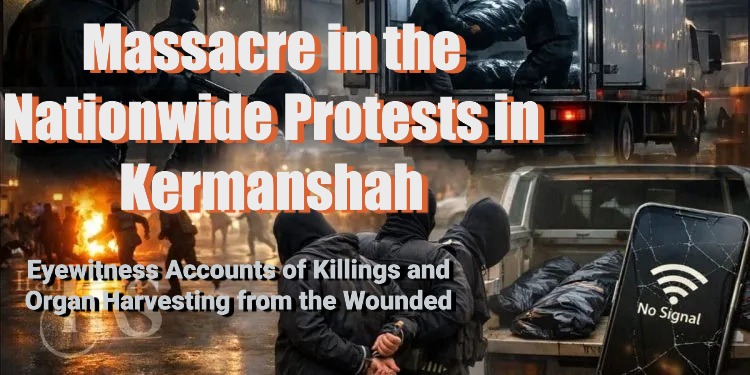
According to observers, the use of foreign forces, organized torture, extrajudicial killings, and even the trafficking of victims’ organs all indicate that the suppression of the nationwide protests in Kermanshah has not spiraled out of control, but is part of a deliberate policy to create terror and silence the protests.
Iran Human Rights Society, Friday, January 23, 2026 – Shocking reports leaking out from inside Kermanshah reveal the horrific scale of the suppression of nationwide protests in this city. According to citizens and eyewitnesses, more than one thousand protesters were killed in Kermanshah in just a few days. Local sources say this massacre involved the direct participation of IRGC (Islamic Revolutionary Guard Corps) forces, elements of Iraq’s Popular Mobilization Forces (Hashd al-Sha’bi), and the Fatemiyoun Brigade. The accounts obtained not only describe direct shootings and killings of protesters but also speak of torture, mutilation of corpses, and even the harvesting of organs from victims—accounts that have elevated the scale of crimes against humanity during the nationwide protests to an unprecedented level.

Kermanshah; A City Turned into a Killing Field
According to public reports, the suppression of nationwide protests in Kermanshah began on January 8, 2026, and continued with unprecedented intensity at least until January 11, 2026. Local residents say security forces not only resorted to direct shootings at protesters but also launched a massive wave of arrests. Many of those arrested were never returned to their families, and their fate remains unknown to this day.
A local source, whose name is withheld for security reasons, says: “This was not just street suppression. It was a cleansing operation. People were either killed on the spot or taken away and never returned. Everyone here knows the number of deaths is far higher than what the regime claims. People here are talking about a figure well over a thousand.”
Witness One: “I saw with my own eyes how they drilled holes in their joints”
One eyewitness, who claims to have personally seen the victims’ bodies, recounts a horrifying experience:
“You have no idea what they did here… Tell this to foreign media. Say that I saw with my own eyes how those arrested between January 8 and 11, 2026—many of them—had all their joints drilled, from ankles to knees, wrists to elbows, and shoulders. Then they were shot in the head.”
He continues: “Many of the corpses had their hearts, kidneys, and livers removed by doctors and then stitched up. These shameless people even make money from corpses and traffic their organs. There was a corpse whose hands were drilled, tendons removed, stapled so the fingers would clench, and then killed.”
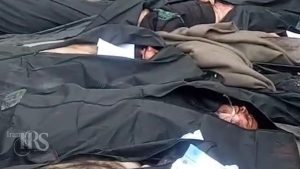
This witness stresses that what he saw went beyond any human imagination: “I myself saw piles of corpses stacked on top of each other. We went to identify one of our friends and, after a lot of coordination and interrogation, we were allowed in. They took our phones. Even the doctors had no phones. The cameras inside the forensic medicine facility were disabled so no one could take photos or videos of the crime scenes on the bodies.”
Witness Two: “They counted about 1,400 bodies”
Another witness, who claims to be in contact with a civilian doctor, speaks of a much higher figure: “A count of about 1,400 bodies of protesting people has been done. According to witnesses and a civilian doctor, many victims were alive when injured. Healthy organs like kidneys and hearts were removed from them, and then they were given a final shot.”
He adds: “Also, some of the killed in Kermanshah had no space left, so they filled the stadium. Many who were killed were initially alive, but after organ removal, they were murdered.”
This witness also points to pressure on families: “The repressive forces were from the IRGC, along with Hashd al-Sha’bi and Fatemiyoun. They told the family of one of the deceased that if they want the rest of the family not to be arrested, they must say their son…”
He leaves the sentence unfinished but indicates the intent was to force families to accept the regime’s narrative.
Role of the IRGC, Hashd al-Sha’bi, and Fatemiyoun
According to local witnesses, the suppression of nationwide protests in Kermanshah did not involve only domestic forces. Citizens repeatedly reported the presence of individuals with non-local and even Arabic accents. They specifically attribute these individuals to Iraq’s Hashd al-Sha’bi forces and the Fatemiyoun Brigade, who participated alongside the IRGC in the suppression operations.
One Kermanshah resident says: “We heard Arabic being spoken. These were not just police or Basij forces. Many are certain that Hashd al-Sha’bi and Fatemiyoun were brought in to finish the job.”
Nationwide Protests and Enforced Silence via Internet Shutdown
At the height of the nationwide protests in Kermanshah, internet access in the province was severely restricted or completely cut off. Human rights activists say this was done to prevent the transmission of images and accounts of the killings. Witnesses say this communication blackout allowed many crimes to remain undocumented visually.
One witness says: “If the internet had been on, the world would now see what they did to the people. They did everything in the dark.”
Fear, Threats, and Silencing of Families
Accounts also describe severe pressure on families of the deceased. According to witnesses, families were not only prohibited from holding mourning ceremonies but, in some cases, threatened that if they protested or shared information, other family members would be arrested.
In some instances, families were forced to accept the regime’s official narrative or remain silent about the cause of their loved ones’ deaths. This policy is described as part of a systematic effort to conceal the true scale of the killings during the nationwide protests.
Crimes Against Humanity in the Shadow of Nationwide Protests
Human rights activists stress that what happened in Kermanshah was not merely harsh suppression but contained all the elements of crimes against humanity: widespread and systematic attacks against the civilian population, with prior knowledge and planning.
According to observers, the use of foreign forces, organized torture, extrajudicial killings, and even the trafficking of victims’ organs all show that the suppression of nationwide protests in Kermanshah was not out of control but part of a deliberate policy to instill fear and silence the protests.
Call for International Investigations
Following the release of these accounts, human rights activists have called for the immediate involvement of international bodies. They emphasize that an independent fact-finding committee with full authority must be established to investigate what happened in Kermanshah and other cities.
According to these organizations, without international pressure and oversight, the risk of continued suppression, rising victim numbers, and the destruction of evidence of crimes against humanity during the nationwide protests remains.
Systematic Human Rights Violations and Crimes Against Humanity in Kermanshah
What, according to numerous testimonies, occurred during the suppression of nationwide protests in Kermanshah—including extrajudicial killings, torture, mutilation of corpses, forced organ harvesting, enforced disappearances, and threats to families—constitutes clear examples of crimes against humanity under international law.
- Article 3 – Right to Life (Universal Declaration of Human Rights) The direct killing of protesters and final shots to detainees openly violate the fundamental right to life and arbitrarily deprive individuals of life.
- Article 5 – Prohibition of Torture and Inhuman Treatment (Universal Declaration of Human Rights) Drilling joints with power tools, mutilating corpses, and pre-execution torture constitute severe physical and psychological inhuman treatment and torture.
- Article 6 – Right to Life (International Covenant on Civil and Political Rights) Extrajudicial killings of protesters without judicial orders or due process clearly violate the state’s obligation to protect citizens’ lives.
- Article 7 – Prohibition of Torture (International Covenant on Civil and Political Rights) Torture of detainees, forced organ harvesting, and degrading treatment of corpses absolutely violate the international prohibition on torture.
- Article 9 – Prohibition of Arbitrary Detention (International Covenant on Civil and Political Rights) Widespread arrests, secret detention, and enforced disappearances violate citizens’ right to liberty and security.
- Article 16 – Recognition of Legal Personality (Universal Declaration of Human Rights) Failure to register detainees’ names and erasing victims’ identities denies the right to recognition as a person before the law.
- Article 25 – Human Dignity and Humane Treatment of Detainees (Mandela Rules) Inhuman treatment of detainees and their corpses violates fundamental principles of human dignity and minimum standards for the treatment of prisoners.
See also the below articles:
- Death Sentence Issued for Armin Nourmohammadi; Judicial Repression Escalates Against Iranian Protesters
- Mass Transfer of Detained Protesters to Qazal Hesar Prison; Hidden Quarantine to Eliminate Protesters
Follow Iran Human Rights Society on social networks:
Telegram /Twitter /Instagram / YouTube / Facebook
Join Iran Human Rights Society on Twitter

Discussion about this post