
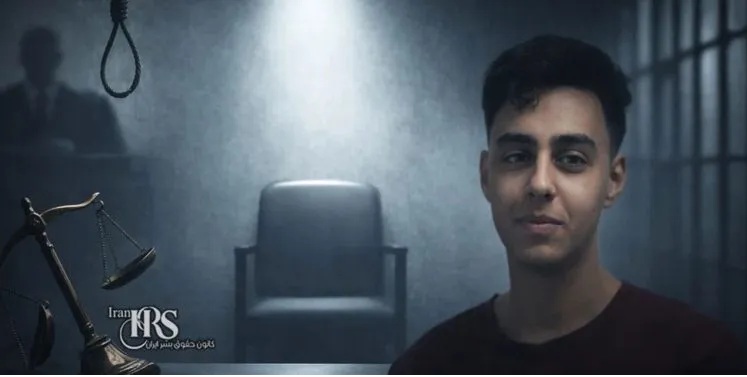
The lawyer of Mohammad Amin Biglari reported the issuance of the harshest punishment in Branch 15 and the prevention of studying the case at the cassation stage.
Iran Human Rights Society, Thursday, February 19, 2026 – The lawyer of Mohammad Amin Biglari, a 19-year-old teenager sentenced to death in a case related to the nationwide protests, announced the issuance of a verdict in Branch 15 of the Revolutionary Court presided over by Judge Salavati and stated that at the Supreme Court stage, they have been deprived of access to the case and the possibility of effective defense.
Issuance of Verdict in Branch 15 and Application of the Harshest Punishment
Hassan Aghakhani, one of Mohammad Amin Biglari’s lawyers, announced that his client’s case, along with six other defendants, was heard jointly in Branch 15 of the Revolutionary Court. According to him, the harshest punishment has been considered for all defendants.

He added that the charge title for Mohammad Amin Biglari, according to the statements of the appointed lawyer, has been designated as “enmity against God” (moharebeh). However, the official details of the charge and the documents of the case have not been provided to the chosen lawyers.
According to this lawyer, the hearing of the case took place on February 7, 2026, and only one day later, on February 8, 2026, the verdict was issued. This short interval between the hearing and the issuance of the verdict has been criticized by the lawyer of the case.
Prevention of Studying the Case at the Supreme Court Stage
Hassan Aghakhani announced that he and his colleague, Ms. Sedri-Nia, have declared representation at the cassation stage in the Supreme Court. Their goal was to enter the case as chosen lawyers.
However, according to him, the head of Branch 9 of the Supreme Court has neither granted permission to study the case nor provided the possibility of presenting a defense. He emphasized that without access to the contents of the case, there is no possibility of preparing a supplementary defense brief.
He said they will try to meet with the head of Branch 9 and convince him to issue permission to study the case and submit a defense brief.
Ambiguity Regarding the Confession Attributed to Mohammad Amin Biglari
According to Hassan Aghakhani, the appointed lawyer of the case informed the family that Mohammad Amin Biglari has confessed. However, the nature and content of this confession have not been clarified.
This lawyer stated that it appears the confession contained in the case is not attributable to his client. He added that even if a confession exists, the conditions under which it was obtained and the mental and social state of the accused must be taken into consideration.
Family Situation and Living Conditions of the Accused
Mohammad Amin Biglari is 19 years old and, according to his lawyer, has obtained his high school diploma and has been working in two jobs simultaneously to provide for his livelihood.
His father, due to poor physical condition, is unable to follow up on the case. Mohammad Amin Biglari’s uncle, along with the two lawyers of the case, are pursuing his situation.
According to Hassan Aghakhani, Mohammad Amin Biglari’s family spent several weeks without any news of his situation. His father, with his poor physical condition, repeatedly searched among the bodies transferred to Kahrizak for any sign of his son.
Mohammad Amin Biglari has currently been in detention in Qezel Hesar prison for nearly one month.
Criticism of the Trial Process and Lack of Effective Defense
The lawyer of Mohammad Amin Biglari emphasized that the lack of access to the case and the prevention of studying it violates the right to effective defense. He said that without the possibility of examining the documents, complete legal defense is not possible.
He also expressed doubt about relying on the confession of a 19-year-old teenager who grew up in difficult social conditions. According to him, such a confession must be accompanied by precise and legal scrutiny.
Human Rights Violations in the Trial and Examination of Mohammad Amin Biglari’s Case
In Mohammad Amin Biglari’s case, numerous instances of violation of fundamental principles of fair trial have been raised:
- Violation of the Right to a Fair Trial – Article 10 of the Universal Declaration of Human Rights: Hasty proceedings and issuance of a verdict in a short interval after the court session.
- Violation of the Right to Access to a Chosen Lawyer – Article 14 of the International Covenant on Civil and Political Rights: Prevention of studying the case by chosen lawyers at the cassation stage.
- Violation of the Right to Effective Defense – Fundamental Principles of Criminal Procedure: Impossibility of submitting a supplementary brief and examining documents.
- Violation of the Presumption of Innocence – Article 11 of the Universal Declaration of Human Rights: Possible reliance on a confession whose attribution to the accused is in doubt.
- Violation of the Right of the Family to Information about Detention Status – Article 9 of the Covenant on Civil and Political Rights: Several weeks of the family being uninformed about the accused’s situation.
Mohammad Amin Biglari’s case is currently pending in the Supreme Court, and his lawyers emphasize the existence of serious obstacles in the path of legal defense. They have announced that they will continue their legal pursuit until the possibility of studying the case and providing effective defense is provided.
See also the below articles:
- Rejection of Mehrab Abdullahzadeh’s Request for Retrial; Continuation of Legal Ambiguities in the Case of One of the Detainees of the Nationwide Protests
- Names of 130 More Detainees from the Nationwide Protests; Expansion of Widespread Arrests Among Students and University Students
Follow Iran Human Rights Society on social networks:
Telegram /Twitter /Instagram / YouTube / Facebook
Join Iran Human Rights Society on Twitter







Discussion about this post