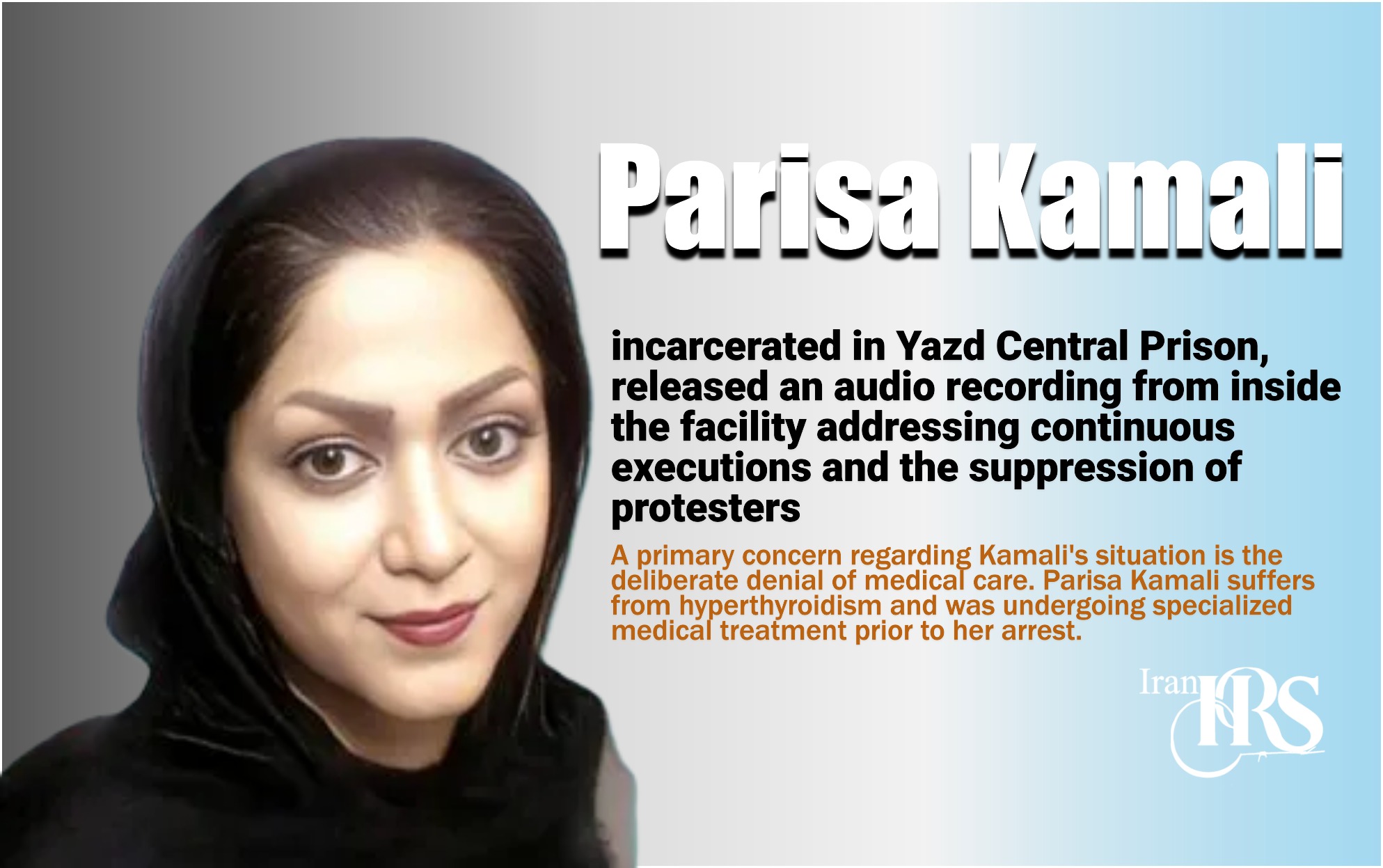
Parisa Kamali, a political prisoner held in the Central Prison of Yazd, released an audio message criticizing ongoing executions and state repression, calling on human rights organizations and the international community to take action to halt the “killing machine.” Concurrently, reports indicate an escalation of security pressure, medical neglect, and severe restrictions against her.

Iran Human Rights Society, Wednesday, August 5, 2026 – Parisa Kamali, a political prisoner incarcerated in Yazd Central Prison, released an audio recording from inside the facility addressing continuous executions and the suppression of protesters. She emphasized that while the regime seeks self-preservation through terror and intimidation, “we have crossed the threshold of fear and are filled with rage.” She urged international human rights organizations and the global community to take effective action to halt executions and human rights violations in Iran.
Key Takeaways from Parisa Kamali’s Audio Message
In her message, Parisa Kamali described the current state of society as the cumulative result of years of state violence and repression, stating that people continue to face the painful consequences of past and present massacres.
She noted that the ongoing implementation of death sentences and the creation of an atmosphere of fear will not deter the public from continuing to protest and demand their rights.
In a poignant segment of her message, she stated:
“We are a perpetually mourning people. Before we could even process the grief of the government massacres of January, our wounds are reopened once again. Blood has been flowing from 1988 (1367 SH) to this very day. The mullahs’ executioner regime attempts to instill fear and terror through continuous killings to prolong its survival, but they are gravely mistaken. We have escaped bitter death, and we are filled with rage.”
The political prisoner expressed hope for the day capital punishment is erased from the country’s penal code and the right to life is respected as a fundamental human right.
Appeal to Human Rights Organizations
Kamali appealed to international organizations and human rights advocacy groups not to remain silent regarding the plight of political prisoners and the execution trend in Iran.
She urged the global community to adopt effective measures to stop executions and shut down what she described as the regime’s “killing machine.”
Concluding her message, she reiterated her firm opposition to capital punishment, repeating the slogan “No to Execution” and calling for a free and prosperous Iran.
Arrest, Charges, and Judicial History
Parisa Kamali, born in 1986 is married and a geography student. She was arrested in Isfahan on April 29, 2024.
Following her arrest, she was transferred to Dovlatabad Prison in Isfahan, where she faced security-related charges during interrogations and trial proceedings, including:
- “Acting against national security”
- “Destruction of public property”
- “Membership in the People’s Mojahedin Organization of Iran (PMOI/MEK)”
The court, presided over by Judge Tavakoli, initially sentenced her to six years in prison. According to published reports, her sentence was later reduced to three years and six months following a formal waiver of appeal (“submission to the verdict” / Taslim be Ra’y).
Exile to Yazd Central Prison and Escalating Restrictions
In 2025 Parisa Kamali was abruptly transferred without prior notice from Isfahan Prison to the Central Prison of Yazd.
Following this exile transfer, restrictions imposed on her intensified significantly, including:
- Denial of access to required medical treatment
- Severe limitations on family phone calls and visits
- Escalated security surveillance and internal pressure
Reports indicate that security pressure mounted further after her protest statements were published externally. In recent months, Yazd Central Prison has increasingly been used to hold exiled political prisoners transferred from other provinces, accompanied by frequent reports of disciplinary restrictions.
Medical Condition and Denial of Healthcare
A primary concern regarding Kamali’s situation is the deliberate denial of medical care. Parisa Kamali suffers from hyperthyroidism and was undergoing specialized medical treatment prior to her arrest.
Before her detention, her treating physician diagnosed nodules on her thyroid gland and deemed regular ultrasounds, routine blood work, and specialized endocrinological monitoring essential.
However, since her transfer to Yazd Central Prison, her treatment has been suspended, and access to specialists and recommended medical diagnostics has been denied. The continuation of this medical neglect poses serious risks to her physical health and well-being.
Fact Box | Case of Parisa Kamali
| Parameter | Details |
| Name | Parisa Kamali |
| Year of Birth | 1986 (1365 SH) |
| Status | Political Prisoner |
| Arrest Date | April 29, 2024 |
| Current Detention Facility | Yazd Central Prison (Exile location) |
| Primary Charges | Acting against security, destruction of public property, membership in PMOI/MEK |
| Final Sentence | 3 years and 6 months imprisonment |
| Medical Status | Hyperthyroidism with thyroid nodules; denied specialized care |
| Latest Action | Audio message from prison calling for international action against executions |
Legal Review Under Domestic Law
The judicial practices enforced by the ruling authority in Iran have drawn continuous criticism from legal experts regarding the security prosecution of political prisoners, exile transfers, and denial of prisoner rights. Parisa Kamali’s case highlights significant legal issues regarding detainee treatment and medical access obligations.
Key Legal Ambiguities
- Unannounced internal transfer (exile) without prior notification to family or legal counsel.
- Deprivation of necessary medical treatment despite pre-existing specialized diagnoses.
- Increased security pressure and restrictions imposed in retaliation for exercising free speech from prison.
Applicable Domestic Statutes
- Article 22 of the Constitution: Mandates that the life, dignity, property, and rights of all individuals are inviolable.
- Article 32 of the Constitution: Prohibits arbitrary arrest and requires strict adherence to legal procedures.
- Article 35 of the Constitution: Encapsulates the right to legal counsel.
- Article 39 of the Constitution: Strictly forbids any dignity-infringing behavior, abuse, or degradation of prisoners.
- Prisons Organization Executive Regulations: Obligates prison authorities to ensure the physical health of prisoners, grant access to medical care, and arrange external treatment when facility clinics lack required specialized equipment.
Identified Statutory Violations
- Arbitrary exile transfer without advance family notification;
- Restrictions placed on family communications and visitation rights;
- Failure to provide specialized healthcare for a pre-existing medical condition;
- Retaliatory pressure applied following the public release of protest statements.
International Human Rights Standards & Violations
From an international legal perspective, access to healthcare, freedom of expression, and humane treatment during detention are non-negotiable standards. The conditions imposed on Parisa Kamali raise severe concerns regarding compliance with international covenants.
Applicable International Legal Instruments
- Article 5 of the Universal Declaration of Human Rights (UDHR): Absolute prohibition of cruel, inhuman, or degrading treatment.
- Article 19 of the UDHR: Protection of the right to freedom of opinion and expression.
- Article 10 of the International Covenant on Civil and Political Rights (ICCPR): Mandates that all persons deprived of their liberty shall be treated with humanity and respect for inherent human dignity.
- UN Standard Minimum Rules for the Treatment of Prisoners (Nelson Mandela Rules): Dictates that prisoners should enjoy the same standards of healthcare available in the community, with immediate referral of sick prisoners who require specialized treatment to specialized institutions or civil hospitals.
See also the below articles:
- 19-Year-Old Political Prisoner Releases Audio Message From Tehran Prison
- Sikan Roshani Death Sentence Issued for Detained Kurdish Protester
Follow Iran Human Rights Society on social networks:
Telegram /Twitter /Instagram / YouTube / Facebook
Join Iran Human Rights Society on Twitter