
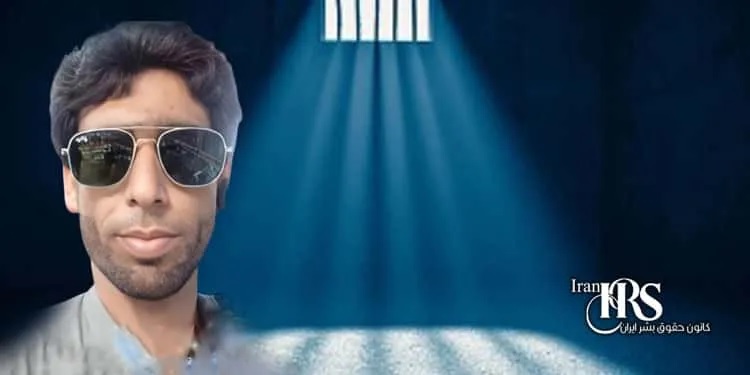
According to the initial claim by the prosecutor’s office, Yousuf Zeinoldini’s detention was supposed to be limited to 48 hours. However, more than 13 days later, not only does his family have no information about his whereabouts, but no official authority has responded to their legal inquiries.
On Wednesday, May 14, 2025, the Iran Human Rights Organization reported that, amid the escalating trend of arbitrary detentions in Sistan and Baluchistan province, Yousuf Zeinoldini, a 27-year-old Baluch man from Qasr-e Qand, has been held in complete uncertainty since his arrest by plainclothes forces in Nikshahr on Friday, May 2, 2025.
Yousuf Zeinoldini, a married father of three young children, had traveled from Qasr-e Qand to Nikshahr for personal matters when he was detained by unidentified forces. According to a source close to his family, Zeinoldini managed to make a brief call to his family at the time of his arrest, informing them that he had been detained by security forces.
Unfulfilled Promises by the Prosecutor’s Office and Growing Concerns

The prosecutor’s office initially claimed that Zeinoldini’s detention was due to the charge of “carrying a handgun” and was meant to last only 48 hours for interrogation. However, more than 12 days later, his family remains unaware of his whereabouts, and no official authority has responded to their legal inquiries.
Conflicting statements from security institutions regarding the reasons for Zeinoldini’s detention have further heightened concerns. Some sources mention charges such as “links to armed groups abroad” and “shooting at officers.” Such accusations, often raised without evidence and within the framework of politically motivated case-building, are typically used as pretexts for prolonged detention and the application of psychological and physical pressure on detainees.
A Recurring Pattern in Sistan and Baluchistan
In recent years, Sistan and Baluchistan province has become a major hub for extrajudicial detentions and blatant human rights violations in Iran. Many Baluch citizens, particularly young people, have been subjected to arbitrary arrests, detention in secret facilities, torture to extract forced confessions, and the creation of heavy security-related cases.
Security institutions frequently detain individuals without valid judicial warrants and then pressure detainees to accept fabricated charges. In most cases, families are left uninformed about the fate of their loved ones and are denied the right to visitation or even information about the place of detention.
Violation of Human Rights Laws with the Arbitrary Detention of Yousuf Zeinoldini
The arbitrary detention of Yousuf Zeinoldini, or any detentions carried out without a valid judicial warrant, legal grounds, or respect for the rights of the accused, contravenes several human rights laws and principles. These principles are universally recognized and enshrined in various international documents:
Universal Declaration of Human Rights (UDHR):
Article 9: “No one shall be subjected to arbitrary arrest, detention, or exile.” This article explicitly condemns detentions without legal justification.
International Covenant on Civil and Political Rights (ICCPR):
Article 9: “Everyone has the right to liberty and security of person. No one shall be subjected to arbitrary arrest or detention.” Additionally, this article emphasizes that, in the event of detention, the individual must be promptly informed of the reasons for their arrest and brought before a court to challenge the lawfulness of the detention.
Convention Against Torture and Other Cruel, Inhuman or Degrading Treatment or Punishment (CAT):
Arbitrary detentions, particularly when accompanied by torture or inhuman treatment, are clearly in violation of this convention.
UN Standard Minimum Rules for the Treatment of Prisoners (The Nelson Mandela Rules):
These rules emphasize humane treatment of detainees and respect for their human dignity, and arbitrary detentions are in direct conflict with these principles.
Arbitrary detentions have been repeatedly condemned by global human rights bodies, such as the United Nations and non-governmental organizations, which have called on governments to refrain from such actions and to respect individuals’ fundamental rights.
Follow Iran Human Rights society on social networks:
Telegram /Twitter /Instagram / YouTube / Facebook
Join Iran Human Rights Society on Twitter







Discussion about this post