
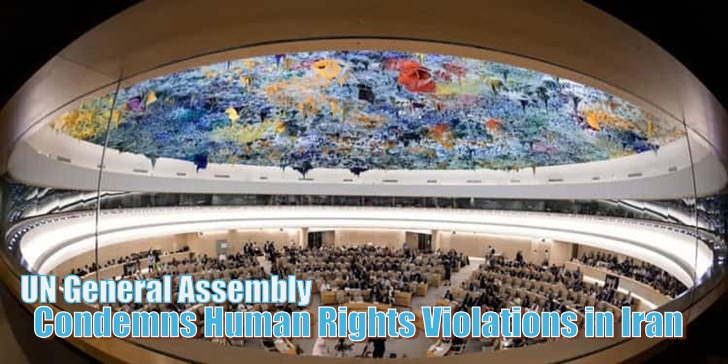
The General Assembly of the United Nations, by adopting a new resolution, strongly condemned the increase in executions and organized suppression of human rights in Iran.
Adoption of the 72nd resolution against the human rights situation in Iran
Iran Human Rights Society, Friday, December 19, 2025 – The General Assembly of the United Nations, by adopting a new resolution, condemned the grave, widespread, and systematic human rights violations by the Iranian government. This resolution was adopted with 78 votes in favor against 27 votes opposed. The recent resolution is considered the 72nd official United Nations document condemning the human rights situation in Iran.
Countries supporting this resolution have considered the increase in executions and suppression of opponents a serious threat to Iran’s international commitments. The resolution emphasizes that the pattern of human rights violations in Iran is not incidental but structural and planned. According to observers, the continued adoption of such resolutions indicates the growing concern of the international community.
Condemnation of the increase in executions as a tool of political suppression
In the text of the United Nations General Assembly resolution, the alarming and continuous increase in the use of the death penalty has been strongly condemned. This document states that many death sentences have been issued based on forced confessions. The resolution directly refers to the execution of sentences without fair trial. The secret execution of sentences and lack of information to families and lawyers has also been described as a gross violation of fundamental rights.
According to this resolution, the Iranian government uses the death penalty as a tool of political suppression.
This tool is employed to silence opponents, protesters, and participants in peaceful demonstrations.
The resolution has warned about the disproportionate application of the death penalty against women and ethnic and religious minorities. Human rights organizations consider this trend an example of instrumental use of criminal justice.
Execution of children and violation of international commitments
The United Nations General Assembly resolution has described the execution of individuals under 18 years of age as a clear violation of international laws. This document explicitly refers to the International Covenant on Civil and Political Rights. The Convention on the Rights of the Child has also been recalled as a binding international document. The resolution calls for the immediate and complete cessation of child executions in Iran.
Child rights activists say the continuation of these executions places the ruling dictatorship in Iran in deeper legal isolation. According to them, disregard for these commitments intensifies the international responsibility of the regime’s leaders.
Torture, arbitrary detentions, and deprivation of treatment
The United Nations resolution has condemned a wide range of human rights violations. Physical and psychological torture in detention centers has been highlighted. Gender-based and sexual violence has also been mentioned as a tool of suppression. Inhuman, degrading, and disproportionate punishments have been strongly condemned.
This document also refers to arbitrary detentions and enforced disappearances. Systematic violation of the right to fair trial is one of the main axes of criticism. Deprivation of prisoners from appropriate medical treatment has aroused serious concern at the United Nations. It has also warned about suspicious deaths in detention.
Suppression of protests and transnational pressure
The General Assembly resolution has condemned the suppression of popular protests in Iran. Severe restrictions on freedom of expression and media are among other axes of criticism. The United Nations has also referred to the transnational suppression of opponents abroad. These actions have been evaluated as a violation of the principle of rule of law in international relations.
The resolution emphasizes that systematic impunity for human rights violators must end. The international community has called for accountability of the perpetrators of these violations.
Warning from the United Nations Special Rapporteur

Previously, Ms. Mai Sato, the United Nations Special Rapporteur on human rights in Iran, had issued a serious warning. She announced in the Third Committee session of the General Assembly that the leaders ruling Iran are pursuing the path of “crimes against humanity.” According to her, widespread executions, transnational suppression, and alarming restrictions on society are concerning. These statements had wide resonance in human rights circles.
Previously, the United Nations Secretary-General had also described the human rights situation in Iran as “bleak” in a report. He warned about the increase in executions, torture of detainees, and suppression of minorities.
Call for more decisive action from the international community
Human rights organizations have emphasized that adopting the resolution is not sufficient. They call for strengthening the language of the resolution and practical pursuit of its provisions. According to these institutions, the international community has moral and legal responsibility. This responsibility includes effective support for victims of human rights violations in Iran.
Human rights violations from the perspective of international documents
- Article 3 of the Universal Declaration of Human Rights- Violation of the right to life with widespread and arbitrary executions.
- Article 5 of the Universal Declaration of Human Rights- Torture, inhuman and degrading treatment against detainees.
- Article 9 of the Universal Declaration of Human Rights- Arbitrary detentions and enforced disappearance of citizens.
- Article 10 of the Universal Declaration of Human Rights- Violation of the right to fair trial through unfair courts.
Convention on the Rights of the Child– Execution of individuals under 18 years of age and clear violation of international commitments.
See also the below articles:
- Political Prisoners Hakimeh Honarmandi and Rouhollah Eskandari Endure One-Year Limbo in Iran
- Mohammad Javad Vafaei Thani Execution Risk Escalates Amid Solitary Confinement and Retrial Rejection
Follow Iran Human Rights Society on social networks:
Telegram /Twitter /Instagram / YouTube / Facebook
Join Iran Human Rights Society on Twitter





Discussion about this post