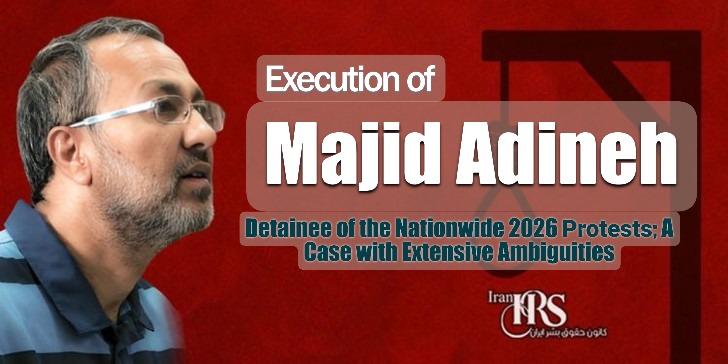
Majid Adineh, a citizen from Mohammadshahr, Karaj, was executed less than eight months after his arrest during the December 2025–January 2026 nationwide protests; the location of the execution and details of his trial have still not been announced.

Iran Human Rights Society, Monday, August 24, 2026 – Majid Adineh, one of those arrested during the December 2025–January 2026 nationwide protests, was executed early Sunday, August 23, 2026. This sentence was carried out under circumstances in which no transparent information has been published about the interrogation stages, the date of the court hearing, the evidence presented, the identity of the lawyer, the possibility of access to a lawyer of his own choice, and how he defended himself against the charges.
The news agency affiliated with the judiciary has announced that Majid Adineh was sentenced to death and confiscation of all his property by the Karaj Revolutionary Court, and that his sentence was upheld in its entirety by the Supreme Court following his appeal. Nevertheless, the location where the sentence was carried out, the date the initial verdict was issued, and the date it was upheld by the Supreme Court have not been announced.
Arrest of Majid Adineh in Mohammadshahr, Karaj
Majid Adineh, from Mohammadshahr, Karaj, was arrested in the final minutes of the night of January 9, 2026, simultaneously with the suppression of the nationwide protests, by forces of the Intelligence Organization of the Islamic Revolutionary Guard Corps of Alborz Province. Another person was also arrested with him, but so far no information about the identity or condition of this person has been published.
The judicial authorities’ media outlet has claimed that at the time of Majid Adineh’s arrest, one handgun, three magazines, 30 rounds of live ammunition, two electric stun guns, two tear-gas sprays, one rechargeable electric saw, and one bottle of gasoline were discovered. These claims have not been independently examined and confirmed by independent sources.
Majid Adineh denied any use of the discovered weapon and said that he had gone to the location to buy clothes. The judiciary, in contrast, has claimed that laboratory examinations indicated firing with a weapon on January 8 and 9, 2026; however, the laboratory report, fingerprints, the result of the gunpowder test, and other alleged documentation have not been publicly released.
Serious Charges and Contradictory Accounts of the Judiciary
According to the official account, Majid Adineh’s charges included “operational action in favor of hostile governments,” “moharebeh through intentional arson,” “assembly and collusion against internal security,” “propaganda activities against the system,” and illegal possession of weapons, ammunition, stun guns, and sprays.
His death sentence was issued on the basis of Article 1 of the “Law on Intensifying the Punishment for Espionage and Cooperation with the Zionist Regime and Hostile Countries against National Security and Interests.” This law, with broad and interpretable language, considers certain actions described as cooperation with hostile governments punishable by death and confiscation of property.
The judiciary’s media outlet has, on the one hand, written that Majid Adineh denied using a weapon and, on the other hand, claimed that he admitted in court to possessing the equipment and spoke about the possibility of using the ammunition. Due to the lack of independent access to the case file, interrogation and court records, it is not possible to examine the accuracy of these accounts.
Majid Adineh Case Information Box
- Name: Majid Adineh
- Place of residence: Mohammadshahr, Karaj
- Date of arrest: January 9, 2026
- Arresting institution: Intelligence Organization of the Islamic Revolutionary Guard Corps of Alborz Province
- Judicial authority: Karaj Revolutionary Court
- Announced sentence: Death and confiscation of all property
- Date of execution: August 23, 2026
- Location of execution: Not announced
- Status of chosen lawyer: Unknown
Legal Examination of the Majid Adineh Case Based on Domestic Laws
The dictatorial laws governing Iran have repeatedly been criticized in previous years because of their incompatibility with fair-trial standards, ambiguity in handling security cases, and restriction of defendants’ rights. Examining the Majid Adineh case based on domestic laws does not mean approving these laws; the purpose is to show cases in which even these laws may not have been observed by the judiciary.
Legal Ambiguities of the Case
Majid Adineh was arrested on the night of January 9, 2026, simultaneously with the nationwide protests, and was executed early on August 23, 2026. In the period of less than eight months between his arrest and the execution of the sentence, no transparent information was published about the duration of the interrogations, the place of detention, the date the indictment was issued, the time of the court sessions, the number of hearings, and the opportunity available to him to prepare his defense.
The judiciary’s media outlet has announced that Majid Adineh’s case was examined at the Karaj Revolutionary Court in the presence of “the defendant’s lawyer”; however, the lawyer’s name, whether the lawyer was chosen or court-appointed, the time the lawyer entered the case, and the extent of the lawyer’s access to security documents and expert reports are unclear.
The judiciary has claimed that at the time of Majid Adineh’s arrest, a handgun, ammunition, a stun gun, a spray, an electric saw, and a bottle of gasoline were discovered. Majid Adineh had denied any use of the weapon. Nevertheless, the judiciary has claimed in another account that he admitted in court to possessing the equipment and spoke about the possibility of using the ammunition.
The technical and laboratory reports cited by the court, the results of the gunpowder test, fingerprints, documentation related to firing the weapon, and the interrogation and court records have not been publicly released. This situation has eliminated the possibility of independent examination of the claims made and of how knowledge, intent, and Majid Adineh’s individual role were established.
Relevant Legal Provisions
An examination of the Majid Adineh case from the perspective of domestic laws recalls several important principles and provisions:
- Principle 22 of the Constitution; considers the life, property, rights, and dignity of persons protected from violation, except in cases permitted by law.
- Principle 32 of the Constitution; permits the arrest of individuals only on the basis of an order and according to procedures prescribed by law.
- Principle 35 of the Constitution; recognizes the right of defendants to have access to a lawyer.
- Principle 36 of the Constitution; permits the imposition and execution of punishment only through a competent court and on the basis of law.
- Principle 37 of the Constitution; emphasizes the presumption of innocence and does not consider anyone guilty before the commission of a crime has been proven in a competent court.
- Principle 38 of the Constitution; prohibits torture and forcing a defendant to confess, testify, or swear an oath.
- Principle 165 of the Constitution; emphasizes the public nature of trials, except in exceptional cases prescribed by law.
- Article 190 of the Code of Criminal Procedure; recognizes the right to have a lawyer present during the preliminary investigation stage.
- Article 144 of the Islamic Penal Code; makes the establishment of an intentional crime conditional upon establishing the perpetrator’s knowledge of the subject and intent to commit the criminal conduct.
Cases of Violation of Law
Considering the published information, the most important legal concerns in the Majid Adineh case are as follows:
- Ambiguity concerning effective and timely access to a lawyer of his own choice;
- The identity of the lawyer and whether the lawyer was chosen or court-appointed being unknown;
- The dates and details of the court sessions and the appeal process not being published;
- The absence of information about sufficient time for the defendant and lawyer to prepare the defense;
- The expert and laboratory reports cited by the court not being published;
- The existence of differing accounts regarding Majid Adineh’s statements during interrogation and in court;
- The absence of the possibility of independently examining the evidence concerning the use of a weapon and attribution of the alleged actions;
- The execution of the irreversible punishment of death in a case with extensive ambiguities;
- The confiscation of all property without publication of details concerning the legal basis and ownership of the assets;
- The location of the execution and details concerning the final stages of the case not being announced.
Examination of the Majid Adineh Case from the Perspective of Human Rights and Violations of International Standards
From a human rights perspective, protection of the right to life, entitlement to a fair trial, the presumption of innocence, effective access to a lawyer, and the prohibition of torture and forced confession are considered fundamental principles of international law. The execution of Majid Adineh under circumstances in which independent information about the manner of interrogation, the evidence in the case, and observance of his defense rights has not been published raises serious concerns about the observance of these rights.
Human Rights Ambiguities of the Case
Majid Adineh was executed less than eight months after his arrest. During this period, no independent report concerning the conditions of interrogation, the manner in which statements were obtained, his access to his family, access to a lawyer of his own choice, and the quality of his defense in court was published. The judiciary’s media outlet has spoken of the presence of a lawyer, but there is no information showing that this lawyer was freely chosen and had access to all the documentation in the case.
In the official report, no specific individual has been attributed to Majid Adineh as a victim of intentional murder, and no information has been provided about the killing of a person as a result of his alleged actions. According to international standards, in countries where the death penalty continues to be carried out, this punishment should be limited only to “the most serious crimes”; a concept that has been interpreted as extremely serious crimes involving intentional killing.
Also, the use of broad designations such as “operational action in favor of hostile governments” without publishing verifiable documentation, together with differing accounts concerning the defendant’s statements, raises serious questions about the presumption of innocence, the independence of the court, and the credibility of the evidence. In a case in which the result is deprivation of life, any ambiguity in the evidence or judicial process can lead to an irreparable error.
Relevant International Documents
- Article 3 of the Universal Declaration of Human Rights; the right to life, liberty, and personal security.
- Article 5 of the Universal Declaration of Human Rights; prohibition of torture and cruel, inhuman, or degrading treatment or punishment.
- Article 9 of the Universal Declaration of Human Rights; prohibition of arbitrary arrest and detention.
- Article 10 of the Universal Declaration of Human Rights; the right to a public and fair hearing before an independent and impartial tribunal.
- Article 11 of the Universal Declaration of Human Rights; the presumption of innocence and the right to all necessary guarantees for defense.
- Article 6 of the International Covenant on Civil and Political Rights; protection of the right to life and limitation of the death penalty to the most serious crimes.
- Article 7 of the International Covenant on Civil and Political Rights; prohibition of torture and inhuman or degrading treatment or punishment.
- Article 9 of the International Covenant on Civil and Political Rights; prohibition of arbitrary arrest and guarantees of the right to be informed of the reasons for arrest.
- Article 14 of the International Covenant on Civil and Political Rights; the right to a fair trial, the presumption of innocence, effective access to a lawyer, and adequate time for defense.
- Articles 2 and 15 of the Convention against Torture; prohibition of torture and prohibition of reliance on statements obtained under torture.
- Nelson Mandela Rules; the obligation to preserve the human dignity, security, and fundamental rights of all persons deprived of their liberty.
See also the below articles:
Follow Iran Human Rights Society on social networks:
Telegram /Twitter /Instagram / YouTube / Facebook
Join Iran Human Rights Society on Twitter