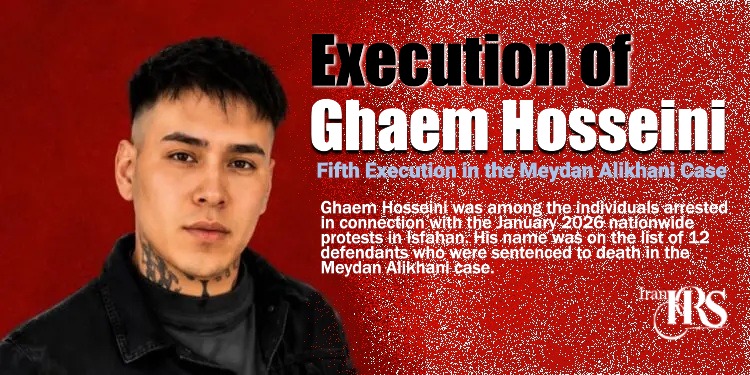
Ghaem Hosseini, one of the detainees of the 2025–2026 nationwide protests, was executed at dawn on Thursday, August 20 in Isfahan’s Dastgerd Prison.

Iran Human Rights Society, Thursday, August 20, 2026 – Ghaem Hosseini, one of the detainees of the January 2026 nationwide protests and one of those convicted in the case known as “Meydan Alikhani,” was executed at dawn on Thursday, August 20, 2026 in Dastgerd Prison, Isfahan.
Mehr News Agency, quoting the Judiciary Media Center, announced the implementation of Ghaem Hosseini’s execution sentence. This execution took place under circumstances where United Nations experts had previously warned about widespread violations of fair trial guarantees in the Meydan Alikhani case and called for the revocation of the death sentences of the 12 defendants in this case.
With the execution of Ghaem Hosseini, the number of those executed in the Meydan Alikhani case reached at least five people, and seven other defendants still face the danger of the implementation of the execution sentence.
What You Read in This Report
- Execution of Ghaem Hosseini in Dastgerd Prison, Isfahan;
- Connection of this case with the protests of January 8, 2026;
- Execution of five of the 12 convicts in the Meydan Alikhani case;
- Sentencing of 23 other defendants to five to 10 years of imprisonment;
- Deprivation of defendants from chosen lawyers in the preliminary stage;
- Warning of UN experts regarding group and closed-door trials.
Execution of Ghaem Hosseini in Dastgerd Prison, Isfahan
Ghaem Hosseini was among the individuals arrested in connection with the January 2026 nationwide protests in Isfahan. His name was on the list of 12 defendants who were sentenced to death in the Meydan Alikhani case.
On July 28, it was reported that Ghaem Hosseini’s family, along with the families of Amirhossein Maleki and Ali Dashti, were summoned to prison to perform their final visit. Despite family protests and warnings from human rights organizations, his sentence was executed on Thursday dawn in Dastgerd Prison.
What Is the Meydan Alikhani Case?
The case known as Meydan Alikhani relates to the protests of January 8, 2026 in Isfahan. According to the narrative of state media, four Basij members were killed during the clashes of that day. Following these events, security forces arrested at least 59 people.
Based on published information, 12 of the defendants in this case were sentenced to death. Additionally, 23 other people received imprisonment sentences of five to 10 years, despite reports indicating they had no direct role in the killing of the mentioned individuals.
UN experts have stated that the 12 young men in this case were tried and sentenced to death in a closed session, while the individual responsibility of each defendant and the details of their charges were not clearly specified. The issued sentences were also not made available to the public.

Five Executions in One Case
Prior to Ghaem Hosseini, four other defendants in this case had been executed:
- Erfan Esfandiari;
- Gol-Mohammad Mohammadi;
- Abolfazl Sepahi Badjani;
- Amirhossein Safari Hosseinabadi.
Erfan Esfandiari and Gol-Mohammad Mohammadi were executed on July 19, and Abolfazl Sepahi and Amirhossein Safari were executed on July 28, 2026.
Based on the published list of 12 people, after these five executions, Alireza Sepahi, Shervin Bagherian Jebelli, Amirhossein Maleki, Ali Dashti, Abolfazl Ebrahimi, Alireza Raeisi, and Amirhossein Ebrahimi Analoocheh remain under the death sentence.
Criticism of the Judicial Process
According to reports, the prosecutor in the case was Mohammad Nakhavan, and the judicial handling was carried out by Mohammad Barati-Dorcheh and Mohammadreza Tavakkoli.
Informed sources say that defendants in the preliminary stage were deprived of the right to choose an independent lawyer and were tried with court-appointed lawyers. It is also reported that lawyers did not have full access to all contents of the case.
UN experts also considered the trial of 12 people in a closed session, the lack of transparency regarding the individual responsibility of defendants, and the broadcasting of television confessions prior to trial as contrary to fair trial standards. They emphasized that confessions obtained under coercion must not be cited as evidence.
Information Box | Execution of Ghaem Hosseini
| Subject | Information |
| Name | Ghaem Hosseini |
| Date of Execution | August 20, 2026 |
| Place of Implementation | Dastgerd Prison, Isfahan |
| Case | Meydan Alikhani |
| Time of Arrest | January 2026 nationwide protests |
| Number of Death Row Convicts | 12 people |
| Number of Executed in Case | At least five people |
| Remaining Convicts | Seven people at risk of execution |
| Most Important Flaws | Deprivation of chosen lawyer and restriction of access to case |
Legal Review of Ghaem Hosseini’s Case Based on Domestic Laws
The laws of the dictatorship ruling Iran in past years have been criticized repeatedly due to conflict with standards of fair trial, ambiguity in political and security cases, reliance on forced confessions, and restricting the right to defense. Reviewing Ghaem Hosseini’s case based on domestic laws does not mean confirmation of these laws; the goal is to show instances where even these same laws were not observed.
Legal Ambiguities of the Case
Details of the role attributed to Ghaem Hosseini in the events of Meydan Alikhani, evidence proving the charge, and the text of the issued sentence have not been published. It is also not clear how much access his lawyer had to the case and whether the possibility of effective defense, independent examination of evidence, and objection to officers’ proofs was provided.
Issuing 12 death sentences in a group proceeding without clarifying the individual responsibility of each defendant is considered one of the most fundamental ambiguities of the case.
Related Legal Articles
- Article 35 of the Constitution: Right to have a lawyer;
- Article 37 of the Constitution: Presumption of innocence;
- Article 38 of the Constitution: Prohibition of torture and invalidity of forced confessions;
- Article 39 of the Constitution: Prohibition of violating the dignity of prisoners;
- Article 165 of the Constitution: Principle of open trials;
- Article 190 of the Code of Criminal Procedure: Right to have a lawyer during preliminary investigations;
- Articles 348 and 350 of the Code of Criminal Procedure: Necessity of the presence of a lawyer in cases with death penalties.
Cases of Law Violation
- Deprivation of chosen lawyer in preliminary stage;
- Restriction of lawyers’ access to case contents;
- Ambiguity regarding evidence proving charges;
- Group trial without separation of individual responsibility;
- Closed nature of sessions and non-publication of sentences;
- Probability of reliance on confessions obtained under pressure;
- Implementation of irreversible punishment despite serious procedural ambiguities.
Reports and News Related to Human Rights Violations in Iran
- List and full details of executed political prisoners from 2021 to present
- Comprehensive list of death row prisoners – political prisoners and detainees of the 2025–2026 protests
- Archive of Judges of Death – judges issuing execution sentences in Iran
- Latest news of protest detainees
- Let the world know what happened in Iran! Shocking videos + new added videos of the 2025–2026 nationwide protest killings
- Legal documentary; Reviewing the record of Mohammadmehdi Shahmirzadi; Judge and Head of Branch 23 of Tehran Revolutionary Court
- Dastgerd Prison in Isfahan; A comprehensive report on double density, floor-sleeping, security pressures, and unsuitable prisoner conditions
- Execution of Shahram Sadeghi; Ambiguity regarding interrogation and trial, and serious questions about how confessions were obtained
Reviewing Ghaem Hosseini’s Case from the Perspective of Human Rights
The execution of Ghaem Hosseini in a case accompanied by reports regarding the absence of a chosen lawyer, closed-door trial, and restriction of access to documents creates serious concern regarding arbitrary deprivation of the right to life.
Related International Documents
- Article 3 of the Universal Declaration of Human Rights: Right to life;
- Article 5 of the Universal Declaration of Human Rights: Prohibition of torture and inhuman behavior;
- Articles 10 and 11 of the Universal Declaration of Human Rights: Right to fair trial and presumption of innocence;
- Article 6 of the International Covenant on Civil and Political Rights: Protection of the right to life;
- Article 7 of the International Covenant on Civil and Political Rights: Prohibition of torture;
- Article 14 of the International Covenant on Civil and Political Rights: Right to fair trial, lawyer, and effective defense.
Based on international standards, implementing execution after a trial in which full fair trial guarantees have not been observed can be an instance of arbitrary deprivation of the right to life.
See also the below articles:
Follow Iran Human Rights Society on social networks:
Telegram /Twitter /Instagram / YouTube / Facebook
Join Iran Human Rights Society on Twitter