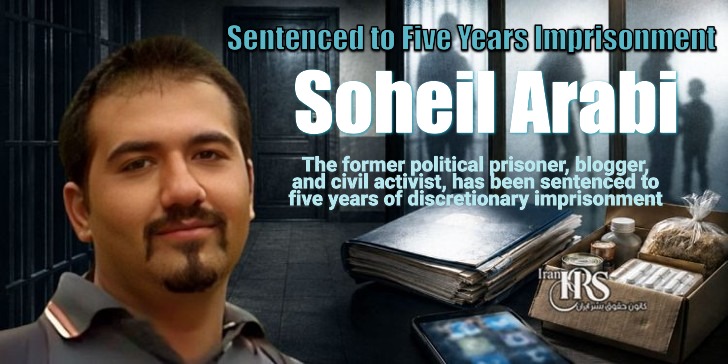
Branch 26 of the Revolutionary Court of Tehran sentenced Soheil Arabi to five years imprisonment and a two-year ban on activities related to social networks.

Iran Human Rights Society, Wednesday, August 19, 2026 – Soheil Arabi, a former political prisoner, blogger, and civil activist, has been sentenced to five years of discretionary imprisonment by Branch 26 of the Revolutionary Court of Tehran, presided over by Judge Iman Afshari. As a supplementary punishment, the court also banned him for two years from engaging in activities related to social networks.
In this case, Soheil Arabi’s communication with individuals outside the country, publication of critical content on social networks, and provision of aid to prisoners, those injured in nationwide protests, and families of the deceased were cited among the items placed under the charge of “assembly and collusion with the intention of committing a crime against national security.”
The issued sentence is primary and open to appeal in the Court of Appeals of Tehran Province within 20 days after notification.
What You Read in This Report
- Issuance of a five-year discretionary imprisonment sentence for Soheil Arabi;
- Two-year ban on activities related to social networks;
- The court’s reliance on communications, critical content, and support activities;
- Placing aid to prisoners and affected families into a security case;
- Ambiguity regarding the realization of legal elements of the charge of “assembly and collusion”;
- Review of the sentence from the perspective of domestic laws and human rights standards.
The Court’s Reliance on Article 610 and Recidivism
Based on the judgment issued on August 16, 2026, Branch 26 of the Revolutionary Court of Tehran, relying on Article 610 of Book Five of the Islamic Penal Code and considering regulations related to “recidivism,” sentenced Soheil Arabi to five years of discretionary imprisonment, counting previous detention days.
In a part of the judgment, officers’ reports regarding Soheil Arabi’s communication with individuals outside the country, exchange of views on topics described as “anti-security,” images related to his activities, and content published on social networks were introduced as documentation for issuing the sentence.
The hearing session for the charge against Soheil Arabi was held on August 10, 2026. Following this session, he announced that based on reports attributed to the IRGC’s Tharallah Headquarters, aid to prisoners, those injured in the nationwide protests of January 2026, and publication of critical content on social networks formed the basis of the charge against him.
In his defense, Soheil Arabi stated that the goal of his support activities was to reduce harm to families, especially children and offspring of prisoners, the injured, and the deceased. According to the published report, he also stated that more than 200 families received aid from this support network and over 100 families had no history of arrest or political activity.
Social Aid; An Instance of Security Charge?
Soheil Arabi’s conviction raises the question of how financial or social aid to families facing the imprisonment, injury, or death of a family member can be considered proof of the realization of “assembly and collusion.”
To realize the charge under Article 610, mere communication with others or performing social activity is not sufficient, and the existence of an agreement between two or more persons to commit a crime against security and their specific intent must be proven. In the published information, clear details regarding the agreed security crime or specific action that Soheil Arabi planned to commit have not been provided.
Soheil Arabi has previously been arrested multiple times and sentenced to heavy punishments due to his writings and activities. In the new sentence, his prior record was also considered as one of the reasons for aggravating the punishment.
Information Box | Soheil Arabi’s Case
- Name: Soheil Arabi
- Position: Blogger, civil activist, and former political prisoner
- Sentence Issuing Authority: Branch 26 of the Revolutionary Court of Tehran
- Case Judge: Iman Afshari
- Charge: Assembly and collusion with the intention of committing a crime against national security
- Sentence: Five years of discretionary imprisonment, counting previous detention days
- Supplementary Punishment: Two-year ban on activities related to social networks
- Date of Sentence Issuance: August 16, 2026
- Status of Sentence: Primary and subject to appeal within 20 days
Legal Review of Soheil Arabi’s Case Based on Domestic Laws
The laws of the dictatorship ruling Iran in past years have been criticized repeatedly due to conflict with standards of fair trial, ambiguity in handling security cases, and restricting freedom of expression. Reviewing Soheil Arabi’s case based on domestic laws does not mean confirmation of these laws; the goal is to show instances where even these same laws may not have been observed during the proceedings.
Legal Ambiguities of the Case
The most important ambiguity is how critical activities and social aid conform to the legal elements of the charge of “assembly and collusion.” Communication with individuals outside the country or publishing critical content, without proving an agreement to commit a specific crime against security, does not alone show the realization of Article 610.
Another ambiguity relates to the use of images, social network content, and officers’ reports as evidence in the case. It is not clear what direct relationship the court established between these items and the intent to commit a security crime.
Related Legal Articles
- Article 23 of the Constitution: Prohibits investigation of beliefs.
- Article 24 of the Constitution: Recognizes freedom of publications and expression of topics.
- Article 35 of the Constitution: Guarantees the right to have a lawyer.
- Article 37 of the Constitution: Emphasizes the presumption of innocence.
- Article 610 of Book Five of the Islamic Penal Code: Conditions the realization of the crime on the assembly and collusion of two or more persons to commit a crime against security.
Cases of Law Violation
- Ambiguity in proving agreement to commit a crime against security;
- Use of critical activities and social communications as security documentation;
- Placing aid to prisoners and affected families into the framework of a security charge;
- Unclear relationship between aid provision and the alleged crime;
- Application of extensive supplementary punishment in the field of online activities;
- Aggravation of punishment by relying on records resulting from civil and critical activities.
Reviewing Soheil Arabi’s Case from the Perspective of Human Rights and Cases of Violation of International Standards
From the perspective of human rights, punishing individuals due to expressing critical views, communicating with others, or performing peaceful support activities creates serious concern regarding the violation of freedom of expression, freedom of association, the right to a fair trial, and the principle of proportionality of punishment.
Restriction of freedom of expression can only be justified when it is legal, necessary, and proportionate to a legitimate goal. The two-year ban on activities related to social networks must also be examined based on these same criteria.
Related International Documents
- Article 10 of the Universal Declaration of Human Rights: The right to an independent and impartial tribunal;
- Article 19 of the Universal Declaration of Human Rights: The right to freedom of opinion and expression;
- Article 20 of the Universal Declaration of Human Rights: The right to freedom of peaceful assembly and association;
- Article 14 of the International Covenant on Civil and Political Rights: The right to a fair trial and the presumption of innocence;
- Article 19 of the International Covenant on Civil and Political Rights: The right to freedom of expression and transmission of information;
- Article 22 of the International Covenant on Civil and Political Rights: The right to freedom of association and collective activity.
See also the below articles:
Follow Iran Human Rights Society on social networks:
Telegram /Twitter /Instagram / YouTube / Facebook
Join Iran Human Rights Society on Twitter