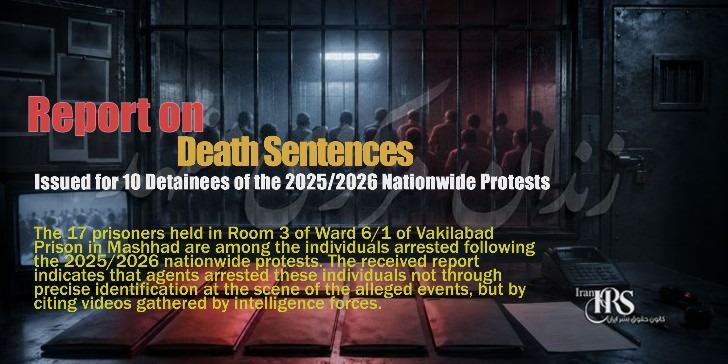
According to received information, 17 detainees of the Mashhad protests are being held in Room 3 of Ward 6/1 of Vakilabad Prison; the identity of these prisoners remains unknown and their families have been placed under pressure to remain silent

Iran Human Rights Society, Thursday, August 27, 2026 – News received by the Iran Human Rights Society indicates the detention of 17 detainees of the 2025/2026 nationwide protests of Mashhad in Room 3 of Ward 6/1 of Vakilabad Prison in Mashhad. According to this report, death sentences have been issued for 10 of these prisoners; nevertheless, the names, identity, charge title, issuing branch of the verdict, and the exact status of their cases are not yet clear.
The source of this report says these individuals were not identified at the scene of protest events based on precise evidence, but rather intelligence agents arrested them by gathering and reviewing videos related to the protests. According to this source, the specific reason and documented evidence for attributing charges have also not been placed at the disposal of families.
The Iran Human Rights Society currently does not have the possibility of independently verifying all details, including whether the death sentences are primary or final. The concealment of prisoners’ identities and the exertion of pressure on families have made independent review of their status difficult, increasing concerns regarding the potential execution of sentences in news silence.
Information Box | Case Information at a Glance
| Subject | Reported Information |
| Place of Detention | Room 3, Ward 6/1 of Vakilabad Prison, Mashhad |
| Number of Detainees | 17 people |
| Time of Arrest | In connection with the 2025/2026 nationwide protests in Mashhad |
| Number of Death Sentences | 10 sentences based on received report |
| Names and Identity | Unspecified to date |
| Method of Identification | Review of videos gathered from protests |
| Status of Families | Threat and exertion of pressure to remain silent |
| Status of Sentences | Whether primary or final is unknown |
Arrest of 17 Protesters Citing Protest Videos
Based on received information, the 17 prisoners held in Room 3 of Ward 6/1 of Vakilabad Prison in Mashhad are among the individuals arrested following the 2025/2026 nationwide protests. The received report indicates that agents arrested these individuals not through precise identification at the scene of the alleged events, but by citing videos gathered by intelligence forces.
It is not yet clear under what conditions these videos were prepared, how the identity of the individuals present in the images was verified, and whether an independent technical expert examination was performed regarding the authenticity of the images or not. Likewise, it is unknown whether the defendants and their lawyers had access to the videos and other case documents, or whether the possibility of effective objection to the method of identification and attribution of charges was provided to them.
Report on the Issuance of 10 Death Sentences in Vakilabad Prison of Mashhad
The most concerning part of the received information is the issuance of death sentences for 10 of these 17 detainees. It is not yet clear which branch of the Revolutionary Court or Criminal Court issued these sentences, what the charges leading to the sentence were, and whether the prisoners had access to a lawyer of choice or not.
Likewise, no information is available regarding the stage of proceedings, date of court sessions, possibility of appeal, and potential referral of the cases to the Supreme Court. The absence of this information, particularly in cases accompanied by the death penalty, highlights the danger of widespread violation of the right to a fair trial.
Identity of Prisoners Remains Unspecified
Despite the importance and urgency of the topic, the names and details of the 17 prisoners held in Vakilabad Prison in Mashhad have not yet been published. The ambiguity of their identity limits the possibility of legal pursuit, appointment of a lawyer, review of physical and mental status, and reporting to human rights organizations.
Until the publication of names, the possibility of matching information with judicial files or family reports also does not exist. Clarifying the identity of these individuals can specify whether the detainees were previously deprived of the right to contact, visitation, medical treatment, and access to a lawyer, and at what stage the reported sentences currently stand.
Threatening Families to Prevent Reporting
Based on the received report, prison agents and intelligence officers have threatened and placed pressure on the families of these prisoners so that they do not speak about the status of their children. Promises were made to families that if they remain silent, there might be a possibility of “resolving the issue.”
In contrast, they were told that if they publish information and their children are executed, the families themselves will have played a role in their killing and will be held responsible. Such remarks exemplify the infliction of severe psychological pressure and the transfer of responsibility for the judiciary’s decisions to families who are trying to save their relatives’ lives.
These threats could be the cause of family silence and the ongoing anonymity of the detainees. Simultaneously, the lack of public reporting increases the risk that cases will reach the execution stage without oversight from public opinion, lawyers, and independent human rights organizations.
Call for Publication of Detainee Names and Information
The source of the report has asked the families of detainees not to be deceived by promises of intelligence agents and to publish information regarding the status of their relatives. In this call, it is emphasized that silence does not create a guarantee for halting death sentences or improving case statuses.
The Iran Human Rights Society also asks all individuals who have verifiable information regarding the names, identity, charges, handling branches, or judicial status of these 17 prisoners to provide their information for documentation and transfer to human rights organizations. Preserving the security of sources and families in publishing this information must remain a priority.
Legal Review of the 2025/2026 Nationwide Protest Detainees’ Case in Vakilabad Prison of Mashhad Based on Domestic Laws
The laws of the dictatorship ruling Iran in past years have been criticized repeatedly due to conflict with standards of fair trial, ambiguity in handling security cases, and restricting freedom of expression and the right to protest. Reviewing the case of the detainees of the 2025/2026 nationwide protests in Vakilabad Prison in Mashhad based on domestic laws does not mean confirmation of these laws; the goal is to show instances where even these same laws may not have been observed by the judiciary.
Legal Ambiguities of the Case
Based on received information, 17 detainees of the 2025/2026 nationwide protests of Mashhad are being held in Room 3 of Ward 6/1 of Vakilabad Prison in Mashhad. It has been reported that these individuals were arrested not based on precise identification at the scene of alleged events, but by citing videos that intelligence agents had gathered from protests.
It is not yet clear under what conditions these images were prepared and gathered, how agents verified the identity of individuals in the videos, and whether visual evidence of the case was placed at the disposal of defendants and their lawyers or not. Likewise, it is unknown whether independent technical expertise was performed to check the authenticity of the videos, time and place of recording images, and matching of faces present in them with the identity of detainees.
The most important reported development in this case is the issuance of death sentences for 10 of these 17 prisoners. Nevertheless, the names of the convicted, charge titles, issuing branch of the ruling, date of court trial, and primary or final status of the sentences have not been announced. Likewise, no information is available regarding the defendants’ enjoyment of a lawyer of choice, sufficient opportunity for defense, and possibility of objecting to case evidence.
On the other hand, it has been reported that intelligence agents and prison officials threatened the families of these prisoners to refrain from reporting. Families were told that in case of silence, their children’s case might be “resolved”; but if they speak about their status and death sentences are executed, the families themselves will be responsible for their children’s death. Such pressures, if confirmed, can disrupt the right to seek justice, access to a lawyer, and legal pursuit of the case.
Related Legal Articles
Reviewing this case from the perspective of domestic laws recalls several important principles and regulations:
- Article 22 of the Constitution: Considers life, rights, dignity, and housing of persons immune from violation, except in cases authorized by law.
- Article 23 of the Constitution: Investigation of beliefs is prohibited, and no one may be subjected to harassment and questioning simply for holding a belief.
- Article 32 of the Constitution: Arrest of individuals must be carried out in accordance with legal criteria, and the charge along with its reasons must be communicated to the defendant in the shortest time.
- Article 34 of the Constitution: Considers seeking justice to be the indisputable right of every individual and recognizes access to a competent court.
- Article 35 of the Constitution: Recognizes the right to have a lawyer for defendants.
- Article 37 of the Constitution: Emphasizes the presumption of innocence, and no one is considered guilty unless their crime is proven in a competent court.
- Article 38 of the Constitution: Prohibits any form of torture to extract confessions or gain information.
- Article 39 of the Constitution: Prohibits the violation of honor and dignity of arrested and imprisoned individuals.
- Code of Criminal Procedure: Emphasizes the necessity of clear communication of charges, defendant’s access to a lawyer, possibility of studying case documents, and possession of sufficient opportunity for defense.
- Executive Regulations of the Prisons Organization: Emphasizes precise registration of prisoners’ details, maintaining their connection with family, and observing legal rights of individuals deprived of liberty.
Cases of Law Violation
Given the published information, the most important legal concerns consist of:
- Arresting individuals citing videos whose method of collection and validity are unclear;
- Ambiguity regarding how the identity of individuals present in images was verified;
- Unclear charge titles of the 17 prisoners;
- Issuance of death sentences for 10 prisoners without publishing information related to judicial proceedings;
- Unclear primary or final status of death sentences;
- Ambiguity regarding defendants’ access to a lawyer of choice and effective defense;
- Potential deprivation of lawyers from full access to visual documents of the case;
- Threatening families to prevent reporting and legal pursuit;
- Inflicting psychological pressure on families by portraying them as responsible in case of sentence execution;
- Keeping names, judicial status, and handling branches of cases hidden.
Reviewing the Case from the Perspective of Human Rights and Violation of International Standards
From the perspective of human rights, protection of the right to life, freedom of expression, right to protest, prohibition of arbitrary detention, and enjoyment of a fair trial are among fundamental principles of international law. Reports received regarding the status of 17 detainees of the 2025/2026 nationwide protests in Vakilabad Prison of Mashhad and the issuance of death sentences for 10 of them have created serious concerns regarding the observance of these rights.
Human Rights Ambiguities of the Case
Based on available information, the arrest of these individuals occurred by citing videos gathered from protests; but it is not clear whether their potential presence in images alone formed the basis for attributing charges or whether the judiciary presented other independent evidence.
It is not yet clear what the charges leading to the issuance of death sentences were and whether acts attributed to the defendants fall under the category of “most serious crimes” intended by Article 6 of the International Covenant on Civil and Political Rights or not. Based on international standards, the death penalty should not be applied for participating in protests, expressing political views, or crimes that did not lead to intentional murder.
The unclear identity of the convicted, non-publication of information related to court sessions, and ambiguity regarding their access to an independent lawyer have eliminated the possibility of evaluating trial fairness. In cases leading to the death penalty, full observance of fair trial guarantees carries double necessity, and any fundamental defect in proceedings can convert sentence execution into an arbitrary deprivation of the right to life.
Likewise, threatening families to remain silent, using feelings of fear and guilt, and portraying them as responsible in case of sentence execution can constitute psychological pressure and inhuman treatment. These pressures, in addition to families, deprive prisoners of public support, effective access to a lawyer, and communication with human rights organizations.
Related International Documents
- Article 3 of the Universal Declaration of Human Rights: Right to life, liberty, and personal security.
- Article 5 of the Universal Declaration of Human Rights: Prohibition of torture and cruel, inhuman, or degrading treatment or punishment.
- Article 9 of the Universal Declaration of Human Rights: Prohibition of arbitrary arrest, detention, or exile.
- Article 10 of the Universal Declaration of Human Rights: Right to a public and fair hearing by an independent and impartial tribunal.
- Article 11 of the Universal Declaration of Human Rights: Presumption of innocence and right to enjoy necessary guarantees for defense.
- Article 19 of the Universal Declaration of Human Rights: Right to freedom of opinion and expression.
- Article 6 of the International Covenant on Civil and Political Rights: Protection of the right to life and restricting the death penalty to the most serious crimes.
- Article 7 of the International Covenant on Civil and Political Rights: Prohibition of torture and cruel, inhuman, or degrading treatment or punishment.
- Article 9 of the International Covenant on Civil and Political Rights: Prohibition of arbitrary arrest and right to immediate notification of reasons for arrest and charges.
- Article 10 of the International Covenant on Civil and Political Rights: Obligation for humane and respectful treatment of all persons deprived of liberty.
- Article 14 of the International Covenant on Civil and Political Rights: Right to enjoy a fair trial, a lawyer, and sufficient opportunity for defense.
- Article 19 of the International Covenant on Civil and Political Rights: Right to hold opinions and freedom of expression.
- Article 21 of the International Covenant on Civil and Political Rights: Right of peaceful assembly.
- UN Safeguards Guaranteeing Protection of the Rights of Those Facing the Death Penalty: Allows execution of the death penalty only after final judgment by a competent court with full observance of fair trial guarantees.
- Nelson Mandela Rules: Emphasizes preserving prisoner dignity, connection with family, access to legal counsel, and transparent registration of information of individuals deprived of liberty.
See also the below articles:
- Deprivation of Afshin Rangriz Heirati from Treatment in Evin Prison
- Death Sentence Issued for Amir-Mohammad Mojallal Choubari
Follow Iran Human Rights Society on social networks:
Telegram /Twitter /Instagram / YouTube / Facebook
Join Iran Human Rights Society on Twitter