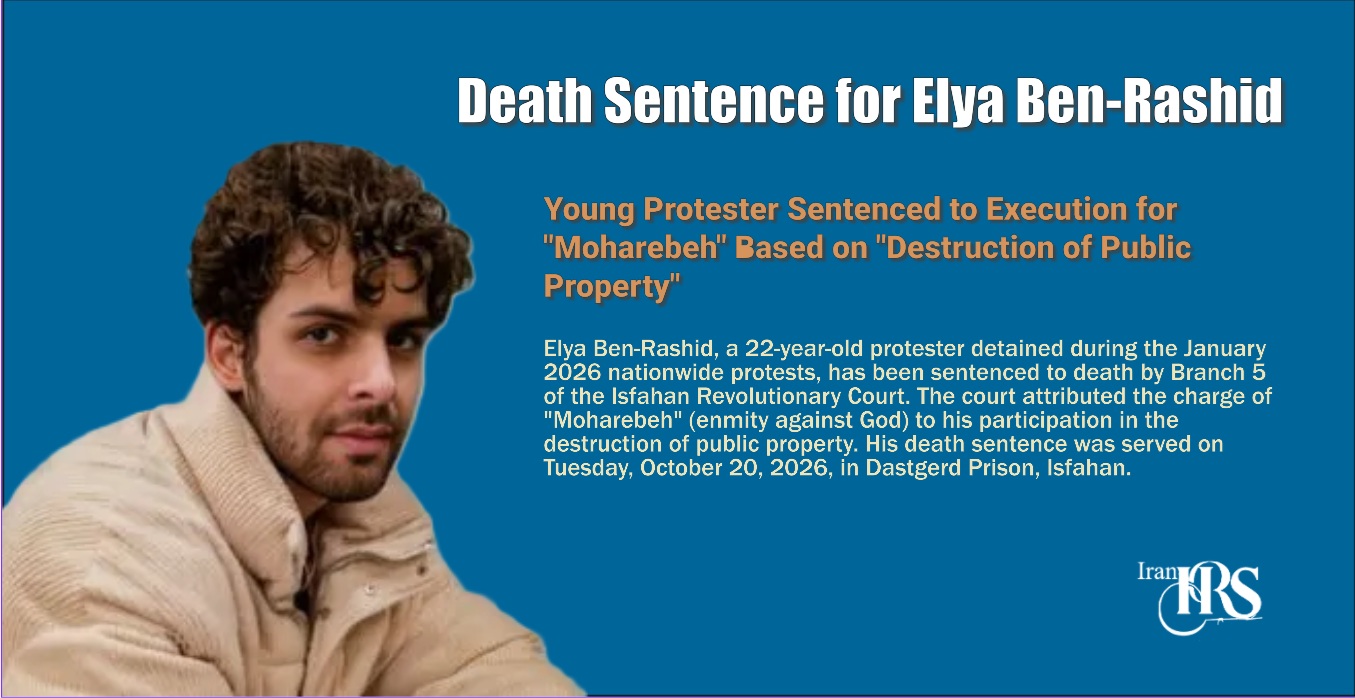
Elya Ben-Rashid, a 22-year-old protester detained during the January 2026 nationwide protests, has been sentenced to death by Branch 5 of the Isfahan Revolutionary Court. The court attributed the charge of “Moharebeh” (enmity against God) to his participation in the destruction of public property. His death sentence was served on Tuesday, October 20, 2026, in Dastgerd Prison, Isfahan. This prisoner had previously been sentenced to imprisonment and flogging, and reports of physical and psychological pressures against him have been published

Iran Human Rights Society, Thursday, October 22, 2026– Elya Ben-Rashid, a young protester detained during the January 2026 nationwide protests, was sentenced to death on charges of “Moharebeh” by Branch 5 of the Isfahan Revolutionary Court. This verdict was served on him on Tuesday, October 20.
Elya Ben-Rashid, who is incarcerated in Dastgerd Prison in Isfahan, also faces additional sentences of imprisonment and a travel ban alongside the death penalty.
Details of Elya Ben-Rashid’s Death Sentence in Isfahan Revolutionary Court
According to the issued verdict, Branch 5 of the Isfahan Revolutionary Court sentenced Elya Ben-Rashid to death on the charge of “Moharebeh through participation in the destruction of public property.”
The court also set three years, six months, and one day of imprisonment for the charge of “assembly and collusion to commit crimes against national security,” and nine months and one day of imprisonment for “propaganda against the system.”
His combined prison sentences total four years, three months, and two days. Furthermore, a two-year ban on leaving the country was issued as a supplementary punishment.
Arrest of Elya Ben-Rashid in Shahin Shahr Protests
Elya Ben-Rashid, originally from Ahvaz and residing in Shahin Shahr, Isfahan, was arrested by security forces during the January 2026 protests.
According to received information, his arrest date was January 12, 2026.
Having lost both his father and mother, he lived with his grandparents for years. Elya also has a younger sister.
Following his arrest, he was transferred to Dastgerd Prison in Isfahan and faced security-related charges.
Physical and Psychological Pressures and Deprivation of Food and Water
Published reports from sources close to Elya Ben-Rashid indicate that during the initial days of his arrest, he was subjected to severe physical and psychological pressures in solitary confinement.
It has also been reported that during this period, he was deprived of access to food and water.
The Iran Human Rights Society previously addressed his detention conditions and restrictions on his defense rights in a report titled “Continued Uncertainty of Elya Ben-Rashid and Prolonged Detention Without Access to Chosen Legal Counsel.”
Previous Sentence of Imprisonment and 20 Lashes
Prior to the issuance of his death sentence, Elya Ben-Rashid had been sentenced in a separate case.
In June 2026, Branch 102 of Criminal Court 2 of Shahin Shahr sentenced him to six months of imprisonment and 20 lashes.
At that time, the charge of Moharebeh was still under examination in the Revolutionary Court.
Details of that conviction were published in a previous report by the Iran Human Rights Society titled “Elya Ben-Rashid Sentenced to Imprisonment and Flogging.”
Legal Review of Elya Ben-Rashid’s Case Based on Domestic Laws
The dictatorship’s laws governing Iran have always been criticized for restricting human rights. Examining this case under domestic laws does not signify an endorsement of these regulations, but serves to demonstrate the failure to comply with even these rules.
Legal Ambiguities of the Case
The primary legal ambiguity is mapping the charge of destroying public property to the title of Moharebeh and issuing a capital sentence.
Relevant Statutory Articles
Article 279 of the Islamic Penal Code links Moharebeh to drawing weapons under specific conditions. Articles 35 and 38 of the Constitution also provide for the right to counsel and the prohibition of torture.
Potential Violations of the Law
Issuing a Moharebeh verdict without establishing its legal elements and reports of denial of counsel raise severe concerns regarding compliance with defense rights.
Review of the Case from a Human Rights Perspective and Violations of International Standards
Elya Ben-Rashid’s death sentence in a case related to the destruction of public property conflicts with international restrictions on the death penalty. Article 3 of the Universal Declaration of Human Rights protects the right to life; Article 5 prohibits torture and inhuman punishment; and Articles 10 and 11 emphasize fair trials and the presumption of innocence. Article 6 of the International Covenant on Civil and Political Rights also restricts the imposition of the death penalty to the most serious crimes.
See also the below articles:
- Mai Sato; Guterres Presented Report on Executions and Suppression of Protesters to the General Assembly
- Amnesty Warning: Fatemeh Aini & Protesters Face Imminent Execution
Follow Iran Human Rights Society on social networks:
Telegram /Twitter /Instagram / YouTube / Facebook
Join Iran Human Rights Society on Twitter