
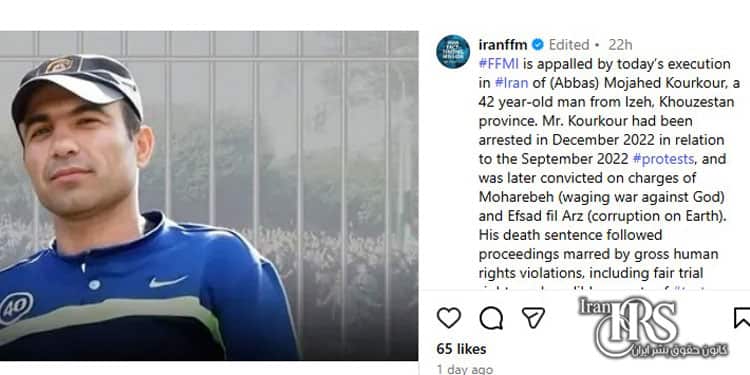
According to documents published by the UN Human Rights Council (A/HRC/58/CRP.1), the case of Mojahed Kourkour is one of the most prominent examples of human rights violations in Iran during the suppression of protests.
UN Response to the Execution of Mojahed Kourkour
Iran Human Rights Society, Thursday, 12 June 2025 – The UN Independent Fact-Finding Committee issued an official statement reacting to the execution of Mojahed Kourkour, a 42-year-old protester from Izeh, and called on the Islamic Republic authorities to immediately halt the implementation of death penalties.
In its statement, published on Thursday, 12 June 2025, the committee emphasized that the judicial process leading to Kourkour’s death sentence and execution was marred by serious human rights violations, including torture, forced confessions, and denial of a fair trial.
Mojahed Kourkour was arrested during the nationwide protests in 2022 and, after several months, was sentenced to death on charges of “waging war against God” (moharebeh) and “corruption on earth” (efsad fil-arz). The sentence was carried out despite strong evidence of torture and lack of legal due process in his case.
Risk of Execution for Other Protesters
The UN Fact-Finding Committee also warned of the ongoing risk of execution for other civil and political activists. The statement highlighted that activists such as Pakhshan Azizi, Sharifeh Mohammadi, and Varisheh Moradi are at imminent risk of execution.
The committee urged the Islamic Republic to immediately halt the execution of protesters’ death sentences and establish an immediate moratorium on the death penalty.
Support from UN Special Rapporteur
Mai Sato, the UN Special Rapporteur on human rights in Iran, also reacted to the execution, endorsing the committee’s stance. In a post on X (formerly Twitter), she noted that Kourkour’s case had previously been formally raised in UN communications with the Iranian government.
Expressing concern over the increasing trend of executing protesters, she called on the Islamic Republic authorities to end the cycle of violent executions.
Justice, Human Rights, and State-orchestrated Scenarios
The Ambiguous Case of Mojahed Kourkour
According to documents published by the UN Human Rights Council (A/HRC/58/CRP.1), the case of Mojahed Kourkour is one of the most glaring examples of human rights violations in Iran during the suppression of protests.
Paragraphs 163 to 165 of the report state:
Paragraph 163:
Mojahed Kourkour was arrested in December 2022 in Izeh, Khuzestan province. He was charged with offenses including moharebeh, efsad fil-arz, and collaboration with armed groups. The Revolutionary Court accused him of participating in riots, committing violence against security forces, and carrying firearms, but the evidence presented was seriously questioned by independent sources and human rights organizations.
Paragraph 164:
This paragraph emphasizes serious violations of due process in Kourkour’s case. He was denied consistent access to a lawyer, the charges against him were unclear, and confessions were extracted under torture. The Revolutionary Court issued its ruling based solely on dubious confessions and security agency reports, without adequately reviewing defense evidence.
Paragraph 165:
The report concludes that the issuance and execution of the death sentence in such a judicial process constitutes a clear violation of human rights and international treaties to which Iran is a signatory. The Fact-Finding Committee called on the Islamic Republic to halt all death sentences related to protesters and urgently review these cases.
Execution as a Tool of Repression
The execution of Mojahed Kourkour, given the available evidence, is clearly part of a systematic policy of suppressing public protests in Iran. UN human rights experts have repeatedly stated that Iran’s judiciary, by violating fair trial principles, uses the death penalty to instill fear and terror in society.
According to independent organizations, many detainees from the protests have been coerced into confessions under severe psychological and physical pressure, and courts issue harsh sentences without adhering to legal procedures.
Call for Immediate Halt to Executions
In its concluding statement, the UN Fact-Finding Committee stressed that the Islamic Republic must immediately end its campaign of executing protesters and cooperate with the international community to allow independent investigations of these cases.
The committee also urged the global community and all human rights organizations to increase diplomatic efforts to stop the wave of executions in Iran.
Public Concern Over Executions in Iran
The execution of Mojahed Kourkour has deeply alarmed not only the Iranian public but also international human rights organizations.
This case has once again drawn global attention to the repeated human rights violations in Iran and the instrumental use of the death penalty as a tool of repression.
With the serious threat of execution facing other protesters, the call for an immediate halt to executions and a review of the Islamic Republic’s judicial processes has become an urgent global demand.
Follow Iran Human Rights Society on social networks:
Telegram /Twitter /Instagram / YouTube / Facebook
Join Iran Human Rights Society on Twitter



Discussion about this post