
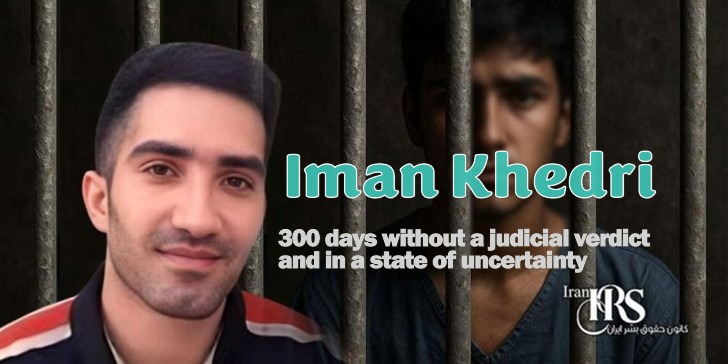
Iman Khedri, a political prisoner from Masjed Soleyman, faces prolonged detention in Abadan Prison without trial. Authorities raise serious human rights concerns after nearly 300 days.
Iran Human Rights Society, Wednesday, December 24, 2025 – Iman Khedri, the detained citizen residing in Masjed Soleyman, has been held in Abadan Prison for nearly 300 days without a judicial verdict and in a state of uncertainty. The continuation of this prolonged detention of the political prisoner, without transparent judicial proceedings, has raised serious human rights concerns.
Continued Detention Without Judicial Proceedings
Authorities arrested Iman Khedri on March 4, 2025, at his home in Masjed Soleyman. IRGC Intelligence agents used electric shockers and physical violence during the arrest. Now, he endures nearly 300 days in Abadan Prison without a judicial verdict. This ongoing uncertainty highlights grave human rights issues in Iran.
An informed source reports that Khedri remains in limbo. Despite 295 days passing, officials hold no trial. They deny temporary release. They ignore requests for transfer. This situation creates immense psychological stress for Khedri and his family.

Furthermore, Abadan Prison lies far from his family’s home in Ahvaz. Family members struggle with regular visits. They find it hard to monitor his condition.
Vague Security Charges
The charges against Iman Khedri include “attempting to disrupt public order” and “acting against national security through communication with opposing media.” However, no official indictment or clear explanation regarding the specifics of these charges has been provided so far, and the judicial process remains in ambiguity.
Legal observers emphasize that raising general and vague security charges, without presenting clear evidence, is one of the common patterns in political cases that severely limits the defendants’ right to an effective defense.
Violent Arrest in Masjed Soleyman
The arrest of Iman Khedri took place on March 4, 2025, at his personal residence in Masjed Soleyman. According to reports, Sepah Intelligence forces used electric shockers and physical violence during the arrest. After the arrest, he was initially transferred to the Sepah Intelligence detention center in Ahvaz.
Subsequently, on March 20, 2025, Iman Khedri was transferred from the Ahvaz detention center to Abadan Prison; a transfer that was carried out without official explanation and, according to his close associates, aimed at increasing pressure on this political prisoner.
Unofficial Exile and Additional Pressure
Khedri’s lawyer, Fereshteh Tabanian, suggests the transfer relates to his support for Sheiban Prison inmates in Ahvaz. His family lives in Ahvaz. Detention in Abadan acts as unofficial exile.
This separation limits family contact. It intensifies psychological strain. Such practices violate humane treatment standards for prisoners.
History of Security Pressures
Iman Khedri has previously had a history of arrests and security confrontations due to his activities. The repetition of arrests and the continuation of security pressures have increased concerns about the targeted nature of this case and raised serious questions about adherence to fair trial principles.
Human Rights Violations in Iman Khedri’s Case
The review of the arrest and detention process of Iman Khedri indicates multiple and systematic violations of his fundamental rights; violations that contravene both domestic laws and the government’s international obligations.
- Article 9 of the International Covenant on Civil and Political Rights – Prohibition of arbitrary detention Prolonged detention without charging and judicial proceedings.
- Article 14 of the International Covenant on Civil and Political Rights – Right to a fair trial Failure to form a court and deprivation of public and fair proceedings.
- Article 49 of the Criminal Procedure Code – Notification regarding detention Family unaware for 14 days of the detention location and status of the detainee.
- Article 38 of the Constitution – Prohibition of torture Use of electric shockers and violence during arrest.
- Mandela Rules, Principle 58 – Right to contact with family Punitive transfer to a prison far from the family’s place of residence.
The continued uncertain detention of Iman Khedri, alongside the lack of judicial transparency and intensified security pressures, has turned this case into a clear example of systematic human rights violations; a situation that continues without effective accountability.
See also the below articles:
- Evin Prison Female Political Prisoners Face Severe Health Crisis and Unsanitary Conditions
- UN Experts Demand Halt to Zahra Tabari Execution in Iran
Follow Iran Human Rights Society on social networks:
Telegram /Twitter /Instagram / YouTube / Facebook
Join Iran Human Rights Society on Twitter








Discussion about this post