
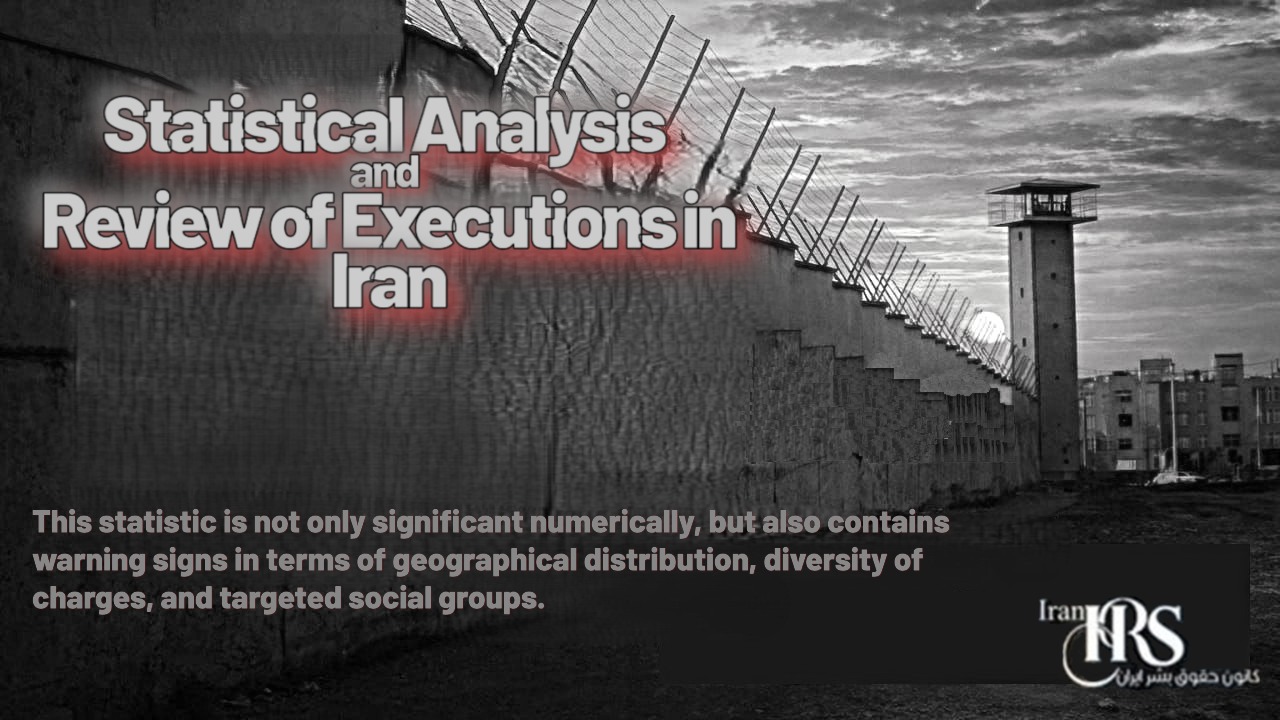
While in Azar 1403 (approximately November 22 to December 21, 2024) a total of 144 people had been executed in Iran, the number of executions in Azar this year has increased more than two and a half times.
Iran Human Rights Society, Friday, December 26, 2025 – Based on investigations conducted by the research team of the Iran Human Rights Society, Azar ( November 22 to December 21, 2025), with the registration of at least 363 executions in prisons and public squares in various cities of Iran, has become one of the bloodiest months in terms of implementing the death penalty in the past three decades. Examination of available data shows that on average, more than 12 people were executed daily in this month. A worrying figure that indicates the quantitative and qualitative intensification of the use of the death penalty. This statistic is not only significant numerically, but also contains warning signs in terms of geographical distribution, diversity of charges, and targeted social groups.
More than two and a half times increase in executions compared to last year
Comparing the statistics of executions in Azar( November 22 to December 21, 2025) with the same period in the past year clarifies the dimensions of this leap. While in Azar( November 22 to December 21, 2024) a total of 144 people had been executed, the number of executions in Azar( November 22 to December 21, 2025) this year has increased more than two and a half times. This sudden growth raises serious questions about criminal policies, judicial proceedings, and the increasing use of execution as a tool for social control.
Geographical Spread of Executions in Iran
Authorities conducted executions across at least 64 cities in 31 provinces. The death penalty spread nationwide. However, concentrations appeared in Fars, Razavi Khorasan, Lorestan, Khuzestan, and Isfahan. These areas showed higher numbers. Regional policies may drive this pattern. Alternatively, case volumes or prevention failures play roles.
Impact on Minorities and Vulnerable Groups
Ethnic minorities and foreign nationals faced disproportionate executions. Records show at least 16 Baluch individuals, 33 Kurds, and 8 Afghans among the executed. This highlights discrimination. These groups encounter unequal trials. They experience double vulnerability. Ages ranged from 22 to 55 years. Society lost many in productive years.
Women and the death penalty; a less visible but increasing face
In Azar( November 22 to December 21, 2025) , at least 10 women were executed in various prisons; a statistic that, although less than men, indicates a worrying trend. Women such as Mina Sadoughi, Mahin Rahimi, Rana Faraj-Oghli, Elnaz Azizi, and others were mostly executed on charges such as murder or drug-related crimes. The execution of women, especially in conditions where many of them have faced complex family, social, and economic backgrounds, raises serious questions about the lack of supportive and rehabilitative approaches in the criminal system.
The names of the executed women are listed below:
Mina Sadoughi: She was 41 years old and was executed on November 26, 2025, on drug-related charges in the central prison of Shiraz.
Mahin Rahimi: She was executed on November 26, 2025, on murder charges in the central prison of Mashhad.
Rana Faraj Oghli: She was executed on December 3, 2025, on murder charges in the central prison of Tabriz.
One person: She was executed on December 3, 2025, on drug-related charges in the central prison of Mashhad.
Elnaz Azizi: She was executed on December 10, 2025, on murder charges in the central prison of Mashhad.
Sedigheh Ghorbani: She was 29 years old and was executed on December 13, 2025, on murder charges in the central prison of Urmia.
Hamidah Jabari: She was 46 years old and was executed on December 13, 2025, on murder charges in the central prison of Qom.
Razieh Abbasi: She was 40 years old and was executed on December 17, 2025, on murder charges in Qazalhisar prison.
Mahin Rashidi: 39 years old, executed on December 17, 2025, on drug-related charges in the central prison of Shiraz.
Mahdieh Keyhani: 41 years old, executed on December 21, 2025, on murder charges in the central prison of Hamedan.
Public executions; display of violence as a deterrent tool
The implementation of at least three public executions in Azar( November 22 to December 21, 2025) reveals another dimension of the intensification of execution policy. The execution of individuals such as Mostafa, 27 years old, in Bastam, Semnan, and Mohammad Zakari in Borazjan shows that public execution is still used as a tool to create public fear and display power. This method, in addition to heavy psychological consequences for society, especially children and adolescents, its deterrent effectiveness is also highly doubtful. Public executions are as follows:
Mostafa (last name unknown): He was 27 years old and was publicly executed on November 25, 2025, on rape charges in Bastam, Semnan.
One person: Executed publicly on December 2, 2025, on murder charges in Semnan.
Mohammad Zakari: Executed publicly on December 2, 2025, on murder and rape charges in Borazjan.
Peak days of executions; a sign of acceleration in implementing sentences
Examination of the temporal distribution of executions shows that some days were particularly accompanied by peaks in death sentence implementations. December 2, 2025 (11 Azar 1404) with 32 executions, December 17, 2025 (26 Azar 1404) with 31 executions, and November 26, 2025 (5 Azar 1404) and December 10, 2025 (19 Azar 1404) each with 26 executions are among the unprecedented days in this regard. This temporal concentration may be a sign of haste in implementing sentences or efforts to close accumulated cases; a matter that itself increases concerns about the quality of judicial proceedings.
Reasons Behind Rapid Executions in Iran
Experts link the surge to regime instability. Economic pressures mount on people. Social unrest lingers from past protests. International isolation grows. Legitimacy erodes. Therefore, authorities deploy executions for deterrence. They aim to create terror. However, society resists more actively now.
Analysts view this as prevention. They target potential new protests. Events since 2022 challenged the system deeply.
Execution as a human rights crisis
The collective data of Azar( November 22 to December 21, 2025) shows that execution is not only still one of the main tools of criminal policy, but is expanding with a worrying speed and scope. The significant increase in statistics, prominent presence of minorities and women, and continuation of public executions all indicate a deep crisis in dealing with crime and punishment. This trend, more than ever, highlights the necessity of serious rethinking in the use of the death penalty and attention to more humane and effective solutions.
Violation of fundamental human rights principles in the process of implementing executions
The widespread and increasing implementation of executions is a direct violation of international human rights standards.
Violated articles:
- § Article 3 of the Universal Declaration of Human Rights — Right to life: Implementing hundreds of executions in one month, especially in the absence of fair trial, is a clear violation of the fundamental right to life.
- § Article 5 — Prohibition of torture and cruel behavior: Many defendants are subjected to pressure, threats, or harsh interrogations before the sentence is recorded, and there are numerous reports of forced confessions.
- § Article 10 — Right to fair trial: Limited access to a lawyer, short trial sessions, and lack of effective defense opportunities are common in cases leading to execution.
- § Article 7 of the International Covenant on Civil and Political Rights — Prohibition of coercion: Using confessions under pressure in issuing death sentences violates this article.
- § Article 14 — Fair and public trial: Many court sessions are held behind closed doors, and defendants do not have the opportunity to present effective defense.
See also the below articles:
- UN Experts Demand Halt to Zahra Tabari Execution in Iran
- No to Execution Tuesdays Campaign: 100 Weeks of Defiant Resistance Against Iran’s Death Penalty Regime
Follow Iran Human Rights Society on social networks:
Telegram /Twitter /Instagram / YouTube / Facebook
Join Iran Human Rights Society on Twitter





Discussion about this post