
A hearing on the case of Ehsan Hosseinipour Hesarloo, Matin Ahmadi, and Erfan Amiri, among protesters arrested during the nationwide protests of 2025-2026, was held at the Revolutionary Court of Tehran; reports indicate a lack of effective defense and allegations of torture to extract confessions.
Iran Human Rights Society, Sunday, February 15, 2026 – Mizan News Agency reported the holding of the first session of the trial regarding the charges against three detained protesters from the nationwide protests of 2025-2026—Ehsan Hosseinipour Hessarloo, Matin Ahmadi, and Erfan Amiri—at Tehran’s Revolutionary Court. Reports indicate a lack of effective defense and claims of torture to extract confessions.
Official Announcement of the Court Session
According to a report by Mizan News Agency, the first trial session for the main defendants in the attack and arson at Seyyed al-Shohada Mosque in Pakdasht was held at Tehran’s Revolutionary Court. In this session, the prosecutor’s representative, the victims’ next of kin, witnesses, and informants were present. The official report states that the three defendants appeared in court along with their lawyers. The judge declared the session official and began examining the charges.
Details of the Charges and Claims Raised
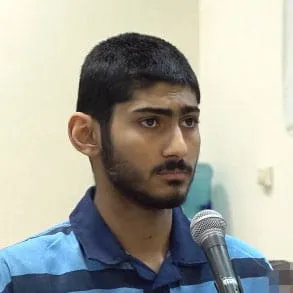
The charges listed in the indictment include “acting against internal security through effective participation in riots,” “assembly and collusion to act against national security,” “participation in the murder of two people,” “deliberate arson of the mosque,” and “destruction of public property.” According to the issued indictment, these three defendants are accused of carrying cold weapons, transporting and using Molotov cocktails, and playing an effective role in attacking security forces. The official report claims that the arson at Seyyed al-Shohada Mosque led to the death of two young men named “Ali Akbar and Taha.” This claim forms the main axis of the case and the charge of participation in murder. In the court session, only Ehsan Hosseinipour, as the first-ranked defendant, defended himself. He stated in his defense that he learned how to make Molotov cocktails from virtual space (online sources) and, when throwing it, did not imagine anyone was inside the mosque.
Lack of Chosen Lawyer and Ineffective Defense
According to published information, these defendants were deprived of having a chosen lawyer. The lawyers present in the court were of the appointed (taskhiri) type, and reports show that no effective defense was provided for the defendants. In similar cases, restrictions on choosing a lawyer and access to the case file have been among the criticized issues. In this case as well, no report has been published of extensive defenses being presented or serious challenges to the prosecution’s evidence. Legal experts emphasize that, according to principles of fair trial, the defendant must have the right to freely choose a lawyer. The absence of a chosen lawyer can limit the defense process.
Claims of Torture and Forced Confessions
In cases related to the nationwide protests, the issue of torture and extraction of forced confessions has been raised repeatedly. In this case too, reports have emerged about pressure to obtain confessions. Ehsan Hosseinipour referred in the court session to some details of the actions attributed to him. However, no independent report on the conditions of detention and the method of obtaining confessions has been published. In similar cases, defendants, after transfer to security detention centers, have been subjected to pressure to accept charges. The use of confessions in the indictment has been one of the main axes for proving the charges.
Legitimacy of Revolutionary Courts and Validity of Verdicts
The court handling this case is Tehran’s Revolutionary Court. These courts have faced extensive criticism at the international level in past years. Some legal observers consider these courts to lack standards of fair trial. Restrictions on access to a lawyer, reliance on confessions, and lack of transparency in the proceedings are among the raised issues. At the international level, verdicts issued from such processes face challenges to their legitimacy due to violations of fair trial standards. The principle of judicial independence and the right to effective defense are among the standards under discussion in this case.
Violation of Fair Trial Principles in the Handling of Protesters’ Cases from the Nationwide Protests
The process of handling this case for the three defendants has been reported to conflict with several fundamental human rights principles:
- Violation of the right to access a chosen lawyer: Article 14 of the International Covenant on Civil and Political Rights – Every defendant has the right to benefit from a lawyer of their own choosing.
- Violation of the prohibition of torture: Article 5 of the Universal Declaration of Human Rights – Obtaining confessions under torture or coercion is prohibited.
- Violation of the right to a fair trial: Article 10 of the Universal Declaration of Human Rights – Every individual has the right to be tried by an independent and impartial court.
See also the below articles:
- Issuance of Death Sentence for Saleh Mohammadi, One of the Detainees from the Nationwide Protests of 2025-2026
- Overcrowding and torture in Vakilabad Prison, Mashhad; A detainee’s account of the nationwide protests of 2025-2026
Follow Iran Human Rights Society on social networks:
Telegram /Twitter /Instagram / YouTube / Facebook
Join Iran Human Rights Society on Twitter




Discussion about this post