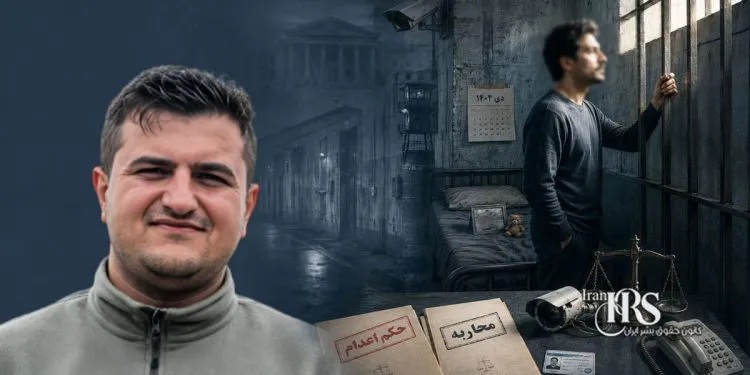
Kamal Khan-Babaei, one of the detainees of the nationwide 2025-2026 Protests, has been sentenced to death by Branch One of the Qazvin Revolutionary Court on the charge of “moharebeh”. Informed sources say this charge has been attributed to breaking a camera.
Iran Human Rights Society, Thursday 2 July 2026 – The issuance of a death sentence for Kamal Khan-Babaei, one of the detainees of the nationwide 2025-2026 Protests, has increased concerns about the process of handling protesters’ cases. This prisoner, who has been held in Choubindar Prison in Qazvin since January, has been sentenced to the punishment of death on charges of “destruction of public property” and “moharebeh”. According to published information, one of the bases for attributing the charge of moharebeh has been stated as breaking a camera.

How was Kamal Khan-Babaei arrested?
Kamal Khan-Babaei, son of Reza, is one of the individuals who were arrested during the nationwide 2025-2026 Protests.
According to published reports, he was arrested in the city of Qazvin on January 8, 2026 by security forces and was subsequently transferred to Choubindar Prison in Qazvin.
From the time of his arrest until now, he has been held in this prison and the process of handling his case has been carried out in the Qazvin Revolutionary Court.
Why has Kamal Khan-Babaei been sentenced to death?
According to the ruling issued by Branch One of the Qazvin Revolutionary Court presided over by Judge Asadi, Kamal Khan-Babaei has been faced with charges of “destruction of public property” and “moharebeh” and has been sentenced to the punishment of death.
According to an informed source, the attribution of the title “moharebeh” in this case has been attributed to breaking a camera.
At the same time, more details of the court documents or the manner of legal reasoning for attributing this charge title have not been published publicly.
What ambiguities has the charge of moharebeh created in this case?
Kamal Khan-Babaei’s case has attracted attention because, according to published information, the charge of moharebeh has been raised based on a behavior that, according to an informed source, has been stated as breaking a camera.
Some jurists believe that imposing the death penalty requires careful examination of the legal elements of the crime, providing sufficient evidence, and full observance of the principles of fair trial. Therefore, in cases where the death penalty is raised, transparency in the handling process and publication of legal documents have special importance.
What is the family status of Kamal Khan-Babaei?
According to available information, Kamal Khan-Babaei is married and has one child.
The issuance of a death sentence for him, in addition to having a direct impact on the fate of this prisoner, has also placed his family in difficult emotional and social conditions.
Legal examination of the case based on domestic laws
Before examining the legal aspects of this case, it should be noted that many criminal laws, especially in political, security, and death penalty cases, have always been criticized by international human rights institutions due to incompatibility with the principles of fair trial, the right to life, and fundamental freedoms. However, even based on these same domestic laws, security and judicial authorities in many cases do not adhere to legal requirements, the defensive rights of the accused, and trial formalities, and numerous reports of violation of the same laws by these same authorities have been published.
Legal ambiguities
The published information about Kamal Khan-Babaei’s case has raised questions about the proportionality of the charge title “moharebeh” with the attributed behavior, the manner of evaluating evidence, observance of the accused’s defensive rights, and transparency of the handling process. Also, details related to the court documents and the legal reasoning leading to the issuance of the death sentence have not been published publicly so far.
Related legal articles
Article 32 of the Constitution: No one can be arrested except by the order and in the manner specified by law.
Article 34 of the Constitution: The right to seek justice is the indisputable right of every individual.
Article 35 of the Constitution: In all courts, parties have the right to choose a lawyer for themselves.
Article 37 of the Constitution: The principle is innocence and no one is recognized as a criminal unless his crime is proven in a competent court.
Article 38 of the Constitution: Any coercion to obtain a confession is prohibited.
Criminal Procedure Code: Emphasizes observance of the accused’s defensive rights, access to a lawyer, and fair trial.
Cases of violation of the law
Ambiguity in the proportionality of the charge title “moharebeh” with the attributed behavior.
Lack of public information about the documents for issuing the death sentence.
The necessity of precise observance of trial guarantees in cases leading to the death penalty.
The need for complete examination of the right to defense and the accused’s effective access to a lawyer.
Why can Kamal Khan-Babaei’s case be noteworthy from a human rights perspective?
Kamal Khan-Babaei’s case, from a human rights perspective, raises issues such as the right to life, fair trial, and observance of legal guarantees in cases leading to the death penalty. Human rights institutions have always emphasized that in such cases, the highest standards of trial must be observed and any ambiguity about evidence or the handling process must be examined transparently.
Related human rights articles
Article 3 of the Universal Declaration of Human Rights: Every human being has the right to life, liberty and security of person.
Article 10 of the Universal Declaration of Human Rights: Everyone is entitled to a fair and public hearing by an independent and impartial tribunal.
Article 11 of the Universal Declaration of Human Rights: The principle of innocence until the crime is proven.
Article 6 of the International Covenant on Civil and Political Rights: The right to life and the necessity of precise observance of all legal guarantees in cases leading to the death penalty.
Article 14 of the International Covenant on Civil and Political Rights: The right to enjoy a fair trial and full guarantee of the accused’s defensive rights.
The issuance of a death sentence for Kamal Khan-Babaei, one of the detainees of the nationwide 2025-2026 Protests, has once again drawn attention to the process of handling protesters’ cases. Given the heaviest punishment foreseen in the law, full observance of the principles of fair trial, transparency in legal reasoning, and guarantee of the accused’s defensive rights are among the most important requirements for handling such cases.
See also the below articles:
- Saeed Gharibi: Ongoing Imprisonment and Medical Neglect in Adelabad Prison, Shiraz
- Ahmad Alizadeh: New Prison Sentence for Retired Teacher and Activist
Follow Iran Human Rights Society on social networks:
Telegram /Twitter /Instagram / YouTube / Facebook
Join Iran Human Rights Society on Twitter