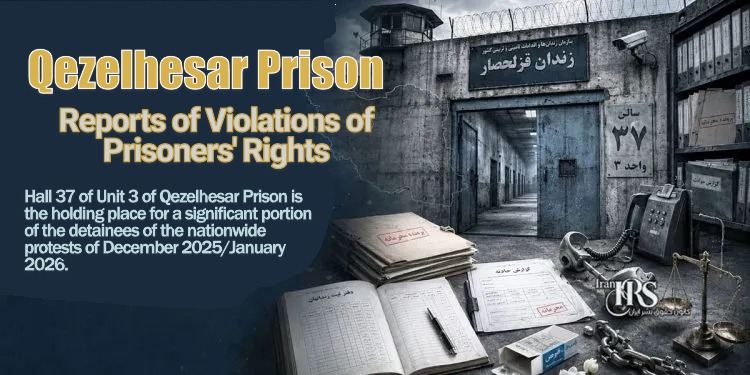
Reports received from Qezelhesar Prison indicate that detainees of the nationwide protests of December 2025/January 2026 in Hall 37 of Unit 3 are facing extensive restrictions, deprivation of basic rights, continuous pressures, and violent behavior. Human rights sources have called for an independent investigation into the performance of the officials of this ward.
Iran Human Rights Society, Tuesday, July 7, 2026 – Qezelhesar Prison has once again been at the center of reports related to the violation of prisoners’ rights in recent months. According to information received from informed sources, about 100 detainees from the nationwide protests of December 2025/January 2026 are being held in Hall 37 of Unit 3 of this prison; a hall where, according to human rights sources, its prisoners face severe restrictions, deprivation of basic facilities, psychological pressures, and reports of violence and mistreatment. This report also focuses on the performance of the officials of this ward towards the prisoners and calls for an independent investigation and accountability regarding these reports.
Hall 37 Unit 3; Holding Place for Detainees of the December 2025/January 2026 Protests
According to published information, Hall 37 of Unit 3 of Qezelhesar Prison is the holding place for a significant portion of the detainees of the nationwide protests of December 2025/January 2026. Human rights sources say many of these prisoners face security cases and heavy charges, and prison officials keep them in conditions where their communication with other prisoners and even their families has been minimized.
According to these sources, placing these prisoners in an isolated environment, along with extensive restrictions, has increased concerns about their situation; especially since some of the detainees face the risk of issuance or execution of heavy sentences, including execution.
Reports of Extensive Restrictions Against Prisoners
According to reports received from inside the prison, prisoners in Hall 37 face a series of restrictions, which include deprivation of phone calls, severe restriction of visitations, prevention of regular use of fresh air (yard time), restrictions on purchasing from the prison store, and prevention of the entry of required medications.
Also, informed sources have reported receiving accounts about requests for sums of money to use certain facilities inside the ward,
including resting areas, beds, cooling equipment, and television.
The Performance of Hall 37 Officials Under the Scrutiny of Human Rights Reports
According to received reports, the performance of the officials of Hall 37 Unit 3 and some staff of this ward in connection with the method of treating prisoners has been criticized by human rights sources. These reports indicate the imposition of severe restrictions, punitive treatments, preventing prisoners’ access to basic rights, and the use of various pressures to control prisoners.
The main agents of crime and torture of prisoners in Ward 37 of the Qezelhesar Unit consist of:

Head of Hall 37 in Unit 3 of Qezelhesar – Nasrollah Ghaffari
Substitute Officer – Qasem Sahraei
Guard Officer – Reza Naseri
Guard Officer – Amirhossein Gholam Shahi
Prisoner Representative (Vakil-e-Band) – Saeid Ahmadzadeh
It is also said that four prisoners who act as assistants to the prisoner representative in the internal affairs of the hall play a role in implementing certain restrictions and exerting pressure on prisoners. Human rights activists have called for an independent investigation into how this ward is managed and the role of the responsible individuals in these reports. The names of these individuals are:
Ali Sheidaei Masoud Ghaffari Hamidreza Tajik Amir Sadeq
Qasem Sahraei; A Name That Has Been Repeatedly Raised in Human Rights Reports
Among the officials introduced in the reports related to Hall 37, the name of Qasem Sahraei attracts attention more than others. According to reports published by human rights sources, he was previously known as the substitute officer of Rajai Shahr Prison, and his name has been raised in various reports about the method of treating political prisoners.
In these reports, it is alleged that he has been involved in numerous cases of forced transfer of prisoners to solitary confinement, violent treatments, and security operations inside the prison. Also, some human rights reports have raised his name in connection with the events of March/April 2026 and the treatment of political prisoners in Qezelhesar Prison.
These allegations have not been officially answered by responsible officials so far.
Population Density and Difficult Conditions of Maintenance in Hall 37
According to published information, Hall 37 of Unit 3 of Qezelhesar Prison faces a high population density and a lack of basic facilities. Sources close to the families of prisoners say the number of individuals held in this hall is more than its predicted capacity, and this very issue has made daily life conditions difficult for the prisoners.
According to these sources, many prisoners face a lack of sleeping space, improper ventilation, limited sanitary facilities, and undesirable welfare conditions. Also, reports of a shortage of some essential items, restrictions on using public facilities, and difficulty in accessing medical services have been published.
Human rights activists warn that keeping prisoners in such conditions, especially individuals who have passed through periods of interrogation and security pressures before being transferred to prison, can leave serious effects on their physical and mental health.
Restriction of Contact with Family; A Tool for Increasing Psychological Pressure
Another issue raised in the reports related to Hall 37 is the severe restriction of prisoners’ communication with their families.
According to these reports, prisoners in this hall are allowed to make phone calls only once a week and for a short duration, and visitations are also carried out purely in booth form (behind glass) and with time restrictions. The families of many of the detainees say these restrictions have caused an increase in their anxiety regarding the situation of their loved ones and have minimized the possibility of knowing about the real conditions of the prisoners.
Human rights activists believe that maintaining the prisoner’s connection with the family is considered among the most important rights of prisoners, and depriving them of regular contact and visitation can intensify psychological pressures on the prisoner and their family.
Concern About the Health of Prisoners
According to reports received from inside the prison, restrictions on the entry of certain medications and the difficulty of prisoners’ access to medical services are among other concerning issues in Hall 37.
Informed sources say a number of prisoners have underlying diseases and need continuous treatment, but the process of their access to medicine and medical services is accompanied by restrictions. Human rights activists have warned that any delay in treatment or preventing prisoners’ access to medical care can place their health at serious risk.
Request for an Independent Investigation into Published Reports
With the increase in reports related to the situation of Hall 37, a number of activists and human rights organizations have called for conducting an independent investigation into the conditions of keeping prisoners and the performance of the officials of this section of Qezelhesar Prison.
In their belief, an independent review of these reports can help clarify the realities, determine the responsibility of related individuals, and guarantee the observance of prisoners’ rights. It has also been emphasized that prison officials must provide a transparent explanation regarding the published reports and that the possibility of access for independent monitoring bodies to this ward should be provided.
Legal Review of the Situation of Hall 37 Prisoners
According to published information, cases such as deprivation of contact with family, restriction of access to medical services, preventing fresh air (yard time), restriction of purchasing essential items, and reports related to violent behavior with prisoners can be reviewed from the perspective of domestic law and international human rights standards.
Human rights experts emphasize that even individuals who are in detention or serving a sentence possess fundamental rights that must be observed by prison officials. Observing human dignity, access to medical services, communication with family, and enjoying suitable maintenance conditions are among these rights.
Legal Dimensions and Human Rights Violations in Qezelhesar Prison
Published reports about the situation of Hall 37 Unit 3 of Qezelhesar Prison have raised concerns about the observance of the fundamental rights of prisoners. The following cases are among the most important citable human rights standards:
The Right to Enjoy Humane Treatment and Preserving the Dignity of Prisoners
Respectful treatment of individuals deprived of liberty is one of the fundamental principles of human rights, and any humiliating or violent behavior with prisoners stands in conflict with this principle.
The Right to Access Medical Services
Prisoners must have access to required medical services and medications without discrimination and delay. Deprivation of treatment can put their health and life at risk.
The Right to Communication with Family
Regular contact and visitation with family members are among the recognized rights of prisoners, and unnecessary restrictions in this field can have serious psychological effects on prisoners and their families.
Prohibition of Exerting Pressure and Punishment Outside the Framework of Law
Any exertion of pressure, violent treatment, or creation of restrictions outside legal regulations must be independently reviewed, and in case of proof, its perpetrators must be held accountable.
Dimensions of Human Rights Violations in Qezelhesar Prison
Published reports about the situation of prisoners in Hall 37 Unit 3 of Qezelhesar Prison create serious concerns about the observance of fundamental rights of prisoners and recognized standards of human rights.
Deprivation of contact with family, restriction of access to medical services, preventing fresh air (yard time), reports related to the beating of prisoners, and also claims raised about receiving sums of money in exchange for using basic prison facilities are among the cases that require an independent, transparent, and impartial review. Human rights activists emphasize that prison officials are duty-bound to guarantee the security, health, and dignity of all prisoners without discrimination, and any claim related to mistreatment or violation of prisoners’ rights must be addressed through independent mechanisms.
Related Legal Articles and Human Rights Standards
Article 5 of the Universal Declaration of Human Rights
No individual shall be subjected to torture or to cruel, inhuman, or degrading treatment or punishment. Reports related to beatings and mistreatment of prisoners, if proven, stand in conflict with this principle.
Article 10 of the International Covenant on Civil and Political Rights
All individuals deprived of their liberty shall be treated with humanity and with respect for the inherent dignity of the human person. Maintenance conditions, the behavior of officers, and the method of managing the prison must comply with this principle.
Rule 24 and 27 of the Nelson Mandela Rules
Prisoners must have access to suitable medical services, medicine, and medical care without discrimination. Preventing treatment or delay in providing medical services can endanger the health of prisoners.
Rule 23 of the Nelson Mandela Rules
All prisoners must enjoy the possibility of fresh air (yard time) and activity in the open air on a daily basis. Long-term deprivation of fresh air contradicts international standards of managing prisons.
Rule 58 of the Nelson Mandela Rules
Prisoners must be able to communicate regularly with their family and relatives through visitations, phone calls, or correspondence. Extensive restrictions in this field can leave significant psychological effects on prisoners and their families.
Rule 1 of the Nelson Mandela Rules
All prisoners must be treated without discrimination and with the preservation of human dignity. Any degrading behavior, exertion of pressure outside the framework of law, or abuse of administrative position, if proven, contradicts this principle.
Call for Gathering Information About the Situation of Prisoners in Qezelhesar Prison
Iran Human Rights Society invites families, relatives, friends, former cellmates, and all individuals who have access to information, documents, images, videos, or any type of documentation related to the situation of prisoners in Qezelhesar Prison of Karaj to place their information at the disposal of this Society for documentation and reflection to human rights bodies.
Information such as specifications of prisoners, physical and mental status, maintenance conditions, duration of detention, judicial processing trends, case status, deprivation of furlough, restrictions applied, medical needs, cases of violation of prisoners’ rights, and any verifiable report, image, or document can play an effective role in the accurate documentation of the situation of prisoners and clarifying its dimensions.
The purpose of this call is breaking the wall of silence and lack of news surrounding the situation of prisoners, documenting potential cases of human rights violations, increasing public awareness, and providing the ground for reflecting these reports to international bodies defending human rights. Every documented and reliable information can be an effective step in recording realities, supporting prisoners’ rights, and strengthening the trend of accountability towards published reports.
Communication Addresses:
Email: info@iranhrs.org
Contact Form: https://iranhrs.org/contact-us/
WhatsApp: +31 6 17325233
Telegram: @MaryamHashemai
Instagram: maryamhashemie2020
This information will be placed at the disposal of media, human rights organizations, and international bodies through secure and reliable channels. In the belief of human rights activists, publishing valid documents, testimonies, and documentation about cases of violations of prisoners’ rights, abuse of power, administrative corruption, and the role of individuals involved in these actions can help clarify the hidden dimensions of these violations and provide the ground for independent investigations and accountability of officials.
Human rights activists emphasize that individuals who have played a role in violating prisoners’ rights, exerting pressure, torture, harassment, and inhumane behaviors must not remain immune from public scrutiny and accountability. Documenting these cases and presenting them to competent international bodies can provide the ground for legal follow-up and accountability of the perpetrators of these actions.
Documented and continuous exposure of human rights violations, in addition to helping realize justice, gives a clear message to violators of prisoners’ rights that no illegal action and no behavior violating human dignity will be erased from the memory of society and public opinion, and its perpetrators sooner or later will inevitably have to answer before competent authorities and public opinion.
See also the below articles:
- Human Rights Violation Report in Iran June 2026 | Iran Human Rights Society
- Ehsan Meshksar Political Prisoner Denied Anklet Release in Adelabad Prison
Follow Iran Human Rights Society on social networks:
Telegram /Twitter /Instagram / YouTube / Facebook
Join Iran Human Rights Society on Twitter