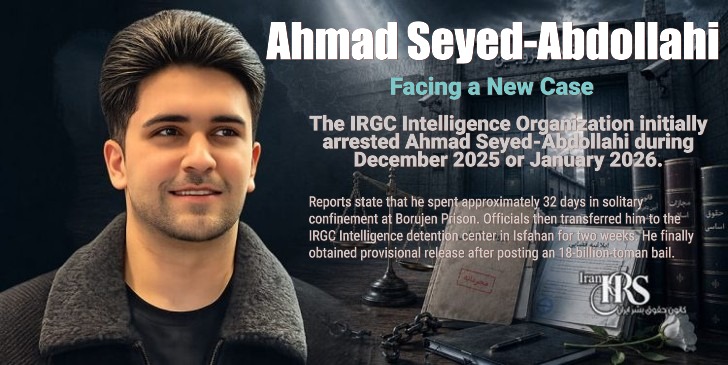
Ahmad Seyed-Abdollahi, a psychologist and political prisoner from Borujen, was returned to Borujen Prison to serve a seven-month sentence just two days after being released on bail. Concurrently, his new case involving the charge of “propaganda against the state” remains under investigation at the interrogator’s office.
Iran Human Rights Society, Wednesday, July 8, 2026 – Ahmad Seyed-Abdollahi, a counselor and psychologist from Borujen, was transferred back to Borujen Prison on Tuesday, July 7, 2026, to serve his prison sentence. This occurred only two days after he had been released on bail from temporary detention regarding a separate case. Meanwhile, his new case involving the charge of “propaganda against the state” remains in the interrogation phase, increasing concerns over his legal status.
Why Did Ahmad Seyed-Abdollahi Return to Prison?

Ahmad Seyed-Abdollahi, born in 1992, is a counselor and psychologist residing in Borujen. He was returned to prison to serve his finalized sentence following a notification from the Criminal Enforcement Branch of the Borujen Prosecutor’s Office.
According to the notification issued on June 27, 2026, he was ordered to present himself to the enforcement branch within 10 days to execute the prison sentence. He ultimately entered Borujen Prison on Tuesday, July 7, 2026, to begin serving his term.
His return to prison took place just two days after being released on bail in a separate case that is still under investigation by the interrogator.
How Was Ahmad Seyed-Abdollahi Arrested?
Ahmad Seyed-Abdollahi was initially arrested in December 2025 / January 2026 by the Intelligence Organization of the Islamic Revolutionary Guard Corps (IRGC).
According to published reports, he spent approximately 32 days in solitary confinement at Borujen Prison before being transferred to the IRGC Intelligence detention center in Isfahan for about two weeks. He was eventually released provisionally after posting an 18-billion-toman bail to allow his legal proceedings to continue.
What Was the Ground for Ahmad Seyed-Abdollahi’s Conviction?
Based on the issued verdict, Ahmad Seyed-Abdollahi was found guilty for publishing an English-language video addressed to the US President and sending it to an opposition media outlet.
Citing the law on “Aggravating the Punishment for Espionage and Cooperation with the Zionist Regime and Hostile States Against National Security and Interests,” enacted in 2025/2026, the court sentenced him to seven months of discretionary imprisonment (Ta’zir).
Additionally, a five-year deprivation of government and public services was imposed as a supplementary punishment. This verdict was issued in February/March 2026, with the court citing his lack of an effective criminal record and his acceptance of the preliminary ruling as mitigating factors.
What Is the Current Status of Ahmad Seyed-Abdollahi’s New Case?
Ahmad Seyed-Abdollahi was arrested again by security forces at his home in late May 2026.
On July 4, 2026, he was temporarily released after posting a bail of 3.5 billion tomans. In this new case, he faces the charge of “propaganda against the state,” and the matter remains under investigation by the interrogation branch.
Why Has Ahmad Seyed-Abdollahi’s Re-arrest Raised Ambiguities?
Shortly before his second arrest, the First Interrogation Branch of the Public and Revolutionary Prosecutor’s Office of Borujen, headed by Interrogator Vahid Ghadirdokht Ghahfarokhi, had issued a summons for Ahmad Seyed-Abdollahi to defend himself against the charge of “propaganda against the state.”
According to the summons issued on May 25, 2026, he was required to appear before the interrogation branch within five days. However, security forces proceeded to arrest him before the formal judicial proceedings could even begin.
This action has raised questions regarding the necessity of an arrest while a formal judicial summons process was actively underway, leading to ambiguities regarding how his new case is being handled.
Legal Analysis of the Case Based on Domestic Laws

Before analyzing the legal aspects of this case, it must be noted that many criminal laws under the ruling dictatorship—particularly in political, security, and capital punishment cases—have been heavily criticized by international human rights organizations for contradicting the principles of a fair trial, the right to life, and fundamental freedoms. However, even based on these domestic laws, security and judicial authorities frequently fail to adhere to statutory requirements, the defense rights of defendants, and due process, with numerous reports documenting violations of the regime’s own regulations.
Legal Ambiguities in the Case
- Re-arresting the defendant before the judicial summons process was completed.
- Prolonged detention in solitary confinement.
- Transferring the defendant to the IRGC Intelligence detention facility.
- Concurrently executing a sentence while investigating a separate new case.
- Imposing disproportionately heavy bail amounts.
Relevant Legal Provisions
- Article 32 of the Constitution (Prohibition of arbitrary arrest)
- Article 34 of the Constitution (Right to seek justice and access competent courts)
- Article 35 of the Constitution (Right to legal counsel)
- Article 37 of the Constitution (Presumption of innocence)
- Relevant articles of the Criminal Procedure Code regarding the rights of the accused.
Violations of the Law
- Arrest prior to completing the formal judicial summons process.
- Prolonged holding in solitary confinement.
- Transfer to a security detention facility without adequate transparency.
- Deprivation of effective access to a lawyer.
- Imposition of disproportionate and exorbitant bail.
- Restricted communication with family during detention.
- Implementing a sentence simultaneously while processing an active, separate case.
- Restricting the opportunity for an effective defense against the allegations.
- Ambiguity surrounding the necessity of the re-arrest.
- Utilizing a controversial and legally disputed charge title.
Human Rights Violations in the Handling of Ahmad Seyed-Abdollahi’s Case
If the published reports are accurate, the case of Ahmad Seyed-Abdollahi raises serious concerns regarding the observance of the fundamental rights of defendants in political and security cases. Arresting an individual before the judicial summons process is completed, prolonged solitary confinement, transfers to security detention centers, exorbitant bail demands, and executing a prior sentence while actively investigating another case are all matters requiring independent and transparent review under international human rights standards.
Human rights activists emphasize that all defendants, regardless of the nature of their charges, must be guaranteed the right to a fair trial, access to legal counsel, preservation of human dignity, and a hearing before an independent and impartial tribunal.
Relevant Human Rights Instruments
- Article 9 of the Universal Declaration of Human Rights (UDHR): Prohibition of arbitrary arrest.
- Article 10 of the UDHR: Right to a fair and public hearing.
- Article 14 of the International Covenant on Civil and Political Rights (ICCPR): Right to a fair trial and the right to a defense.
- Article 9 of the ICCPR: Right to liberty and security of person.
- Rule 43 of the Nelson Mandela Rules: Prohibition of prolonged solitary confinement and practices that are detrimental to the physical and mental health of prisoners.
See also the below articles:
- Qezelhesar Prison: Disclosure of Hall 37 Unit 3 Officials and Rights Violations
- Human Rights Violation Report in Iran June 2026 | Iran Human Rights Society
Follow Iran Human Rights Society on social networks:
Telegram /Twitter /Instagram / YouTube / Facebook
Join Iran Human Rights Society on Twitter