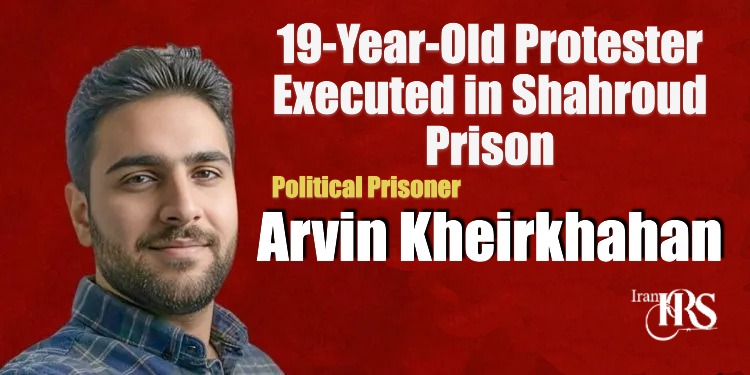
Political prisoner Arvin Kheirkhahan, who was detained during the 2025 nationwide protests, was executed at dawn on August 1, 2026, in Shahroud Prison. His family reported that prison authorities delayed surrendering the body and imposed strict time restrictions for holding a funeral service.
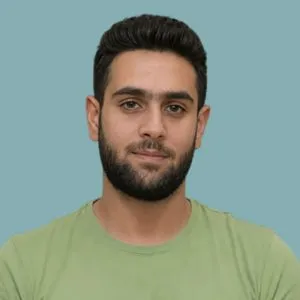
Iran Human Rights Society, Saturday, August 1, 2026 – Early Saturday morning, the death sentence of political prisoner Arvin Kheirkhahan, a 19-year-old youth detained during the 2025 nationwide protests, was carried out in Shahroud Prison. He had previously been sentenced to death on charges of Moharebeh (enmity against God) by Branch 1 of the Shahroud
Revolutionary Court—a verdict subsequently affirmed without modification during appeal proceedings and by the Supreme Court. The execution took place despite sparse public information regarding due process guarantees, prosecution evidence, or the defendant’s legal defense.
What You Will Read in This Report
- Execution of Arvin Kheirkhahan in Shahroud Prison
- Informing the family and funeral restrictions
- Legal background of the case
- Ambiguities surrounding judicial proceedings
- Human rights evaluation
Fact Box | Arvin Kheirkhahan
| Field | Details |
| Name | Arvin Kheirkhahan |
| Age at Execution | 19 years and 6 months |
| Execution Location | Shahroud Prison |
| Date of Execution | August 1, 2026 |
| Primary Charge | Moharebeh (Enmity against God) |
| Sentencing Authority | Branch 1 of the Shahroud Revolutionary Court |
| Case Status | Sentence affirmed on appeal and by the Supreme Court; executed |
| Identified Ambiguities | Lack of public record regarding arrest conditions, interrogation practices, evidence, and access to chosen counsel |
Execution of Arvin Kheirkhahan in Shahroud Prison
According to received reports, the death sentence of Arvin Kheirkhahan was carried out around 4:00 AM on Saturday, August 1, 2026, inside Shahroud Prison.
Kheirkhahan was 19 years and six months old at the time of execution. He was among those detained during the 2025 nationwide protests.
He had been sentenced to capital punishment by Branch 1 of the Shahroud Revolutionary Court under the charge of Moharebeh. Following defense appeals, the ruling was affirmed by both the appellate court and the Supreme Court prior to implementation.
Family Restrictions on Body Surrender and Funeral Services
A source close to the family confirmed the execution and stated that prison authorities withheld the body immediately following the execution.
According to the source, authorities instructed the family to return at 3:00 AM the following day to receive the body, stipulating that the burial must be conducted strictly at 5:00 AM.
The imposition of tight time limits for claiming the body and holding memorial services reflects ongoing restrictions imposed on families of executed political prisoners.
Judicial Timeline
Arvin Kheirkhahan was arrested in connection with the 2025 nationwide protest wave.
Following initial processing, Branch 1 of the Shahroud Revolutionary Court tried him on Moharebeh charges and issued a death sentence.
Despite legal challenges submitted by defense representatives, the appellate court and the Supreme Court upheld the capital ruling, leading to its execution in Shahroud Prison.
Procedural Ambiguities
Despite the execution’s completion, specific details remain unpublished regarding the exact date and circumstances of Kheirkhahan’s arrest, the specific acts supporting the Moharebeh charge, interrogation conditions, access to chosen legal counsel, and the evidentiary basis relied upon by the court.
Furthermore, details regarding court hearings, defense arguments, and independent evidentiary evaluations were not made accessible to the public or legal monitors.
This lack of judicial transparency prevents an independent assessment of fair trial compliance, placing Arvin Kheirkhahan’s trial among security cases marked by procedural concerns.
The execution of 19-year-old Arvin Kheirkhahan, a detainee from the 2025 nationwide protests, was carried out while numerous ambiguities remain surrounding his arrest, investigation, judicial proceedings, and case documentation. The restrictions imposed on his family regarding body surrender and burial arrangements have further heightened concerns about the treatment of convicts’ families following executions.
Legal Review of the Case Based on Domestic Laws
The legal framework applied by the ruling dictatorship in Iran has been repeatedly criticized in recent years by jurists and human rights organizations due to its incompatibility with fair trial standards, ambiguities in handling security cases, and extensive reliance on capital punishment. The case of Arvin Kheirkhahan is among those where published information raises serious questions regarding compliance with fair trial principles, judicial transparency, and guarantees for the defendant’s right to defense.
Legal Ambiguities of the Case
According to published information, following his arrest during the 2025 nationwide protests, Arvin Kheirkhahan was sentenced to death by Branch 1 of the Shahroud Revolutionary Court on charges of Moharebeh. However, details regarding the timing and circumstances of his arrest, supporting evidence for the charges, interrogation proceedings, court room standards, and the defense presented by the accused have not been publicly disclosed.
Furthermore, there is no clear information regarding his access to chosen defense counsel, the opportunity to review case files, or the evidence cited by the court. Under such conditions, an independent evaluation of fair trial compliance remains impossible—representing one of the most significant legal ambiguities in this case.
On the other hand, restricting the timeframe for surrendering the body and setting a rigid hour for the burial service raise further legal questions regarding respect for the rights of families following executions.
Relevant Domestic Statutory Provisions
- Article 32 of the Constitution: Mandates statutory compliance during detention and immediate formal notification of charges.
- Article 35 of the Constitution: Guarantees defendants the right to select their own legal representation.
- Article 37 of the Constitution: Establishes the presumption of innocence until guilt is proven in a competent court.
- Article 38 of the Constitution: Strictly prohibits torture or coercion for extracting confessions, invalidating forced admissions.
- Article 39 of the Constitution: Forbids any infringement upon the dignity or honor of detainees and prisoners.
- Code of Criminal Procedure: Protects defense rights, effective legal assistance, impartial proceedings, and adherence to procedural standards.
Identified Statutory Violations
- Lack of public transparency regarding prosecution evidence for Moharebeh;
- Ambiguities surrounding access to chosen legal representation and effective defense facilities;
- Absence of published court opinions and trial transcripts;
- Restrictions placed on public information regarding judicial progress;
- Strict limitations imposed on the family regarding burial timing and rites.
Human Rights Violations Regarding Arvin Kheirkhahan
From an international legal perspective, executing an individual under trials lacking verified fair trial guarantees, open evidentiary standards, and access to chosen defense counsel violates core international instruments.
The right to life is absolute, requiring that any proceedings carrying capital penalties observe strict due process guarantees. Furthermore, restricting family access to bodies and restricting burial practices aggravates family suffering and conflicts with international standards regarding human dignity.
Relevant International Legal Instruments
- Article 3 of the Universal Declaration of Human Rights: Right to life, liberty, and security of person.
- Article 5 of the Universal Declaration of Human Rights: Absolute prohibition of torture or cruel, inhuman, or degrading treatment or punishment.
- Article 10 of the Universal Declaration of Human Rights: Right to a fair and public hearing by an independent and impartial tribunal.
- Article 6 of the International Covenant on Civil and Political Rights: Protects the right to life, restricting capital punishment strictly to cases where all fair trial safeguards are fully observed.
- Article 14 of the International Covenant on Civil and Political Rights: Guarantees fair trial standards, adequate legal defense facilities, and access to counsel.
- UN Convention Against Torture: Explicitly prohibits coerced confessions or statements obtained under duress.
- UN Nelson Mandela Rules: Mandates respect for the human dignity of prisoners and consideration for their families.
Overall, the case of Arvin Kheirkhahan once again brings concerns surrounding protest-related trial proceedings, capital punishment usage, judicial transparency, and defendant defense rights to the forefront of international human rights scrutiny.
See also the below articles:
- Shandiz Protest Detainees Face Imminent Execution Risk in Mashhad
- Mehdi Nazer and Mahnaz Chardoli Death Sentences Under Supreme Court Review
Follow Iran Human Rights Society on social networks:
Telegram /Twitter /Instagram / YouTube / Facebook
Join Iran Human Rights Society on Twitter