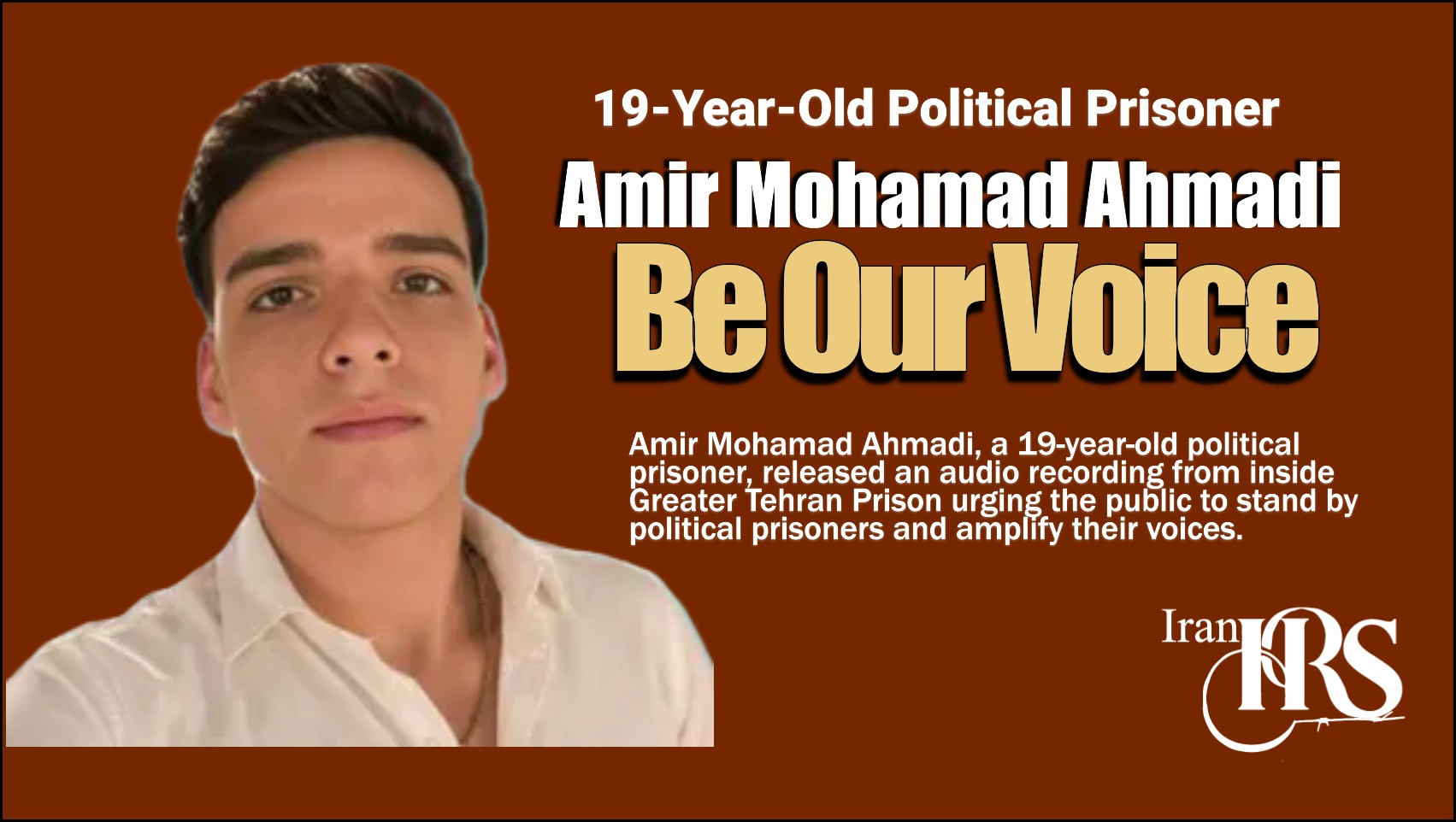
Amir Mohamad Ahmadi, a 19-year-old political prisoner held in Greater Tehran Prison, issued an audio message from inside prison asking the public to be the voice of political prisoners and not to forget them. He states that after more than seven months in detention, his five-year prison sentence was upheld by the Appeals Court without an effective hearing.

Iran Human Rights Society, Wednesday, August 5, 2026 – Amir Mohamad Ahmadi, a 19-year-old political prisoner, released an audio recording from inside Greater Tehran Prison urging the public to stand by political prisoners and amplify their voices. Ahmadi, who has been in custody since January 2, 2026 stated that the Appeals Court rubber-stamped his five-year sentence without conducting a meaningful review.
Key Points from Amir Mohamad Ahmadi’s Audio Message
In his audio recording broadcast from Greater Tehran Prison, Ahmadi detailed his situation while asking the public to continue supporting political prisoners.
He noted that he has been detained since January 2, 2026, and has now served over seven months of his sentence.
In the final section of his message, the political prisoner addressed the public directly:
“Be our voice; do not forget us. We have always stood by the people, we stand by them now, and we always will; please stand behind us.”
This appeal comes amid a surge of reports in recent months highlighting worsening conditions for political prisoners and procedural violations in security-related judicial cases.
Confirmation of Sentence by the Appeals Court
According to Ahmadi, Branch 26 (note: text mentions both Branch 28 and Branch 26) of the Tehran Revolutionary Court, presided over by Judge Iman Afshari, originally sentenced him to five years of discretionary imprisonment (Ta’zir).

As supplementary penalties, the court imposed a two-year travel ban and a two-year ban on accessing social services.
Ahmadi stated that after filing an appeal against the sentence, his case was forwarded to the Appeals Court. However, after approximately six months, the appellate authority confirmed the lower court’s verdict verbatim without conducting a substantive or effective review. He described this process as prolonging his legal uncertainty and depriving him of genuine appellate remedies.
Circumstances of Detention and Profile
Amir Mohamad Ahmadi, born in 2007 (1386 SH), was arrested by security forces on January 2, 2026, during nationwide protests. He has been held in Greater Tehran Prison continuously since his arrest.
Fact Box | Case of Amir Mohamad Ahmadi
| Parameter | Details |
| Name | Amir Mohamad Ahmadi |
| Age | 19 years old |
| Year of Birth | 2007 (1386 SH) |
| Date of Arrest | January 2, 2026 |
| Detention Facility | Greater Tehran Prison |
| Case Context | 2026 Nationwide Protests |
| Primary Sentence | 5 years of discretionary imprisonment (Ta’zir) |
| Supplementary Penalties | 2-year travel ban; 2-year prohibition from social rights/services |
| Case Status | Sentence upheld by the Appeals Court |
| Prisoner Statement | “Be our voice; do not forget us.” |
Legal Analysis Under Domestic Law
The judicial procedures enforced by the ruling authority in Iran have drawn widespread condemnation from legal scholars and human rights organizations regarding the mass detention of protesters and the handling of security charges. Ahmadi’s case highlights persistent issues concerning defense rights, appellate review standards, and due process guarantees.
Key Legal Ambiguities
- Lack of Effective Appellate Review: Claims that the Appeals Court rubber-stamped the trial court’s ruling after six months without evaluating defense arguments.
- Prolonged Pre-trial & Post-Sentence Uncertainty: Extended delays in handling appeals without procedural updates.
- Defense Limitations: Questionable access to chosen defense counsel during trial proceedings.
Applicable Domestic Statutes
- Article 34 of the Constitution: Guarantees the right of all citizens to seek justice through competent tribunals.
- Article 35 of the Constitution: Explicitly recognizes the right of every defendant to select legal representation.
- Article 37 of the Constitution: Encapsulates the presumption of innocence until proven guilty in a lawful trial.
- Article 39 of the Constitution: Forbids any infringement on the dignity or rights of detainees.
- Iranian Code of Criminal Procedure: Mandates fair hearings, effective right of appeal, and thorough judicial evaluations at appellate levels.
International Human Rights Framework & Violations
Under international human rights law, the right to a fair trial includes an effective appellate process before an independent judicial body. Disregarding appeal grounds without substantive review constitutes a failure to meet international fair trial standards.
Relevant International Legal Provisions
- Article 9 of the Universal Declaration of Human Rights (UDHR): Prohibition of arbitrary arrest and detention.
- Article 10 of the UDHR: Right to a fair and public hearing by an independent tribunal.
- Article 11 of the UDHR: Guarantee of the presumption of innocence.
- Article 14 of the International Covenant on Civil and Political Rights (ICCPR): Guarantees fair trial rights, adequate defense facilities, and the right to have convictions and sentences reviewed by a higher tribunal according to law.
See also the below articles:
- Azerbaijani Activists Prison Sentences: 40 Years Handed Down in Tehran
- Sikan Roshani Death Sentence Issued for Detained Kurdish Protester
Follow Iran Human Rights Society on social networks:
Telegram /Twitter /Instagram / YouTube / Facebook
Join Iran Human Rights Society on Twitter