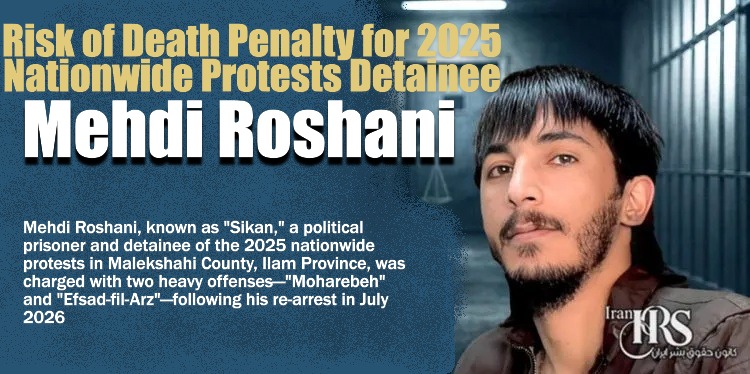
Mehdi Roshani (Sikan), a detainee from the 2025 nationwide protests in Malekshahi, faces charges of “Moharebeh” (enmity against God) and “Efsad-fil-Arz” (corruption on Earth) following his re-arrest—charges that carry the potential risk of the death penalty.

Iran Human Rights Society, Thursday, August 13, 2026 – Mehdi Roshani, known as “Sikan,” a political prisoner and detainee of the 2025 nationwide protests in Malekshahi County, Ilam Province, was charged with two heavy offenses—”Moharebeh” and “Efsad-fil-Arz”—following his re-arrest in July 2026. According to available information, these charges were formally
communicated to him in Branch 6 of the Interrogative Court of the General and Revolutionary Prosecutor’s Office of Ilam, where his case remains in the preliminary investigation stage. Reports have also emerged indicating physical and psychological torture during his initial detention period, aimed at extracting forced self-incriminating confessions.
Re-Arrest of Mehdi Roshani and Opening of a New Case
According to received reports, Mehdi Roshani (Sikan) was re-arrested by government forces on Saturday, July 18, 2026, and transferred to Ilam Central Prison.
Following this arrest, a new judicial case was opened against him, and in Branch 6 of the Interrogative Court of the General and Revolutionary Prosecutor’s Office of Ilam, he was formally charged with “Moharebeh” and “Efsad-fil-Arz.”
These two charges are among the most severe offenses in Islamic Penal Law and, depending on the specific charge, alleged acts, and judicial rulings, carry the possibility of the death penalty. Consequently, the formal reading of these charges has raised grave concerns regarding the fate of this political prisoner.
Based on the latest available information, Mehdi Roshani’s case remains at the preliminary investigation (Bazporsi) stage, and an indictment has not yet been formally issued. Therefore, at this juncture, a final court verdict has not been handed down.
Background of Arrest During the 2025 Nationwide Protests
Mehdi Roshani’s case traces back to protests on January 6, 2026 (16 Dey 1404) in Malekshahi County.
According to published details, security forces raided his home on January 21, 2026, and placed him under arrest. Mehdi Roshani was subsequently transferred to Tehran; however, no official or transparent information was released regarding the reason for his transfer, exact detention location, or interrogation conditions during that period.
A lack of transparency surrounding the whereabouts of a detainee—particularly in political and security-related cases—impedes family members and legal counsel from obtaining crucial information and reduces oversight regarding interrogation procedures.
Reports of Torture to Extract Confessions
One of the most critical aspects of the reported information involves allegations concerning his interrogation process following his transfer to Tehran.
According to these reports, he was subjected to severe physical and psychological pressure during detention to force self-incriminating confessions. Sources behind these reports cite visible signs of torture on his body, stating that electric shocks and floggings were utilized during interrogation sessions.
While these allegations require independent verification, any claim of torture or forced confession assumes critical importance in a case involving charges carrying the death penalty.
Initial reports also noted that confessions extracted during detention were referenced in judicial proceedings. However, as the new case remains in the investigation stage without a finalized indictment, claims that these confessions served as the “basis for a death sentence” cannot be confirmed. The verified fact at present is the formal issuance of charges carrying the risk of capital punishment, rather than an issued death sentence.
Concerns Over Forced Confessions as Case Evidence
The potential reliance on statements extracted under torture or coercion remains a primary source of concern in Mehdi Roshani’s case.
A confession carries legal validity only when obtained freely and without coercion. In a prosecution involving charges of “Moharebeh” and “Efsad-fil-Arz,” an independent investigation into torture allegations and the exclusion of statements obtained under duress are of vital importance.
Given the potential consequences of these charges, guaranteeing Mehdi Roshani access to legal counsel of his choice, full disclosure of prosecution evidence, and adequate time to prepare a defense represent basic requirements for a fair trial.
Legal Review of Mehdi Roshani’s Case Under Domestic Laws
Iran’s judicial framework has faced recurring criticism over fair trial violations, opacity in security cases, reliance on heavy charges, and forced confessions. Reviewing Mehdi Roshani’s case under domestic legal statutes does not constitute an endorsement of these laws; the goal is to highlight instances where even existing statutes must be observed during arrest, interrogation, and prosecution.
Relevant Legal Articles
- Article 32 of the Constitution: Mandates that arrests must follow legal procedures, and charges along with supporting evidence must be communicated immediately to the arrestee.
- Article 35 of the Constitution: Recognizes the fundamental right to legal representation.
- Article 37 of the Constitution: Establishes the presumption of innocence, specifying that no individual shall be deemed guilty unless proven in a competent court.
- Article 38 of the Constitution: Explicitly prohibits all forms of torture to extract confessions or gather information, nullifying the legal validity of coerced confessions.
- Article 39 of the Constitution: Strict prohibition against any act violating the honor and dignity of detainees or prisoners.
- Article 169 of the Islamic Penal Code: Clarifies that confessions obtained under coercion, force, torture, or physical/mental abuse hold no legal value or validity.
- Code of Criminal Procedure: Emphasizes the detainee’s right to be informed of charges, access defense rights, and ensure legal adherence during preliminary investigations.
Instances of Law Violation
Based on published reports, key legal concerns in Mehdi Roshani’s case include:
- Reports of physical and psychological torture during interrogation;
- Alleged use of electric shocks and floggings to pressure the defendant;
- The potential extraction of confessions under torture or duress;
- Lack of clarity regarding potential reliance on coerced statements in judicial files;
- Absence of transparency regarding detention facilities and conditions during initial custody;
- Unclarified reasons for transferring Mehdi Roshani from Ilam to Tehran following his first arrest;
- Non-disclosure of specific acts or evidence underlying the “Moharebeh” and “Efsad-fil-Arz” charges;
- Formal reading of capital charges while the case remains in preliminary investigation;
- The necessity to ensure effective access to counsel and defense preparation in a case directly tied to the right to life.
Human Rights Perspective and Potential Violations of International Standards
From a human rights standpoint, protection of the right to life, the absolute prohibition of torture, the right to a fair trial, and access to legal counsel constitute foundational principles of international law. Mehdi Roshani’s situation—specifically facing charges that carry the death penalty alongside reports of torture to extract confessions—presents serious concerns regarding compliance with international standards.
Relevant International Documents
- Article 3 of the Universal Declaration of Human Rights: The right to life, liberty, and security of person.
- Article 5 of the Universal Declaration of Human Rights: Prohibition of torture or cruel, inhuman, or degrading treatment or punishment.
- Article 10 of the Universal Declaration of Human Rights: The right to a fair and public hearing by an independent and impartial tribunal.
- Article 11 of the Universal Declaration of Human Rights: Presumption of innocence and guarantee of all defense rights necessary for trial.
- Article 6 of the International Covenant on Civil and Political Rights (ICCPR): Protection of the right to life and strict restrictions on the application of the death penalty.
- Article 7 of the ICCPR: Absolute prohibition of torture or cruel, inhuman, or degrading treatment.
- Article 14 of the ICCPR: Guarantees to a fair trial, presumption of innocence, and full defense guarantees.
- Nelson Mandela Rules: Obligation to respect human dignity for persons deprived of liberty and prohibition of torture or inhuman treatment.
See also the below articles:
- Greater Tehran Prison Brigade 5: Severe Overcrowding & Corruption
- 32 Countries Condemn Iran Executions of Protesters
Follow Iran Human Rights Society on social networks:
Telegram /Twitter /Instagram / YouTube / Facebook
Join Iran Human Rights Society on Twitter