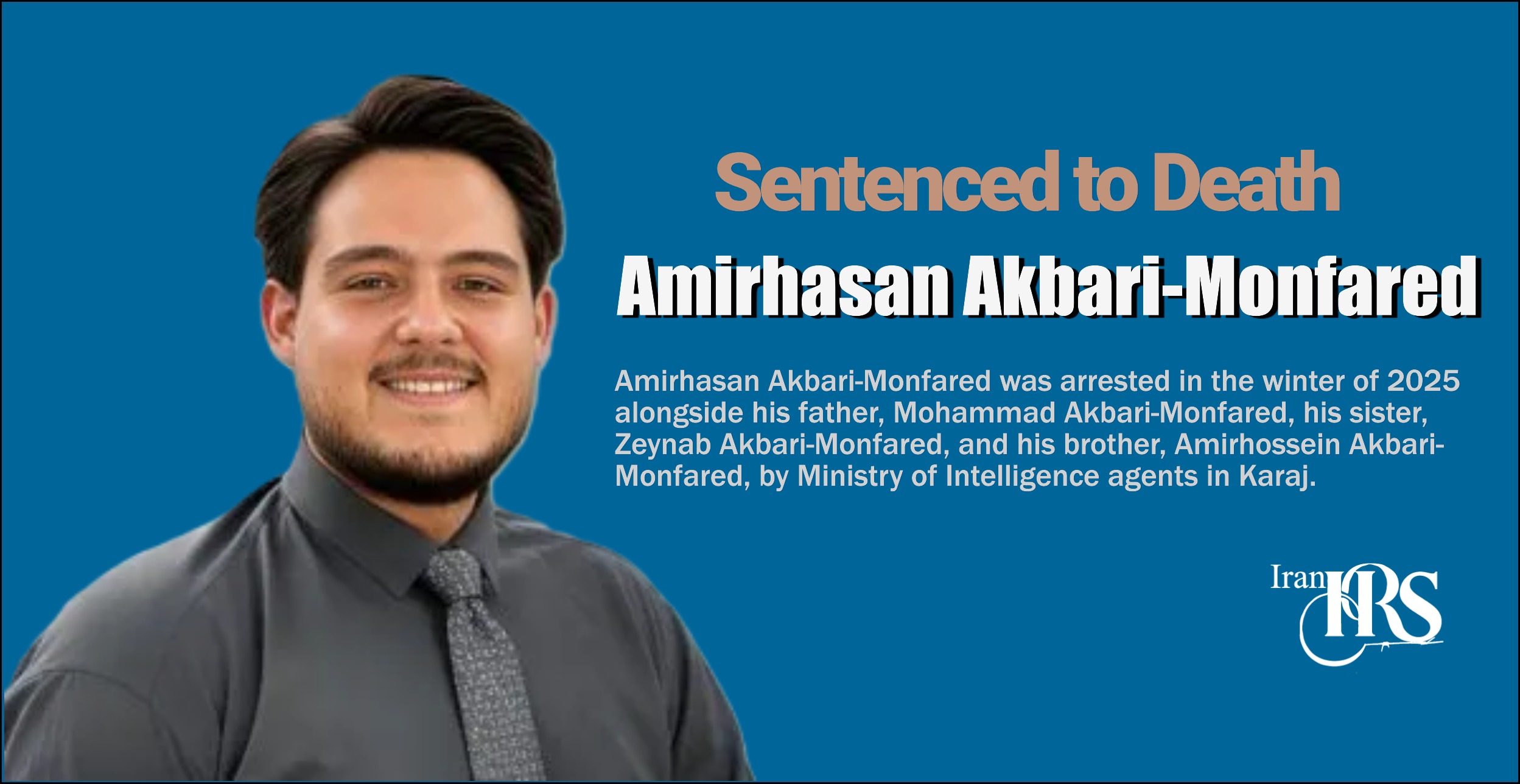
Amirhasan Akbari-Monfared, a political prisoner incarcerated in Evin Prison, has been sentenced to death by Branch 15 of the Tehran Revolutionary Court, presided over by Judge Abolghasem Salavati, on charges of “baghi” (armed rebellion) through membership in the People’s Mojahedin Organization of Iran (PMOI/MEK).

Iran Human Rights Society, Thursday, July 23, 2026 – Amirhasan Akbari-Monfared, a political prisoner held in Evin Prison, has been sentenced to death following a ruling issued by Branch 15 of the Tehran Revolutionary Court under Judge Abolghasem Salavati. The verdict was formally served on him on July 21, 2026.
Akbari-Monfared had previously stood trial before Branch 15 of the Tehran Revolutionary Court. The issuance of this sentence has once again brought heightened focus to concerns regarding the increasing use of capital punishment against political prisoners and individuals in security-related cases.
Key Information | Amirhasan Akbari-Monfared
| Title | Details |
| Name | Amirhasan Akbari-Monfared |
| Year of Birth | 2001 |
| Occupation | Accounting student |
| Detention Facility | Evin Prison |
| Court | Branch 15, Tehran Revolutionary Court |
| Presiding Judge | Abolghasem Salavati |
| Charge | Baghi (rebellion) through membership in the PMOI/MEK |
| Sentence | Death (capital punishment) |
| Date Verdict Served | July 21, 2026 |
Death Sentence for Amirhasan Akbari-Monfared
According to the judgment issued by Branch 15 of the Tehran Revolutionary Court, Amirhasan Akbari-Monfared was sentenced to capital punishment on charges of “baghi” via alleged membership in the People’s Mojahedin Organization of Iran. The ruling was officially delivered to him on July 21, 2026.
The political prisoner remains detained in Evin Prison, where he had been held prior to his trial proceedings before the Revolutionary Court.
Family Arrest in Winter 2025
Amirhasan Akbari-Monfared was arrested in the winter of 2025 alongside his father, Mohammad Akbari-Monfared, his sister, Zeynab Akbari-Monfared, and his brother, Amirhossein Akbari-Monfared, by Ministry of Intelligence agents in Karaj.
After a period of detention, three members of the family were released on bail. However, Amirhasan Akbari-Monfared remained in custody and was subsequently transferred to Evin Prison.
A Student Facing Execution
Born in 2001, Amirhasan Akbari-Monfared is an accounting student. The issuance of a capital sentence for a university student on security charges has drawn renewed scrutiny from human rights organizations regarding the trial procedures for political and security-related cases in Revolutionary Courts.
In recent months, numerous reports have detailed heavy sentences, including capital punishment, handed down to defendants in political cases, giving rise to broad international concern over fair trial guarantees and legal defense rights.
Legal Review Based on Domestic Laws
Judicial Considerations
The judicial processes in such cases have faced criticism from legal scholars and human rights monitoring organizations over issues surrounding fair trial standards, transparency in security proceedings, and the extensive application of capital punishment. In the case of Amirhasan Akbari-Monfared, the capital sentence underscores the critical necessity of observing all statutory safeguards, the right to effective legal defense, and thorough judicial scrutiny.
Legal Ambiguities in the Case
The death sentence rests on the charge of “baghi” via alleged organization membership. However, evidentiary details presented during proceedings, the specific legal reasoning, and the complete text of the written judgment have not been made available to the public.
Relevant Statutory Articles
- Article 32 of the Constitution: Prohibition of arbitrary detention and requirement of prompt formal communication of charges.
- Article 35 of the Constitution: Right to legal counsel.
- Article 37 of the Constitution: Presumption of innocence.
- Code of Criminal Procedure: Guaranteeing defense rights, fair proceedings, and the right to appeal.
Statutory Non-Compliance Concerns
- Lack of public disclosure regarding the evidentiary basis of the judgment.
- Necessity for strict observance of defense rights in capital cases.
- Obligation for thorough review of all evidence prior to issuing a irrevocable sentence depriving life.
Human Rights Framework
The imposition of capital punishment on political prisoners remains a subject of grave concern among international human rights bodies. These organizations emphasize that in cases carrying the death penalty, strict adherence to fair trial standards, effective access to counsel, comprehensive defense opportunities, and an independent, impartial tribunal are mandatory.
Related International Standards
- Article 3, Universal Declaration of Human Rights (UDHR): Right to life, liberty, and security of person.
- Article 9, UDHR: Prohibition of arbitrary arrest and detention.
- Article 10, UDHR: Right to a fair and public hearing by an independent and impartial tribunal.
- Article 14, International Covenant on Civil and Political Rights (ICCPR): Right to a fair trial and effective defense.
- Article 6, ICCPR: Protection of the right to life and restricting capital punishment only to the most serious crimes following full due process safeguards.
See also the below articles:
- Mehdi Khanaki Executed: Fast-Tracked Sentence Raised Rights Concerns
- Ghezel Hesar Dry Hunger Strike: 1,500 Inmates Escalate Death-Row Protest
Follow Iran Human Rights Society on social networks:
Telegram /Twitter /Instagram / YouTube / Facebook
Join Iran Human Rights Society on Twitter