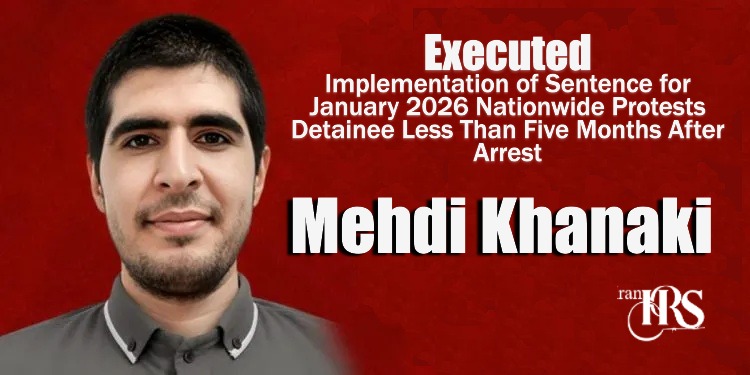
Mizan News Agency reported the execution of Mehdi Khanaki, one of the detainees of the January 2026 nationwide protests. This comes despite the fact that no official information regarding his arrest, trial proceedings, or death sentence had been published prior to this. The execution of this sentence less than five months after his arrest has once again drawn attention to the accelerated pace of judicial proceedings in protest-related cases.

Iran Human Rights Society, Wednesday, July 22, 2026 – Early this morning, Mizan News Agency, affiliated with the judiciary, reported the
execution of Mehdi Khanaki, a detainee from the January 2026 nationwide protests. The official outlet stated that he had been convicted on charges including “membership in illegal groups” (People’s Mojahedin Organization) and participation in the January protests.
The announcement of Mehdi Khanaki’s execution occurred while no prior official reports concerning his arrest, judicial process, or the issuance of his death sentence had been publicly released. This lack of transparency has raised numerous questions regarding the handling of this case.
Key Information | Case of Mehdi Khanaki
| Title | Information |
| Name | Mehdi Khanaki |
| Arrest Date | February 10, 2026 (21 Bahman 1404) |
| Execution Date | July 22, 2026 (31 Tir 1405) |
| Timeframe | Less than 5 months from arrest to execution |
| Arresting Body | FARAJA Intelligence Organization |
| Arrest Location | Personal residence in Karaj |
| Court | Revolutionary Court |
| Primary Allegations | Membership in opposition groups, possession of weapons, explosive materials, and participation in January 2026 protests |
| Primary Sentence | Execution (capital punishment) and confiscation of all property |
Timeline of Proceedings
| Date | Event |
| February 10, 2026 | Arrested at his home in Karaj by intelligence officers. |
| Feb – July 2026 | Trial conducted in the Revolutionary Court without public disclosure of case files or proceedings. |
| July 22, 2026 | Official report by Mizan News Agency confirming the execution of the sentence. |
Background and Arrest Circumstances
According to published information, Mehdi Khanaki was arrested on February 10, 2026, by officers of the FARAJA Intelligence Organization at his personal residence in Karaj.
Following his arrest, his case was brought before the Revolutionary Court. Based on official statements, the court relied on reports from security institutions to try and convict him on charges of “membership in groups opposed to the regime” and “possession of weapons and explosive equipment,” sentencing him to death and confiscation of property.
However, full details regarding the investigation, court hearings, nature of legal defense, and evidentiary documentation have not been made available to the public.
Issuance and Execution of Sentence in Under Five Months
A notable aspect of Mehdi Khanaki’s case is the brief period between his arrest and execution.
Arrested on February 10, 2026, his death sentence was carried out less than five months later. For a case involving capital punishment, this condensed timeline raises critical questions regarding the speed of the judicial process and whether the defendant was afforded full access to his legal rights.
In capital cases, fundamental guarantees of a fair trial require complete procedural adherence, adequate time to prepare a defense, rigorous review of evidence, effective access to chosen legal counsel, and the ability to exhaust all legal appeals. In this instance, information evaluating these components remains unreleased.
Allegations Outlined by Official Outlets
Mizan News Agency claimed that security officers confiscated five handguns, 90 rounds of ammunition, 9 magazines, explosive remotes, 11 improvised grenades, 12 flares, 30 improvised explosive pipes, bombs, explosive junctions, and raw materials for explosives during his arrest in Karaj.
The report further noted that the Revolutionary Court sentenced him to capital punishment and asset confiscation for operational activities benefiting opposition groups, manufacturing explosive devices, and illegal possession of arms and ammunition. To date, the complete text of the verdict and original evidence have not been subjected to independent verification.
Acceleration of Executions
The execution of Mehdi Khanaki comes amid an acceleration in capital punishment cases in recent months, particularly those involving protest activity or security charges.
Human rights bodies often attribute this increase to attempts by authorities to raise the cost of public dissent and create a deterrent environment—a trend that has drawn repeated criticism from UN Special Rapporteurs and international human rights organizations.
Legal Review Based on Domestic Laws
Judicial Considerations
Under domestic legal frameworks, judicial authorities remain bound to observe constitutional guarantees regarding fair procedure, access to counsel, and the presumption of innocence. The brief duration between arrest and execution in this case raises specific legal concerns regarding adherence to statutory safeguards.
Key Constitutional Articles
- Article 32 of the Constitution: Prohibits arbitrary arrest and requires that charges be promptly communicated in writing to the accused.
- Article 34 of the Constitution: Establishes the right to seek justice through competent and accessible courts.
- Article 35 of the Constitution: Guarantees the right of all parties to select legal representation in all courts.
- Article 37 of the Constitution: Affirms the presumption of innocence until guilt is proven in a competent tribunal.
Potential Statutory Non-Compliance
- Expedited trial process concluding in capital punishment within five months.
- Lack of public disclosure regarding arrest, trial proceedings, or verdict prior to execution.
- Uncertainty regarding effective access to legal counsel of choice and adequate defense preparation time.
- Absence of public documentation regarding the independent verification of security reports.
Human Rights Framework
The execution of Mehdi Khanaki also touches upon international legal standards concerning the right to life and fair trial guarantees.
Relevant International Standards
- Article 3, Universal Declaration of Human Rights (UDHR): The right to life, liberty, and security of person.
- Articles 10 & 11, UDHR: The right to a fair and public hearing by an independent, impartial tribunal, and the presumption of innocence.
- Article 6, International Covenant on Civil and Political Rights (ICCPR): Protects the inherent right to life, stipulating that capital punishment—where not abolished—may only be carried out pursuant to a final judgment rendered by a competent court following strict fair trial guarantees.
- Article 14, ICCPR: Guarantees adequate time and facilities for the preparation of defense, right to chosen counsel, and review by a higher tribunal.
See also the below articles:
- Ghezel Hesar Dry Hunger Strike: 1,500 Inmates Escalate Death-Row Protest
- Abolfazl and Alireza Sepahi Execution: Imminent Sentences in Isfahan
Follow Iran Human Rights Society on social networks:
Telegram /Twitter /Instagram / YouTube / Facebook
Join Iran Human Rights Society on Twitter