
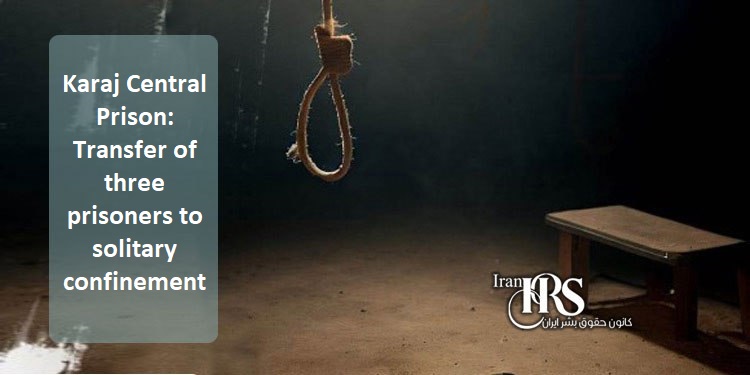
Amid the widespread wave of executions this year, three prisoners in Central Karaj Prison, charged with drug-related offenses, were transferred to solitary confinement. The month of May, with 169 recorded executions, has become one of the bloodiest months in recent times.
Iran Human Rights Society, Sunday, May 24, 2025 – Three prisoners in Central Karaj Prison, named Akbar Ebrahimi, Keram Rahmati (from Ward 4), and Rahim Amiri (from Ward 3), were transferred to solitary confinement on the morning of Sunday, May 24, 2025, for the execution of their death sentences. The charges against them were announced as “drug-related.”
In a deceptive and seemingly “legal” move, prison authorities sent other inmates to the yard before transferring these three prisoners to prevent any resistance. The prisoners were then secretly moved to death row cells. Their families were allowed a final visit on the same day, a bitter tradition signaling the certainty of the execution.
Forced Confession Letters: A Deceptive Tactic to Prove Guilt
A shocking detail reported in this process is the forced writing of “repentance letters” before execution. According to an official directive from the judiciary of the ruling dictatorship, all prisoners sentenced to death for social crimes are required to write repentance letters before their execution. Tragically, these letters are later used as “evidence of guilt” against the prisoners, even if their content is produced under duress, psychological pressure, or threats. This illegal and unethical practice effectively turns the judicial process into a staged farce.
Iran Human Rights Society’s Latest Execution Statistics
Bloody May with 169 Executions
According to human rights organizations, at least 169 prisoners were executed across various Iranian prisons in May 2025 alone, making it one of the bloodiest months in recent years. Human rights experts emphasize that most of these executions are not aimed at delivering justice but rather at instilling fear in society and exacting revenge on marginalized communities.
The majority of executions are related to drug offenses, a direct consequence of poverty, unemployment, systemic corruption, and the regime’s flawed economic policies. In essence, the victims of execution are themselves victims of the regime’s plundering of public wealth. People, driven by dire economic conditions into cycles of crime, ultimately pay the price for high-level corruption with harsh and unjust sentences.
Gross Violations of Human Rights through Issuance and Execution of Death Sentences
The execution of three prisoners in Central Karaj Prison is just one example of a broader wave that has intensified in recent months. Instead of benefiting from justice and social support, people victimized by poverty, corruption, and systemic oppression are silenced through death sentences. Rather than addressing the root causes of crime, the regime prefers to hide its failed policies behind the gallows.
The surge in executions in Iran should serve as a serious alarm for international institutions, human rights organizations, and global public opinion. As long as this trend continues, new names may be added to the list of victims of this death machine every day.
The issuance and execution of death sentences for prisoners charged with offenses like drug-related crimes are clear violations of several articles of the International Covenant on Civil and Political Rights (ICCPR), to which Iran is a signatory:
Article 6 explicitly states that the “right to life” is a fundamental human right, and no one should be arbitrarily deprived of it. Paragraph 2 of this article specifies that in countries where the death penalty has not been abolished, it should only be applied for the “most serious crimes.” However, drug-related offenses are not considered “most serious crimes” under UN standards.
Article 7 prohibits torture, forced confessions, or cruel, inhuman, or degrading treatment. Forcing prisoners to write repentance letters, which may be produced under psychological pressure or threats and later used as evidence against them, clearly violates this article.
Article 14 emphasizes the right to a fair and public trial by a competent, independent, and impartial court. In many execution cases, including those of the prisoners in Karaj today, defendants are denied independent legal representation, trials are held in secretive and securitized environments, and judges act under the influence of security agencies.
Paragraph 3 of Article 14 further stipulates that every accused person is entitled to adequate time and facilities to prepare a defense, the right to remain silent, the right to examine witnesses, and access to free translation and legal consultation services. Ignoring these rights renders judicial proceedings fundamentally illegitimate.
Article 15 refers to the principle of legality of crimes and punishments, stating that no one should be convicted for an act that was not a crime at the time it was committed. In many cases, arbitrary interpretations, vague laws, and lack of clear standards lead to severe and unjust sentences.
Given these articles, it is evident that the issuance and execution of death sentences in Iran, particularly against those accused of social crimes, systematically contradict human rights principles and Iran’s international obligations. Such practices not only tragically take human lives but also undermine the credibility of the judicial system and the legitimacy of the regime both domestically and internationally.
Follow Iran Human Rights society on social networks:
Telegram /Twitter /Instagram / YouTube / Facebook
Join Iran Human Rights Society on Twitter




Discussion about this post