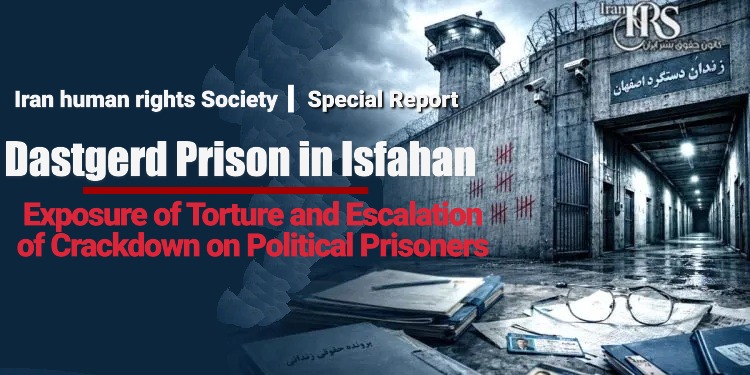
A new report exposes escalating torture, solitary confinement abuse, and severe rights violations at Dastgerd Prison in Isfahan.
Iran human rights Society, Saturday, July 4, 2026 – New reports received from Dastgerd Prison in Isfahan indicate an escalation of torture, organized violence, and degrading treatment of prisoners, particularly political and security prisoners. This report, compiled based on information from informed sources and available testimonies, examines various dimensions of the conditions in solitary confinement cells, detention conditions, the behavior of guards, and the extensive restrictions imposed on prisoners.
Dastgerd Prison: From Bloody Crackdown to Continuous Torture in Solitary Cells
A few days ago, the Iran human rights Society published a report titled “Dastgerd Prison in Isfahan; Exposure of the Massacre and Bloody Crackdown on Prisoners on March 31, 2026,” which investigated the bloody events at this prison. That report detailed the widespread suppression of inmates, the use of extreme violence, and the killing and wounding of a number of prisoners. New information now available to the Iran human rights Society shows that this event was merely part of an ongoing pattern of treatment at Dastgerd Prison. According to this information, violence, torture, humiliation, and the deprivation of prisoners’ basic rights—particularly in solitary confinement cells—remain ongoing and form a part of the daily operational mechanism of this prison.
What Happens in the Solitary Confinement Cells of Dastgerd Prison?
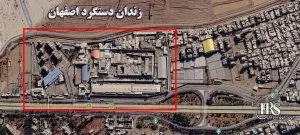
According to received information, the solitary confinement wards of Dastgerd Prison in Isfahan are managed by guards specifically selected and trained for this section. Informed sources state that these guards treat prisoners in a highly violent, humiliating manner, completely disregarding their condition, with the greatest pressure being applied to political and security prisoners.
According to informed sources, guards in these wards have repeatedly beaten prisoners over the slightest pretext and tied them to pillars in the hallways or solitary confinement corridors. These actions have been frequently reported, especially against prisoners who voice protests or make legal requests.
Accounts of Prisoner Torture in Solitary Confinement
According to this report, in some instances, a prisoner’s hands are tied behind their back, and they are then attached to pillars inside the hallway from that position, leaving the prisoner’s body suspended and under extreme physical strain.
Sources state that after blindfolding the prisoner, several guards beat them severely using sticks, batons, punches, and kicks. These blows continue until the prisoner loses consciousness or can no longer stand.
Subsequently, without any medical treatment or examination being provided, the prisoner is returned to their cell, forced to endure the pain from their injuries for hours or even days.
Available reports indicate that as a result of these beatings, some prisoners have suffered bone fractures, severe swelling of limbs, internal bleeding, serious head injuries, and long-term physical complications.
The Role of Intelligence Protection Forces in Inflicting Violence
According to the information received, this behavior is not limited to regular ward guards; in numerous cases, the prison’s Intelligence Protection forces are also present or participate in executing these actions.
Informed sources claim that some of the agents involved in these actions view the infliction of violence against prisoners as part of their organizational duty and consider it commendable behavior—an issue that heightens concerns about the institutionalization of violence in the prison management process.
Deaths of Several Prisoners Under Torture
The report further notes that in some cases, the severity of the beatings was so extreme that prisoners suffered severe bleeding or critical fractures and lost their lives.
According to sources, in such instances, the cause of death is recorded falsely, claiming that the prisoner died during a fight with a cellmate. It is also alleged that by drafting falsified official logs, these cases are closed without any independent investigation into the actual cause of death.
How is the Conduct of Prison Officials Toward Political Prisoners Described?
According to this report, the warden of Dastgerd Prison, named Shirvani, along with certain Intelligence Protection managers, have on numerous occasions observed the condition of prisoners from behind the doors of cells or solitary confinement rooms.
According to sources, during these visits, prisoners demanded their basic rights, including access to fresh air (outdoor time), sunlight, contact and visitation with family, medical services, and investigations into complaints regarding beatings.
However, instead of addressing these demands, prison officials insulted the prisoners using derogatory language. According to the report, expressions such as “Israeli spy,” “Mossad agent,” “traitor,” and “sellout,” along with remarks like “you do not deserve freedom or facilities” or “you must receive harsher punishment,” are among the instances reported by sources.
Mass Arrests Following the December 2025/January 2026 Protests: Overcrowding and Escalating Pressure
According to received information, following the December 2025/January 2026 nationwide protests, a large number of citizens were arrested and transferred to Dastgerd Prison in Isfahan, causing the population of certain wards to significantly exceed their designated capacity. Informed sources state that the overcrowding has reached a level where corridors and even outdoor fresh-air courtyards are being used for the temporary housing of detainees.
This situation, according to sources, has aggravated livelihood, sanitary, and welfare problems for the inmates, severely limiting their access to even the bare minimum necessities of prison life.
New Arrests Based on Forced Confessions
According to this report, the wave of arrests has not stopped even after the end of the protests. Informed sources state that some individuals arrested during the protests were placed under pressure during interrogations to provide information about others, which laid the groundwork for subsequent arrests.
It is also reported that alongside the security and military developments of recent months, other individuals have been arrested on charges such as espionage, propaganda against the state, membership in opposition groups, and connection with Israel, and have been transferred to Dastgerd Prison.
What is the Intake Process Like at Dastgerd Prison?
Based on available information, the first stage of a prisoner’s entry into Dastgerd Prison begins with extensive body searches.
Sources state that upon entry, prisoners are fully searched and, in some cases, forced to strip naked for physical inspections. In addition to manual searches, electronic equipment is used for screening.
Subsequently, all personal belongings, clothing, documents, and mobile phones are confiscated and kept in special storage packages, and a receipt is issued to the prisoner. Following this stage, the prisoner’s personal clothes are replaced with a prison uniform, which sources describe as thin, low-quality, and unsuited for the weather conditions.
Restrictions on Using Personal Clothing
According to this report, prisoners are not allowed to bring extra clothing, underwear, or t-shirts into the ward upon entry, and these items are confiscated. Sources say that even during the cold season, bringing warm clothing at the time of intake is prohibited, forcing the prisoner to spend their first few days solely in the prison uniform.
After recording identification details, fingerprinting, and photographing, the prisoner is transferred to a ward known as “Intake” (Paziresh), which sources describe as one of the most crowded, dilapidated, and chaotic sections of the prison.
The Intake Ward: The Initial Detention Site
According to received information, the Intake ward serves as the initial placement site for many prisoners, and in some cases, political prisoners are forced to spend their entire sentences in this very ward.
A few rooms in this ward are allocated to political and security prisoners, who, according to sources, are constantly monitored by Intelligence Protection forces. Sources also state that the guards’ perspective toward political prisoners is strictly security-oriented, occasionally addressing them as “traitors,” “sellouts,” or “foreign elements.”
Sleeping on the Floor: A Consequence of Overcrowding
One of the issues highlighted in this report is the phenomenon of “floor-sleeping” (Kaf-khwabi). Because the number of prisoners far exceeds the prison’s standard capacity, the number of available beds is insufficient. Consequently, many prisoners are forced to sleep on the floor or spend long hours on the ground. Elderly or sick individuals are not exempt from this restriction, which severely exacerbates physical and psychological strain.
Restrictions on Receiving Warm Clothes
The report also points to restrictions regarding receiving clothing from families. To receive warm clothing, a prisoner must submit a formal request, which can take weeks or even months to process. Even after approval, families are only allowed to deliver a limited number of items under strict specifications (e.g., clothes must not be black, or have zippers, pockets, or specific designs).
The Prison Store and Heavy Financial Costs
The internal prison store, operating under the name “Bahareh,” supplies various clothing items and goods. However, sources state that the prices of these goods are far higher than market rates, and their quality is unsatisfactory. Furthermore, prisoners require a permit to leave their ward to visit the store, which is not always easily issued.
Food Quality and Welfare Conditions
Another critical issue is the low quality of food and the difficulty of accessing basic living items. Informed sources say that the daily food rations do not correspond to the basic nutritional needs of prisoners in terms of volume or quality.
Food is distributed in three meals, but the distribution timing lacks a fixed schedule. This irregularity means that prisoners who are away from their cells or rooms for any reason during distribution are deprived of their limited food and must wait until the next meal.
How are Protesting Prisoners Treated?
Any protest regarding detention conditions, food quality, sanitation, lack of facilities, or the conduct of guards is met with disciplinary and security responses.
Sources state that in numerous instances, prisoners who protested against the conditions were transferred to solitary confinement or faced new judicial cases filed against them. These new cases can pave the way for fresh penalties or an extension of their prison sentences, creating an environment of fear where many refrain from making legal demands.
Legal Review of the Case Based on Domestic Laws
Introduction
In reviewing the legal status of prisons, it must be noted that although parts of the existing criminal and security laws—especially in political and security cases—are consistently criticized by international human rights bodies, prison officials are still obligated under domestic laws to respect prisoners’ legal rights, preserve human dignity, ensure physical and mental health, and implement the regulations of the Prisons Organization.
Legal Ambiguities
Based on published information, claims have been raised regarding beatings, frequent transfers to solitary confinement, deprivation of medical treatment, restrictions on family contact, the opening of new cases due to protests, and substandard detention conditions. If true, an independent judicial review is vital to clarify these aspects.
Related Legal Articles
- Article 22 of the Constitution: The dignity, life, property, and rights of individuals are inviolable except as prescribed by law.
- Article 38 of the Constitution: Any form of torture to extract confessions or obtain information is prohibited.
- Article 39 of the Constitution: Affronts to the dignity and honor of arrested or imprisoned individuals are prohibited and entail legal liability.
- Executive Regulations of the Prisons Organization: Prison officials are obligated to preserve health, ensure sanitation, provide access to treatment, adequate nutrition, and safeguard the dignity of prisoners.
Violations of Law
- Claims of beatings and violent behavior toward prisoners.
- Claims of deprivation of medical services and healthcare.
- Restrictions on access to calls, visitations, and basic facilities.
- Frequent use of solitary confinement or filing new cases in response to prisoner protests.
- Degrading treatment and use of insulting language toward prisoners.
Human Rights Violations Indicated in This Report
If the details presented are accurate, several of the described behaviors conflict with fundamental human rights principles and Iran’s international commitments:
- Article 5 of the Universal Declaration of Human Rights: No one shall be subjected to torture or to cruel, inhuman, or degrading treatment or punishment. (Claims of beatings and violent behavior directly violate this principle).
- Article 10 of the International Covenant on Civil and Political Rights: All persons deprived of their liberty shall be treated with humanity and with respect for the inherent dignity of the human person.
- The Nelson Mandela Rules (Standard Minimum Rules for the Treatment of Prisoners): These rules emphasize the prohibition of torture, access to medical services, adequate nutrition, sanitation, the prohibition of degrading punishments, and respect for prisoners’ dignity.
- Article 12 of the International Covenant on Economic, Social, and Cultural Rights: The right to the highest attainable standard of physical and mental health applies to prisoners as well; depriving them of medical services directly conflicts with this principle.
See also the below articles:
- Amnesty International: Urgent Justice Needed for Iran Protest Victims
- Akbar Bagheri; Halting of Treatment Process Despite Medical Prescription
Follow Iran Human Rights Society on social networks:
Telegram /Twitter /Instagram / YouTube / Facebook
Join Iran Human Rights Society on Twitter