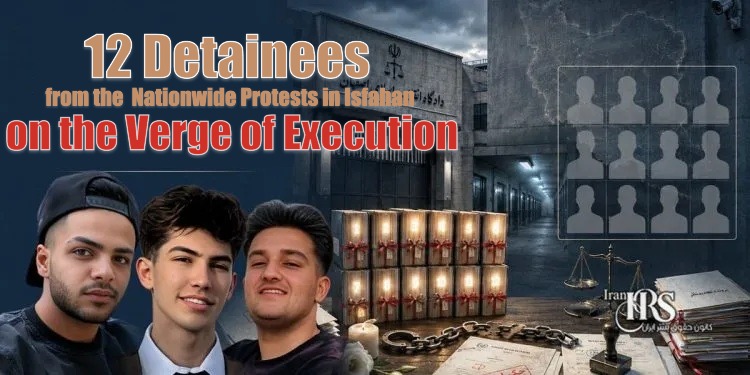
With the confirmation of the death sentences of 12 detainees from the 2025-2026nationwide protests in the case known as the “Alikhani Square” of Isfahan, concerns over the imminent execution of these sentences have escalated. Reports indicate that the defendants were deprived of independent legal counsel and that their lawyers faced restrictions in accessing the case files.
Iran human rights Society, Thursday, July 9, 2026 – The case known as Isfahan’s “Alikhani Square,” which relates to the nationwide protests on January 8, 2026, has entered a new phase. According to published reports, the death sentences of 12 detainees in this case were upheld by the Supreme Court on July 5, 2026, and their files have been forwarded to the Enforcement of Judgments Branch of the Isfahan Revolutionary Court. This development has triggered widespread international concern regarding the imminent risk of execution facing these protesters and the lack of due process in their judicial proceedings.
Information Box | Isfahan’s Alikhani Square Case
| Title | Information |
| Case Name | Alikhani Square of Isfahan |
| Date of Protests | January 8, 2026 |
| Number of Detainees | 59 individuals |
| Sentenced to Death | 12 individuals |
| Sentenced to Imprisonment | 23 individuals (5 to 10 years) |
| Latest Case Status | Death sentences upheld by the Supreme Court |
| Current Stage | Case forwarded to the Enforcement of Judgments of the Isfahan Revolutionary Court |
| Case Prosecutor | Mohammad Nakhjavan |
| Presiding Judges | Mohammad Barati-Dorcheh and Mohammad Tavakoli |
| Primary Concerns Raised | Deprivation of independent counsel, use of court-appointed lawyers, restricted access to files, multiple death sentences for single defendants, young age of several convicts |
How Was the Alikhani Square Case Initiated?
The case known as “Alikhani Square” relates to the events of January 8, 2026, during the nationwide protests in the city of Isfahan. This case was opened following the deaths of four Basij members during the protests, leading security forces to initially arrest at least 59 individuals.
According to published information, in addition to those sentenced to death, 23 other detainees were sentenced to prison terms ranging from five to 10 years, despite reports indicating they played no role in the deaths of the aforementioned individuals.
- Erfan Esfandiari
- Alireza Raeisi
- Shervin Bagherian
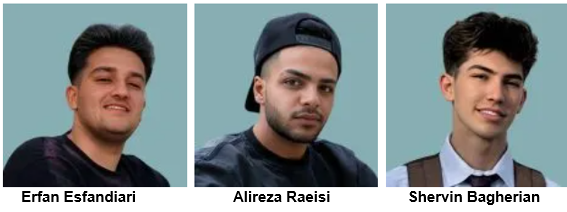
Who Has Been Sentenced to Death in This Case?
According to published reports, 12 individuals are facing the death penalty in this case. Among them, several were born in 2006 and 2007, and some have received more than one death sentence.
The names of the condemned are:
- Alireza Sepahi, 24 years old, four death sentences
- Abolfazl Sepahi, 23 years old, three death sentences
- Ghaem Hosseini, 20 years old, two death sentences
- Gol-Mohammad Mohammadi (Afghan citizen), 23 years old, one death sentence
- Shervin Bagherian, 18 years old, two death sentences
- Erfan Esfandiari, 18 years old, one death sentence
- Amirhossein Safari, 27 years old, one death sentence
- Amirhossein Maleki, 19 years old, one death sentence
- Ali Dashti, 19 years old, one death sentence
- Abolfazl Ebrahimi, 18 years old, one death sentence
- Alireza Raeisi, 21 years old, one death sentence
- Amirhossein Ebrahimi Analoucheh, 19 years old, two death sentences
The issuance of multiple death sentences for single individuals and the young age of several convicts have drawn sharp criticism from human rights activists and international organizations.
Why Has the Risk of Executing the Protesters Escalated?
According to published reports, the sentences of these 12 individuals were upheld by the Supreme Court on July 5, 2026. Following this confirmation, the file was immediately forwarded to the Enforcement of Judgments Branch of the Isfahan Revolutionary Court—a step that dramatically increases the likelihood of imminent executions and has intensified the distress of their families. Human rights defenders have repeatedly warned that in cases linked to nationwide protests, the high speed of processing executions leaves extremely limited windows for domestic legal appeals or international intervention.
What Criticisms Face the Judicial Proceedings?
According to available data, the prosecutor for this case was Mohammad Nakhjavan, and the judicial proceedings were conducted by judges Mohammad Barati-Dorcheh and Mohammad Tavakoli.
Reports indicate that during the initial trial phase, the defendants were completely denied the right to choose independent legal counsel and were tried solely using state-assigned lawyers. Furthermore, informed sources have declared that the defense attorneys were barred from full access to the case files, presenting a major due process violation highlighted by rights groups.
Heavy Sentences for Other Detainees
In addition to those on death row, 23 other detainees in this case received severe prison sentences ranging from five to 10 years. Activists note that the handing down of such heavy sentences in protest-related trials reflects an ongoing pattern of utilizing the judiciary as a tool of repression rather than a venue for fair and objective assessment.
Legal Review of the Case Based on Domestic Laws
Introduction
Before delving into a legal review, it must be noted that many criminal laws within the religious dictatorship—especially regarding political, security, and capital punishment cases—have been condemned by international bodies for violating the right to life, fair trials, and fundamental freedoms. However, even under these domestic frameworks, security and judicial authorities routinely fail to adhere to legal prerequisites, defense rights, and due process protocols.
Legal Ambiguities
The refusal to permit independent legal counsel, the mandatory reliance on state-appointed lawyers, restricted access to evidence files, and the issuance of multiple death sentences per individual constitute the primary legal flaws of this case. Additionally, the young age of several defendants calls for urgent scrutiny of the judicial process.
Related Legal Articles
- Article 32 of the Constitution: Prohibition of detention without legal procedures.
- Article 34 of the Constitution: The right to seek justice for all citizens.
- Article 35 of the Constitution: The right to select a lawyer.
- Article 37 of the Constitution: The presumption of innocence.
- Article 39 of the Constitution: Prohibition of violating the honor and dignity of prisoners and detainees.
Violations of Law
- Deprivation of the right to choose independent counsel.
- Restricted access of lawyers to case files.
- Failure to uphold the right to an effective defense.
- Issuance of multiple death sentences for single defendants.
- Imposition of severe prison terms on other co-defendants without clear evidence of individual culpability.
Human Rights Violations Indicated in This Case
From a human rights perspective, the case of these 12 condemned individuals raises severe alarms regarding the right to life and fair trials. Rights organizations emphasize that when the state seeks the penalty of death, the strict implementation of all fair trial guarantees is an absolute and non-negotiable necessity.
Violated Articles
- Article 3 of the Universal Declaration of Human Rights: The right to life, liberty, and security of person.
- Article 10 of the Universal Declaration of Human Rights: The right to a fair and public hearing.
- Article 14 of the International Covenant on Civil and Political Rights: The right to a fair trial and to legal assistance of one’s own choosing.
- Article 6 of the International Covenant on Civil and Political Rights: Protection of the right to life and strict limitations on the application of capital punishment.
- UN Basic Principles on the Role of Lawyers: The right of all individuals to have access to independent counsel and sufficient means to prepare a defense.
See also the below articles:
- Dastgerd Prison in Isfahan: Exposure of Torture and Political Prisoner Crackdown
- Amnesty International: Urgent Justice Needed for Iran Protest Victims
Follow Iran Human Rights Society on social networks:
Telegram /Twitter /Instagram / YouTube / Facebook
Join Iran Human Rights Society on Twitter