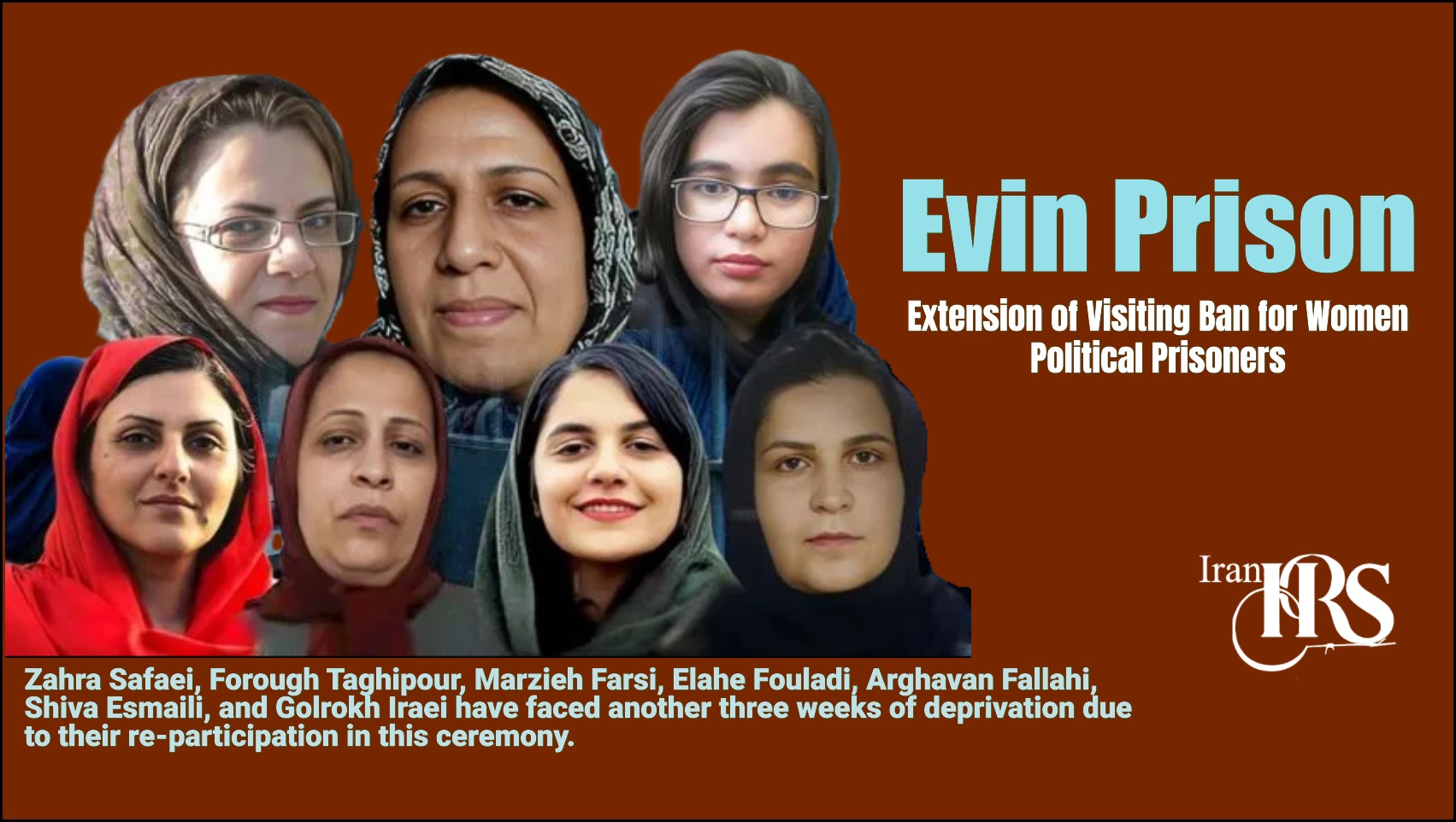
Seven women political prisoners in Evin Prison who had previously been sentenced to three weeks of visiting ban due to participation in the “Tuesdays Against Execution” campaign, faced extension of this punishment after participating again in this ceremony and have now been deprived of family visits for a total of six weeks.
Iran Human Rights Society, Sunday May 10, 2026 – Published reports from Evin Prison indicate intensification of pressure on women political prisoners. According to these reports, Zahra Safaei, Forough Taghipour, Marzieh Farsi, Elahe Fouladi, Arghavan Fallahi, Shiva Esmaili, and Golrokh Iraei, who had previously been sentenced to three weeks of visiting deprivation due to participation in the “Tuesdays Against Execution” campaign, have faced another three weeks of deprivation due to their re-participation in this ceremony. At the same time, dozens of other prisoners have also faced disciplinary punishments only due to presence in the ward yard or observing this ceremony.

Why Were Women Political Prisoners of Evin Deprived of Visits Again?
Based on published reports, Evin Prison officials have extended the visiting deprivation for seven women political prisoners for another three weeks. These prisoners had previously faced visiting ban due to participation in the “Tuesdays Against Execution” campaign.
Informed sources say the reason for extending this deprivation was their re-participation in the protest ceremony, singing, and chanting slogans in support of the “No to Execution” campaign. In this way, the duration of these prisoners’ deprivation from family visits has now reached six weeks.
The names of these prisoners have been announced as Zahra Safaei, Forough Taghipour, Marzieh Farsi, Elahe Fouladi, Arghavan Fallahi, Shiva Esmaili, and Golrokh Iraei.
Which Prisoners in Evin Faced Disciplinary Punishment?
Reports indicate that the pressures were not limited only to these seven women political prisoners. Sources close to the prisoners have announced that all prisoners who were present in the ward yard two weeks ago or even witnessed the protest ceremony have also faced new punishments.
According to these reports, some prisoners have been sentenced to three months of visiting ban only due to observing the songs and slogans, presence in the yard, or even playing volleyball at the time of the ceremony. Also, individuals who only passed by the location or were present on the sidelines of the ceremony have faced disciplinary restrictions.
Human rights activists say such treatments indicate the expansion of collective punishments in prisons and increased pressure on political prisoners.
What Is the “Tuesdays Against Execution” Campaign?
The “Tuesdays Against Execution” campaign is one of the continuous protest forms of political prisoners in various prisons. In this campaign, political prisoners every week on Tuesday declare their opposition to the wave of executions by hunger strike or holding protest ceremonies.
This campaign has become one of the most important symbols of resistance of political prisoners inside prisons over the past two years. Despite security threats, transfer to solitary confinement, and imposition of disciplinary punishments, many political prisoners have still emphasized continuing these protests.
Human rights observers say the severe reaction of prison officials to this campaign indicates the concern of security institutions about the spread of protests inside prisons.
Had Women Political Prisoners Been Threatened Before?
Informed sources have announced that Evin Prison officials had threatened these women political prisoners before implementing the visiting deprivation that if they continued participation in the “Tuesdays Against Execution” campaign, they would face more severe punishments.
According to these reports, threats of transfer to solitary cells, deprivation of contact, and intensification of disciplinary restrictions were among the cases that had previously been notified to these prisoners.
Now the extension of visiting deprivation shows that these threats have entered the implementation stage and prison officials are trying to prevent the continuation of political prisoners’ protests with more pressure.
Why Has Pressure on Political Prisoners Increased After the Start of the War?
Published reports from various prisons show that after the start of the war, pressure on political prisoners has increased. Reduction of phone calls, visiting restrictions, threats of transfer to solitary confinement, and intensification of psychological and security pressures are among the cases that have been reported repeatedly in recent months.
Human rights activists believe that the war atmosphere and security conditions have turned into a tool for further suppression of opponents and limiting protest activities inside prisons. According to them, prison officials are trying to respond to any collective protest or symbolic activity of political prisoners with disciplinary punishments.
Human Rights Violations; Deprivation of Visits and Pressure on Women Political Prisoners in Evin Prison
The case of women political prisoners in Evin Prison is accompanied by serious concerns from a human rights perspective. Extending the visiting deprivation of these prisoners due to participation in the “Tuesdays Against Execution” campaign, imposing collective punishments against other prisoners, and continuous threats of transfer to solitary confinement indicate the intensification of security pressure on political prisoners. Human rights activists warn that using deprivation of visits and limiting prisoners’ communication with family has turned into a tool for applying psychological pressure and silencing protests inside prisons.
Violated Articles:
Violation of the right to freedom of expression and peaceful protest – Article 19 of the Universal Declaration of Human Rights: Punishing prisoners due to participation in protest ceremonies and expressing opposition to executions violates the right to freedom of expression and peaceful protest.
- Violation of the right to benefit from communication with family – United Nations Minimum Standard Rules for the Treatment of Prisoners: Depriving prisoners of visits and contact with family is contrary to the principles of humane treatment of prisoners.
- Violation of the prohibition of inhuman and degrading treatment – Article 5 of the Universal Declaration of Human Rights: Using psychological pressure, threats of solitary confinement, and imposing collective punishments against political prisoners can be considered as examples of inhuman and degrading treatment.
- Violation of the right to liberty and personal security – Article 9 of the International Covenant on Civil and Political Rights: Imposing security restrictions and punishing prisoners due to peaceful protest activity violates their fundamental rights.
- Violation of the right to participate in civil and political activities – International Covenant on Civil and Political Rights: Punishing political prisoners due to participation in protest campaigns violates the right to participate in civil activities and express political views.
See also the below articles:
- Maryam Darisi Sentenced to Prison Again
- Zeinab Mousavi and Her Brother Face Muharebeh Charge in Vakilabad Prison
Follow Iran Human Rights Society on social networks:
Telegram /Twitter /Instagram / YouTube / Facebook
Join Iran Human Rights Society on Twitter