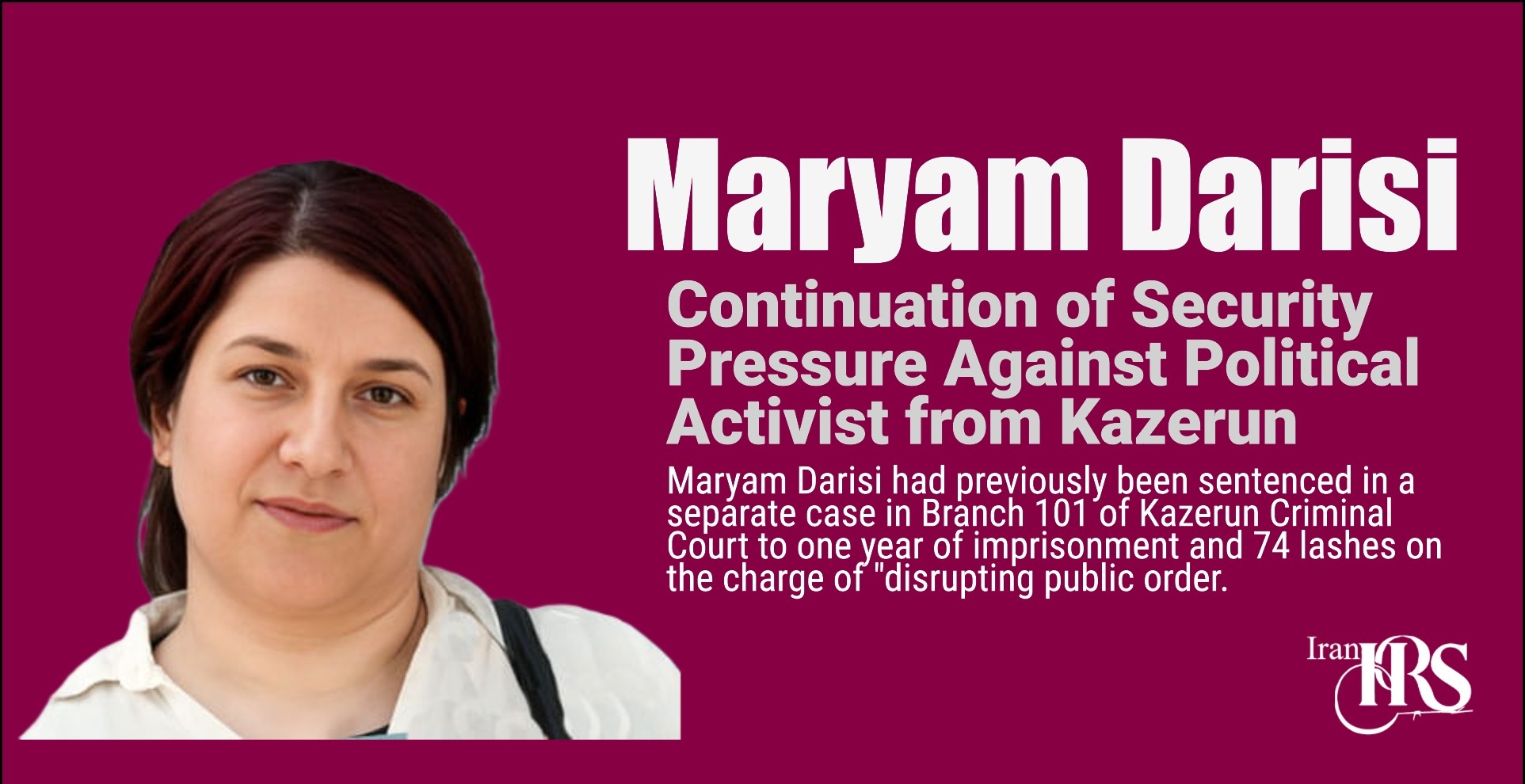
Maryam Darisi, a political activist from Kazerun, was sentenced in a new case in Shiraz Revolutionary Court to one year and three months of ta’ziri imprisonment on the charge of “propaganda against the regime.” She has been arrested, imprisoned, and summoned multiple times in recent years, and now, only a few months after her release from prison, she is facing judicial case-building again.
Iran Human Rights Society, Sunday May 10, 2026 – Based on information received from informed sources, Maryam Darisi, a political activist from Kazerun, has been sentenced to one year and three months of ta’ziri imprisonment following the opening of a new case in Shiraz Revolutionary Court. This ruling was issued on the charge of “propaganda against the regime” and was notified today to her lawyer, Mahmoud Taravat. This ruling is issued at a time when Maryam Darisi has been arrested and imprisoned multiple times in the past years, and only a few months have passed since her release from Adelabad Prison in Shiraz.
Why Was Maryam Darisi Sentenced to Prison Again?

Based on published reports, a branch of Shiraz Revolutionary Court has sentenced Maryam Darisi in a new case to one year and three months of ta’ziri imprisonment on the charge of “propaganda against the regime.” Informed sources say this ruling was issued in continuation of security pressures against her and has increased concerns about the intensification of dealing with political activists and critics.
Maryam Darisi had previously been sentenced in a separate case in Branch 101 of Kazerun Criminal Court to one year of imprisonment and 74 lashes on the charge of “disrupting public order.” The repeated issuance of judicial rulings against her in a short time interval, from the perspective of human rights observers, is a sign of the continuation of the policy of pressure and case-building against political activists.
What Has Been Maryam Darisi’s Arrest Record?
Maryam Darisi has been arrested multiple times by security institutions in recent years. Based on available information, she was arrested on February 14, 2027 by Ministry of Intelligence agents; an arrest that took place in continuation of previous pressures.
She had previously been arrested on October 15, 2022. Maryam Darisi was released on November 02, 2022 after about three weeks of detention by posting bail, but her judicial case continued and a few months later in the same case she was sentenced to 22 months and 17 days of imprisonment.
How Was Maryam Darisi Transferred to Adelabad Prison in Shiraz?
After the finalization of the imprisonment sentence, Maryam Darisi was summoned on August 03, 2024 to serve her sentence and was transferred to Adelabad Prison in Shiraz.
Based on published reports, in mid-January 2025 her ta’ziri imprisonment sentence was converted to open prison (rayi baz) and she was temporarily released from prison. However, this situation did not last long and on March 01, 2025, with the opposition of the prosecutor and the security officer of the case, she was returned again to Adelabad Prison in Shiraz to continue serving her sentence.
Sources close to her family had announced that Maryam Darisi’s return to prison again took place under conditions where she was spending part of her sentence in the form of open prison and there was an expectation of continuing the same process.
Why Was Maryam Darisi’s Release Short-Term?
Maryam Darisi was finally released from Adelabad Prison in Shiraz on September 24, 2025 after completing her sentence period. However, her release lasted only a few months and her re-arrest and case-building against her began again.
Her re-arrest in a short time after release has raised questions about the reasons for the continuation of security pressures against her. Human rights institutions believe that many political prisoners even after release are still under the surveillance and pressure of security institutions and any activity or statement by them can pave the way for the formation of new cases.
Why Are Cases of Political Activists Examined in Revolutionary Courts?
In recent years, a significant portion of cases related to political activists, journalists, and protesters have been examined in revolutionary courts. These courts mainly handle cases related to security charges and have always been criticized by human rights institutions due to lack of transparency, limited access to independent lawyers, and non-public trial proceedings.
Human Rights Violations; Repeated Arrests, Security Pressure, and Violation of Fair Trial
Maryam Darisi’s case is accompanied by serious concerns from a human rights perspective. Her repeated arrests, issuance of multiple judicial cases in a short time interval, and her return to prison again after release have increased concerns about the use of security pressures to limit political activities.
Violated Articles:
Violation of the right to freedom of expression and political activity – Article 19 of the Universal Declaration of Human Rights: Everyone has the right to freedom of opinion and expression. Judicial and security dealing with political and critical activities violates this fundamental right.
Violation of the right to liberty and personal security – Article 9 of the International Covenant on Civil and Political Rights: Repeated arrests accompanied by security pressures and the formation of successive cases violate the right to liberty and personal security.
Violation of the right to a fair trial – Article 10 of the Universal Declaration of Human Rights: Examining the cases of political activists in a security and non-transparent atmosphere calls into question the independence and impartiality of the judicial process and violates the principles of fair trial.
Violation of the right to benefit from an independent trial and effective access to defense – International Covenant on Civil and Political Rights: Examining the case in security courts and continuous pressure on political defendants limits the possibility of benefiting from free and effective defense.
Violation of the prohibition of inhuman treatment and psychological pressure – Article 5 of the Universal Declaration of Human Rights: Successive arrests, security threats, and continuous pressure on political prisoners can be considered as examples of inhuman treatment and a violation of human dignity.
See also the below articles:
- Zeinab Mousavi and Her Brother Face Muharebeh Charge in Vakilabad Prison
- Erfan Shakourzadeh Transfer to Qezelhesar Prison Raises Execution Fears
Follow Iran Human Rights Society on social networks:
Telegram /Twitter /Instagram / YouTube / Facebook
Join Iran Human Rights Society on Twitter