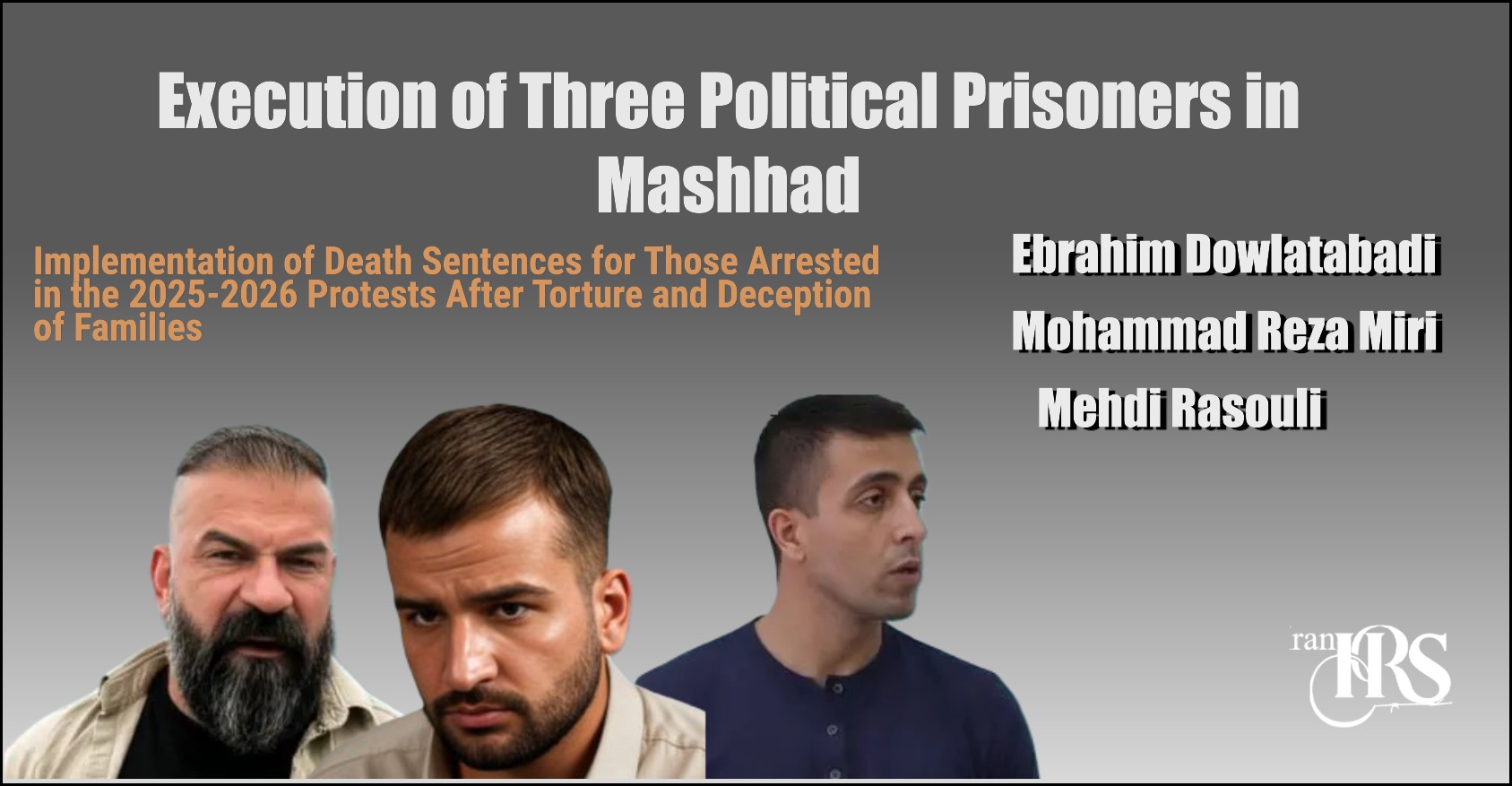
Three political prisoners arrested in the nationwide protests of 2025-2026 were executed at dawn on May 3, 2026 in Vakilabad Prison in Mashhad; sources close to the cases say their sentences were issued and carried out based on forced confessions and after deceiving the families about stopping the execution of the sentence.
Iran Human Rights Society, Monday May 4, 2026 – Three political prisoners arrested in the nationwide protests of 2025-2026 were executed at dawn on Sunday May 3, 2026 in Vakilabad Prison in Mashhad. The execution of Mehdi Rasouli, Mohammad Reza Miri and Ebrahim Dowlatabadi took place while reports indicate that these prisoners had been subjected to torture and pressure to obtain forced confessions and their families had also been forced to silence with the promise of reviewing the case in the amnesty commission.
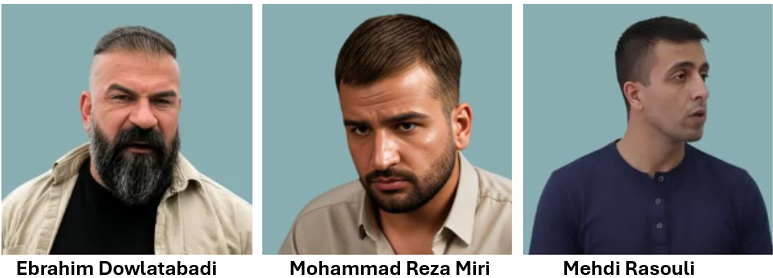
Execution of Three Political Prisoners in Vakilabad Prison in Mashhad
Based on published reports, at dawn on Sunday May 3, 2026 the execution sentence of three political prisoners was carried out in Vakilabad Prison in Mashhad.
The identities of these prisoners have been announced as Mehdi Rasouli 25 years old, Mohammad Reza Miri 21 years old and Ebrahim Dowlatabadi. All three were among those arrested in the nationwide protests of 2025-2026 in the city of Mashhad.
Torture and Forced Confessions at the Center of the Executed Prisoners’ Cases
Sources close to the cases have announced that Mehdi Rasouli had told his relatives before the execution of the sentence that due to severe beatings and torture he had been forced to accept the charges. Based on this information, the confessions obtained under torture had become the most important document cited in his case.
Published reports also show that a similar process existed in the cases of the other executed prisoners and the main documents of the cases were prepared based on confessions obtained under pressure.
Deception of Families with the Promise of Stopping the Execution
Informed sources say that security and judicial institutions had announced to the families of these prisoners that if they refrained from publicizing, there was a possibility of changing the sentence or stopping the execution of the execution.
On this basis, the families had been prevented from public and media informing about the cases. Also, it had been said to the families that the case was under review in the amnesty commission and they should not publicize about it.
Despite these promises, at dawn on the day of the execution of the sentence, the families suddenly became aware of the execution of their children.
Delivery of the Bodies After the Execution of the Sentence
In the morning of Sunday, the families of the executed prisoners became aware of the execution of the sentence. Then around 10 a.m. they were asked to be present at the cemetery.
The bodies of the executed were delivered to their families on the same day. Human rights observers evaluate this process as an example of organized deception of families in political execution cases.
Ebrahim Dowlatabadi; Athlete and Father of Two Children
Ebrahim Dowlatabadi, one of the three executed prisoners, was one of the athletes of the city of Mashhad and the father of two children aged 9 and 14 years.
He was arrested during the nationwide protests of 2025-2026 in Tabarsi Square in Mashhad.
Based on available information, his arrest was carried out by security forces in the last week of January 2026.
After arrest, he was transferred to Vakilabad Prison and Branch One of the Mashhad Revolutionary Court presided over by Gholamreza Akbari-Moghadam sentenced him to execution.
Execution of Those Arrested in the 2025-2026 Protests on the Path of Intensification
The execution of these three political prisoners took place in conditions where the number of cases ending in execution for those arrested in the 2025-2026 protests is on the rise.
In recent months, numerous reports of issuance and implementation of death sentences against political prisoners and protesters have been published.
This trend indicates the intensification of the use of the death penalty in security cases related to protests.
Fear of Protests; Execution as a Tool of Intimidation
Human rights observers and political analysts believe that the increase in political executions in recent months is related to the ruling structure’s concern about the possibility of starting a new wave of protests.
In their opinion, the intensification of the implementation of execution sentences against those arrested in protests is part of the intimidation strategy to prevent the return of street protests.
In this framework, execution is not merely a judicial punishment but a political tool for creating fear in society.
Execution of Three Protesters in Mashhad; Continuation of Political Suppression with the Tool of Death Penalty
The execution of Mehdi Rasouli, Mohammad Reza Miri and Ebrahim Dowlatabadi has once again highlighted the issue of using forced confessions, torture and deception of families in political cases ending in execution. The implementation of these sentences simultaneously with the increase in the execution of political prisoners is evaluated as a sign of the intensification of the use of the death penalty for intimidating society and controlling protests.
Violated Articles:
- Violation of the right to life – Article 3 of the Universal Declaration of Human Rights: Every human being has the right to life, liberty and security of person.
- Violation of the prohibition of torture and forced confession – Article 5 of the Universal Declaration of Human Rights: Obtaining confession under torture for issuing an execution sentence is a fundamental violation of human rights.
- Violation of the right to fair trial – Article 10 of the Universal Declaration of Human Rights: Trial based on forced confessions and without impartial proceedings violates fair trial.
- Violation of the right to the dignity of the family and transparent informing – Fundamental principles of human rights: Deceiving families about stopping the execution of the sentence and late informing violates human dignity and the fundamental rights of the families of the victims.
See also the below articles:
- Deprivation of Female Political Prisoners in Evin Prison from Visits
- Execution of Mehrab Abdollahzadeh in Urmia
Follow Iran Human Rights Society on social networks:
Telegram /Twitter /Instagram / YouTube / Facebook
Join Iran Human Rights Society on Twitter