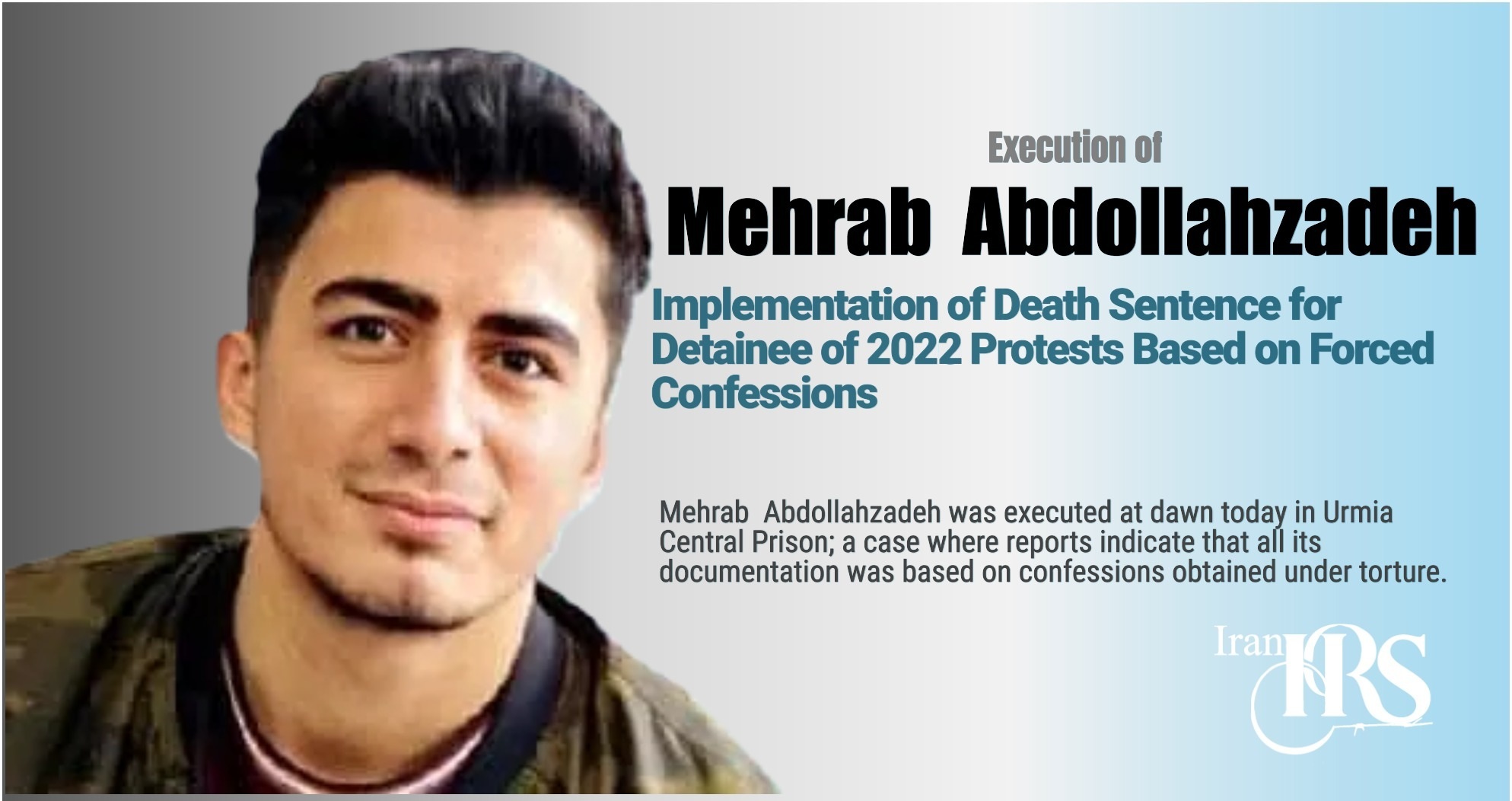
Mehrab Abdollahzadeh, one of the detainees of the nationwide protests of 2022, was executed at dawn today in Urmia Central Prison; a case where reports indicate that all its documentation was based on confessions obtained under torture.
Iran Human Rights Society, Sunday, May 3, 2026 – Mehrab Abdollahzadeh, a detainee of the nationwide protests of 2022, was executed at dawn today in Urmia Central Prison. The implementation of the execution sentence of Mehrab Abdollahzadeh took place while sources close to the case emphasize that all documents and evidence presented against him were formed based on forced confessions obtained under torture, and his requests for examination of independent evidence in the judicial process had been ignored.

Who was Mehrab Abdollahzadeh and how was he arrested?
Mehrab Abdollahzadeh was born on March 15, 1998 in Urmia and was arrested during the nationwide protests of 2022. He was arrested on October 22, 2022 at his workplace by agents of the Islamic Revolutionary Guard Corps Intelligence Organization and transferred to the detention center of this institution.
His arrest took place within the framework of the wave of widespread arrests of protesters following the nationwide protests; a wave that was accompanied by security case-building and issuance of heavy sentences.
38 days of solitary confinement and torture to obtain confession
Based on information published by informed sources, Mehrab Abdollahzadeh was held in solitary confinement in the IRGC Intelligence detention center for 38 days. During this period, he was subjected to intensive interrogations, psychological pressure, and physical torture.
According to sources close to the case, the purpose of these pressures was to force him to accept the charge of participating in the protests and killing a Basij member.
His family was unaware of his place of detention and his condition throughout this period, and he was deprived of the right to contact, visit, and access to a lawyer.
All case documents based on forced confessions obtained under torture
Published reports indicate that all documents of Mehrab Abdollahzadeh’s case were prepared based on confessions obtained during detention and under torture. Sources close to the case have emphasized that no independent, technical, or impartial evidence was presented to prove the charges against him.
In this way, the confessions obtained under torture became the main axis of the case and the basis for issuing the execution sentence.
Ignoring exonerating evidence and rejecting the request for technical examination
Based on available information, Mehrab Abdollahzadeh had denied the charges against him in all stages of interrogation and judicial proceedings. He had requested examination of the location of his mobile phone at the time of the incident to prove his non-presence at the scene.
Also, an informed source has stated that in the existing video from the murder scene that is in the possession of security institutions, no trace of his presence is observed. Despite this, his requests for examination of this evidence in the proceedings were not taken into account.
Process of issuing and confirming the execution sentence of Mehrab Abdollahzadeh
After the end of the interrogations, Mehrab Abdollahzadeh’s case was referred to Branch 7 of the Public and Revolutionary Prosecutor’s Office in Urmia. Then the case with the issuance of the indictment was sent to Branch One of the Urmia Revolutionary Court.
The court, after three trial sessions, issued his execution sentence on September 19, 2024. This sentence was notified to him on October 21, 2024.
The Supreme Court confirmed the execution sentence
After the objection by the lawyers of the case, the issued sentence was referred to the Supreme Court. Branch 9 of the Supreme Court confirmed the execution sentence on December 17, 2025.
Subsequently, Mehrab Abdollahzadeh’s request for retrial in late February 2026 was rejected. With the rejection of the last legal remedies, the ground was prepared for the implementation of the execution sentence.
Increase in executions of political prisoners in the shadow of fear of protests
The execution of Mehrab Abdollahzadeh takes place in conditions where the process of issuing and implementing execution sentences against political prisoners and detainees of protests has noticeably increased.
Human rights observers consider this trend to be part of the ruling structure’s suppression strategy to confront the danger of the spread of social protests. According to analysts, the increase in death sentences in recent months reflects the ruling authorities’ fear of the possibility of starting a new wave of protests in society.
Execution to create fear and control society
Observers believe that the ruling authorities, by intensifying the execution of political prisoners and protesters, are trying to prevent society from entering protests by creating an atmosphere of fear and terror. In this framework, executions are not merely a judicial tool but are considered part of the security mechanism to control public discontent.
Mehrab Abdollahzadeh’s case is also evaluated by observers as an example of the political use of the death penalty to intimidate society.
Execution of Mehrab Abdollahzadeh; Death sentence based on torture and forced confession
The execution of Mehrab Abdollahzadeh was carried out while reports indicate that the process of his arrest, interrogation, and trial was accompanied by torture, forced confessions, and ignoring exonerating evidence. This case, along with the increase in executions of protesters, has intensified concerns about the use of the death penalty for political suppression.
Violated articles:
Violation of the right to life – Article 3 of the Universal Declaration of Human Rights: Everyone has the right to life, liberty and security of person.
Violation of the prohibition of torture and forced confession – Article 5 of the Universal Declaration of Human Rights: Obtaining confession under torture for issuing an execution sentence is a fundamental violation of human rights.
Violation of the right to a fair trial – Article 10 of the Universal Declaration of Human Rights: Ignoring exonerating evidence and lack of impartial proceedings violates fair trial.
Violation of the principle of innocence and the right to defense – Article 11 of the Universal Declaration of Human Rights: Every accused person is presumed innocent until proven guilty according to law and has the right to full defense.
See also the below articles:
- Execution of Nasser Bekrzadeh and Yaqub Karimpour in Urmia Sparks Global Outcry
- Iran Sentences Detainee Mohammad Reza Tabari to Death Following January Protests
Follow Iran Human Rights Society on social networks:
Telegram /Twitter /Instagram / YouTube / Facebook
Join Iran Human Rights Society on Twitter