
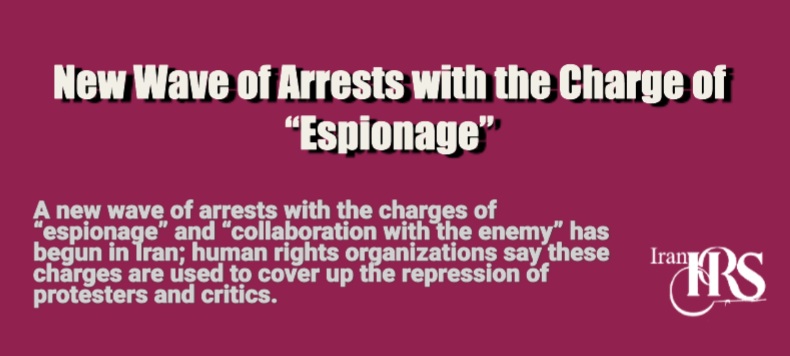
Iran intensifies arrests on espionage charges amid ongoing war and bombardments. Critics, protesters, and minorities face repression, forced confessions, executions, and dual crises of external conflict and internal crackdowns.
Iran Human Rights Society, Saturday, March 21, 2026 – While the country is in a state of war and under bombardment, reports indicate an intensification of arrests, executions, and security pressures inside the country. Human rights organizations and the United Nations Special Rapporteur say that the charge of “espionage” is one of the tools of the government in dealing with critics, protesters, and minorities; a situation that has placed people simultaneously under the pressure of war and internal repression.
United Nations Report on the Increase in Repression
Mai Sato, the United Nations Special Rapporteur on human rights in Iran, in recent days, referring to widespread human rights violations, stated that accusing individuals, especially religious minorities, of “espionage for foreign countries” is one of the common practices of the government in dealing with critics and protesters.
She announced in a session of the United Nations Human Rights Council in Geneva that since the beginning of her mission as Special Rapporteur, the trend of human rights violations in Iran has intensified. In her report, Sato referred to the repression of protesters during the nationwide protests of December 2017 and said that tens of thousands of people, including medical staff and lawyers, have been arrested and forced confessions have been extracted from some of the detainees.
She also criticized the government’s practice of labeling protesters as “terrorists” and accusing religious minorities and critics of espionage, considering this trend as part of the policy of internal repression.
Executions to Create Fear in Wartime Conditions
At the same time, Amnesty International has announced that Iranian authorities are carrying out arbitrary executions to create fear and terror among the people; people who have already been harmed during protests and are now living in war and bombardment conditions.
According to this report, people are facing a wave of executions and repression while being deprived of communication with the outside world due to the internet shutdown. This situation has severely limited the reporting of arrests and repressions.
According to human rights organizations, carrying out executions in such conditions is done with the aim of creating an atmosphere of fear and preventing the formation of protests.
New Wave of Arrests with the Charge of “Espionage”
Meanwhile, security institutions have announced the arrest of dozens of people in various parts of the country on charges of “espionage” and “collaboration with the enemy.” The Ministry of Intelligence announced that it has arrested 97 people on charges of connection with Israel.
Also in another statement, it announced the arrest of 45 people in Qazvin and West Azerbaijan provinces on charges of collaboration with opposition groups. In these statements, it was claimed that some of these individuals were sending information related to military centers.
The Intelligence Organization of Faraja also announced the arrest of six people in Tehran on charges of connection with a terrorist network and stated that weapons and incendiary materials were discovered from these individuals.
At the same time, it has been reported that 71 citizens in various cities including Shahroud, Yazd, Jam, and the provinces of Hormozgan and Khorasan Razavi have been arrested on charges of “espionage.” Also, a video of forced confessions of one of the detainees has been published, the conditions of its recording are unclear.
The Intelligence Organization of the IRGC in Khorasan Razavi also announced the arrest of 10 more people on charges of “espionage.”
Espionage Charge; A Tool for Repression
While security institutions describe these arrests as related to the war and security issues, the United Nations Special Rapporteur and human rights organizations say that the charge of espionage is used in many cases to repress critics, civil activists, and protesters.
According to them, in many cases, detainees are deprived of the right to access a lawyer, and their confessions are taken in unclear conditions and under pressure. The publication of forced confessions is also one of the methods used to legitimize the arrests.
These organizations believe that in wartime conditions, the government, by using the security atmosphere, has intensified arrests and repression, and charges such as espionage, collaboration with the enemy, and acting against national security are used to justify these actions.
People Under Bombardment and Repression Simultaneously
The totality of these reports shows that people in Iran are in a dual situation; on one hand, war and bombardment, and on the other hand, arrests, executions, and internal repression.
Internet shutdown, widespread arrest of citizens, publication of forced confessions, and execution of death sentences are all taking place in conditions where the country is in a state of war and many citizens are facing insecurity, destruction, and crises caused by the war.
Human rights organizations say this situation has caused people to face two crises simultaneously; the crisis of war and the crisis of internal repression.
Human Rights Violations by Government Officials with Intensification of Repression and Arrest of Protesters
In conditions where people are simultaneously facing war and bombardment, as well as internal repression, arrests, and executions; concerns about the intensification of human rights violations in wartime conditions have increased.
- Violation of the right to freedom of expression – Article 19 of the Universal Declaration of Human Rights: Arresting individuals due to media activities, publishing information, or connection with media can be contrary to the right to freedom of expression.
- Violation of the right to liberty and security of person – Article 9 of the International Covenant on Civil and Political Rights: Widespread arrests and detention of individuals without access to a lawyer and information about charges can be considered arbitrary detention.
- Violation of the prohibition of torture – Article 7 of the International Covenant on Civil and Political Rights: Taking forced confessions and broadcasting them can be considered inhuman treatment and torture.
- Violation of the right to a fair trial – Article 14 of the International Covenant on Civil and Political Rights: Lack of access to a lawyer, non-public courts, and reliance on forced confessions are contrary to the principles of a fair trial.
- Violation of the right to life – Article 3 of the Universal Declaration of Human Rights: Carrying out executions in conditions where the fairness of the trial process is in doubt can be considered a violation of the right to life.
Reports published by international organizations and domestic media show that simultaneously with the continuation of the war, a new wave of arrests with espionage charges has begun in Iran. Human rights organizations say these charges are used in many cases to repress critics and protesters.
See also the below articles:
- Increase in Pressures in Karaj Central Prison Amid War Conditions
- Execution of Saleh Mohammadi, Saeed Davoudi, and Mehdi Ghasemi in Iran Amid Nationwide Protests
Follow Iran Human Rights Society on social networks:
Telegram /Twitter /Instagram / YouTube / Facebook
Join Iran Human Rights Society on Twitter






Discussion about this post