Increase in Executions in Recent Months, an Effort by the Regime to Control a Society That Has Shown Its Will for Change and Freedom Through Continuous Protests
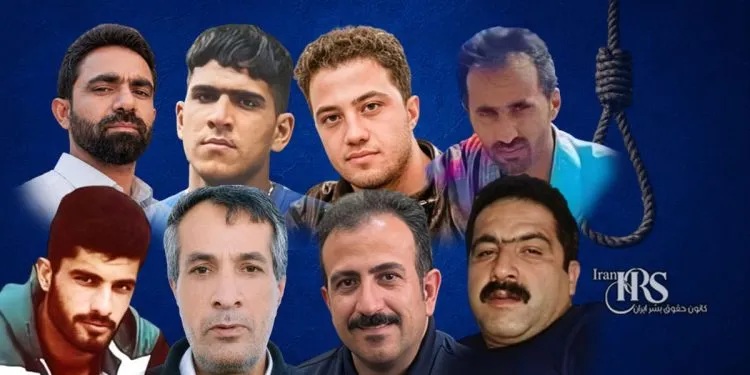
Iran Human Rights Society, Monday 15 June 2026 – Eleven prisoners were executed in the prisons of Isfahan, Shiraz, Ahvaz, Birjand, Kashan, Sanandaj, and Shirvan. Ten of the prisoners were executed in Khordad month and one in Ordibehesht month.
Execution of 2 Prisoners in Birjand Prison
At dawn on Monday 15 June 2026, two prisoners were executed in Birjand prison. The identities of these prisoners are as follows:
- Bilal Sa’adat Jahani, 35 years old, father of 3 children, from Allahabad village of Azadshahr. He was arrested 3 years ago on drug-related charges and sentenced to death.
- Mohammad Amin Narouei, 57 years old, father of 3 children. He was arrested 4 years ago on drug-related charges and sentenced to death.
The execution of these prisoners was carried out without prior notice and without allowing a final visit.
Execution of 3 Prisoners in Isfahan Prison
At dawn on Monday 15 June 2026, three prisoners were executed in Isfahan prison. The identities of these prisoners are as follows:
- Mohammad Reza Gashoul, 49 years old, from Veldan neighborhood of Isfahan, father of 2 daughters. He was arrested 12 years ago on murder charges and sentenced to death.
- Fariborz Jafari, 27 years old, from Khomeini Shahr, who was previously arrested on murder charges and sentenced to death.
- Hamid Reza Afshari, 51 years old, from Fouman, father of 3 children. He was arrested 2 years ago on drug-related charges and sentenced to death.
Execution of Aram Jafari in Sanandaj Prison
In the morning of Monday 15 June 2026, Aram Jafari was executed in Sanandaj prison. He was 44 years old and was arrested one year ago on murder charges and sentenced to death.
Execution of Mohammad Javad Soleimani in Kashan Prison
At dawn on Sunday 14 June 2026, Mohammad Javad Soleimani was executed in Kashan prison. He was 23 years old and was arrested 4 years ago on murder charges and sentenced to death.
Execution of Amin Rajabian in Shirvan Prison
At dawn on Sunday 14 June 2026, Amin Rajabian was executed in Shirvan prison. He was arrested 5 years ago on murder charges and sentenced to death.
Execution of Adnan Mousavi in Sepidar Prison of Ahvaz
In the morning of Sunday 14 June 2026, Adnan Mousavi was executed in Sepidar prison of Ahvaz. He was arrested in 1402 on murder charges and sentenced to death.
Execution of Amir Kafashi in Adelabad Prison of Shiraz
At dawn on Sunday 14 June 2026, Amir Kafashi was executed in Adelabad prison of Shiraz. He was 35 years old and from Shiraz. He was previously arrested on murder charges and sentenced to death.
Execution of Peyman Shah Karami in Dastgerd Prison of Isfahan
At dawn on Wednesday 13 May 2026, Peyman Shah Karami was executed in Dastgerd prison of Isfahan. He was from Khorramabad and was previously arrested on murder charges and sentenced to death.
Execution; A Punishment in Conflict with the Fundamental Right to Life The Right to Life; The Most Fundamental Human Right
Execution as the most severe criminal punishment has always been one of the most controversial issues in the field of human rights. The most important objection to this punishment is its conflict with the right to life as the most fundamental and irreplaceable human right. Article 3 of the Universal Declaration of Human Rights stipulates that “Everyone has the right to life, liberty and security of person.” This principle recognizes the right to life as an inherent and inalienable right for all human beings.
In such a framework, carrying out an execution order means the complete and irreversible deprivation of this fundamental right. Unlike other punishments, if a judicial error occurs, there is no way to compensate for the consequences of carrying out the execution order. The history of judicial systems around the world has also recorded numerous examples of wrongful convictions and the revelation of individuals’ innocence after the execution of the sentence; a matter that has created serious concerns about the continuation of this punishment.
Execution and International Human Rights Commitments
In addition to the right to life, many international institutions believe that execution can also conflict with the prohibition of inhuman and degrading treatment. The psychological effects resulting from the long wait for the execution of the sentence, the conditions of detention of those sentenced to death, and some methods of carrying out this punishment have repeatedly been criticized by rapporteurs and human rights organizations.
On the other hand, Article 6 of the International Covenant on Civil and Political Rights, to which Iran is also a party, emphasizes that even in countries that have not abolished the death penalty, this punishment should only be applied in the most limited possible cases and after full observance of fair trial guarantees. Free access to a lawyer, the right to effective defense, the independence of the court, and the possibility of appellate review are among these guarantees.
In many cases leading to execution, especially political and security cases, human rights institutions have expressed concern about the lack of transparency, restrictions on the defense rights of the accused, and the lack of independent oversight over the trial process. For this reason, the death penalty is still considered one of the most important human rights challenges in the world, and international efforts to limit or completely abolish it continue.
Human Rights Violation; Execution and Deprivation of the Fundamental Right to Life
Issuing and carrying out execution orders from a human rights perspective is considered one of the most serious forms of violation of the right to life. International human rights institutions over the past decades have repeatedly emphasized that the death penalty, due to its irreversible nature, carries the irreparable risk of violating human rights. In cases that are accompanied by judicial ambiguities, restrictions on access to a lawyer, forced confessions, lack of transparency in the trial process, or security pressures, concerns about the violation of fair trial standards are doubled. Therefore, many human rights organizations have called for a halt to the execution of death sentences and movement towards the complete abolition of this punishment.
Violated Articles
Article 3 of the Universal Declaration of Human Rights: The right to life, liberty and security of person. Carrying out an execution order means the complete and irreversible deprivation of the right to life.
Article 5 of the Universal Declaration of Human Rights: Prohibition of torture and cruel, inhuman or degrading treatment or punishment. The conditions of detention of those sentenced to death and the psychological effects of waiting for the execution of the sentence can conflict with this principle.
Article 10 of the Universal Declaration of Human Rights: The right to a fair and public trial. In cases leading to execution, full observance of fair trial guarantees is necessary.
Article 6 of the International Covenant on Civil and Political Rights: The inherent right of every human being to life. This article emphasizes that the death penalty should only be applied in the most limited cases and with full observance of fair trial standards.
Article 14 of the International Covenant on Civil and Political Rights: The right to a fair trial, access to a lawyer, and the possibility of effective defense. Any restriction on these rights casts doubt on the legitimacy of sentences leading to execution.
United Nations General Assembly Resolutions on Halting Executions: The international community has repeatedly called on governments to suspend the execution of death sentences and prepare the ground for the complete abolition of this punishment.
See also the below articles:
- Ali Kamali; Transfer of the Prisoner Sentenced to Execution to Qezelhesar, Concerns about the Danger of Executing the Sentence Have Increased
- Legal Ambiguities in Armin Nourmohammadi Execution Sentence
Follow Iran Human Rights Society on social networks:
Telegram /Twitter /Instagram / YouTube / Facebook
Join Iran Human Rights Society on Twitter