
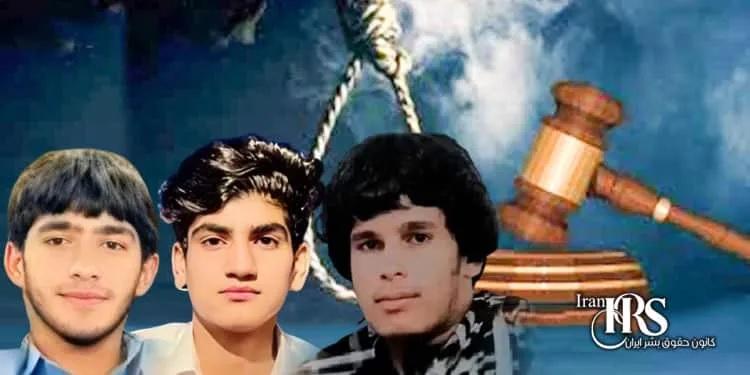

Iran Human Rights Society, Thursday, June 19, 2025 – According to reliable reports, on Monday, June 16, 2025, the Zahedan Revolutionary Court sentenced Mohammad Darvish Naroui and Yasin Kabdani, two detainees from the 2022 nationwide protests, to death on charges of “Moharebeh” (waging war against God) and “corruption on earth.” In the same case, Benjamin Kouhkan, a Baluch teenager, was transferred to quarantine in prison, and no information about his status or fate has been available since.
Death Sentences Without Fair Trial
An informed source told human rights networks: “On Monday, June 16, Yasin, Mohammad Darvish, and Benjamin Kouhkan were transferred from prison to court. The final hearing of their case was held that day, and two of them were sentenced to death.” The source added: “After the court session, Benjamin Kouhkan was transferred from the juvenile rehabilitation ward to quarantine. Since then, there has been no contact or news about him, and his family remains in complete uncertainty. No official sentence has been announced for Benjamin thus far.”
The charges against these three detainees from the 2022 protests include “Moharebeh” and “corruption on earth,” accusations frequently used in Iran’s judicial system without sufficient evidence and often based solely on confessions obtained under torture.
Arrest and Torture of 2022 Protest Detainees

Yasin Kabdani, born April 19, 2004, from Zahedan, was arrested on January 6, 2023, along with his father while traveling to Kerman. His father was released the next day, but Yasin remained in detention and was subjected to severe physical and psychological pressure.
Mohammad Darvish Naroui, 21, also from Zahedan, was arrested on the same date. His case was hastily closed in January 2024 without sufficient evidence, resulting in a heavy sentence.
Benjamin Kouhkan, who was only 16 at the time of his arrest, is another victim in this case. He has been subjected to severe physical, psychological, and sexual torture since his detention. This teenager was repeatedly coerced into making forced confessions under inhumane conditions. In November 2023, Benjamin was transferred to a forensic medical examination to assess his mental age in an irregular and legally questionable manner. Additionally, in October 2023, he, along with Edris Kouhkan and Zabihollah Kouhkan, was taken to the Zahedan Intelligence Agency and subjected to brutal torture to extract further forced confessions.
A Case Riddled with Legal Violations
Yasin Kabdani had previously been sentenced to 15 years in prison, a ruling sent to the Supreme Court for review after his appeal. However, judicial authorities issued a new death sentence in a separate case. Throughout these proceedings, the Zahedan Intelligence Agency obstructed a fair trial by pressuring and repeatedly threatening the detainees’ families. Yasin’s requests for furlough have been consistently denied, and the Ministry of Intelligence has relied on forced confessions without presenting credible evidence to charge the detainees with “Moharebeh.”
Notably, Yasin Kabdani’s legal representation was taken up by Michael Sukkar, a member of the Australian Parliament, but Iran’s judiciary does not recognize this representation.
Benjamin Kouhkan’s Denial of Murder Charges
Benjamin Kouhkan has repeatedly denied the murder charge attributed to him, stating that he was forced to confess under severe and inhumane torture. Even the victim’s family has not confirmed the murder accusation against Benjamin. However, the Zahedan Intelligence Agency has pressured the victim’s family, conditioning the payment of blood money on their filing a complaint against Benjamin and two of his relatives, Edris and Zabihollah Kouhkan. The authorities have further threatened the family with arrest for “collaboration in murder” if they do not comply.
Widespread Human Rights and Children’s Rights Violations
This case is a clear example of human rights violations and gross breaches of children’s rights in Iran. Under the Convention on the Rights of the Child, any detention, torture, or issuance of heavy sentences for individuals under 18 is prohibited. Furthermore, using confessions obtained under torture, particularly to issue death sentences, violates Article 7 of the International Covenant on Civil and Political Rights (ICCPR), to which Iran is a signatory. In this case:
The prohibition of torture (Article 5 of the Universal Declaration of Human Rights) has been violated.
The right to a chosen lawyer (Article 14 of the ICCPR) has not been upheld.
The right to a fair and impartial trial has been disregarded.
The principle of special protection for children in judicial processes has been ignored.
These violations, alongside the widespread detention of teenagers and protesters from the 2022 protests, further expose the repressive nature of the ruling dictatorship’s judiciary and its blatant disregard for fundamental human rights principles.
Amid growing concerns about the fate of Benjamin Kouhkan and other detained teenagers, the European Union, at the UN Human Rights Council, has called for an immediate halt to the execution of death sentences and an independent, impartial investigation of these cases by international bodies.
Follow Iran Human Rights Society on social networks:
Telegram /Twitter /Instagram / YouTube / Facebook
Join Iran Human Rights Society on Twitter





Discussion about this post