
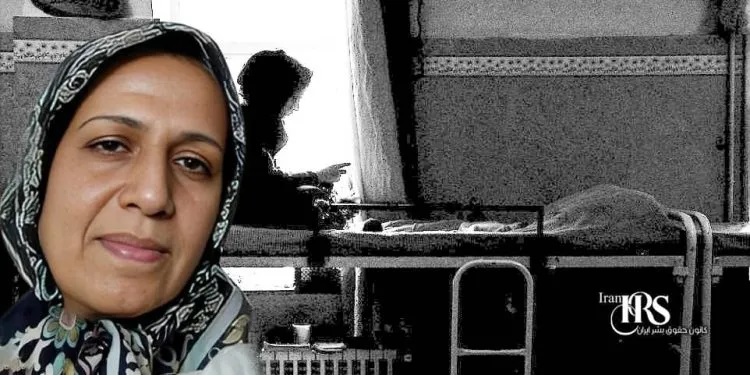
Shiva Esmaeili, a political prisoner in Evin Prison, has been deprived of phone contact with her children due to her support for the “No to Execution Tuesdays” campaign. This action exemplifies the escalating pressures on political prisoners and human rights violations in Iran.
Iran Human Rights Society, June 8, 2025 – Amid intensifying security pressures on political prisoners, Shiva Esmaeili, held in the women’s ward of Evin Prison, has been barred from contacting her children by direct order of prison chief Heidayatollah Farzadi. According to an informed source, this deprivation was imposed due to her support for the protest campaign “No to Execution Tuesdays.”
Esmaeili’s sons, Seyed Mehdi Vafaei Sani and Seyed Alireza Vafaei Sani, are also imprisoned, serving sentences in Ward 8 of Evin Prison. Seyed Mehdi faces a 6-year sentence, and Seyed Alireza a 5-year sentence, both convicted on political charges. This restriction has now stripped the imprisoned mother of her fundamental human right to communicate with her children.
Background of Shiva Esmaeili’s Arrest and Conviction

Shiva Esmaeili, born in 1965, a retired agricultural engineer from Tehran, was arrested in November 2020 for political reasons without legal transparency. After months of uncertainty, on May 14, 2023, Branch 26 of the Tehran Revolutionary Court, presided over by Judge Iman Afshari, sentenced her to 10 years in prison on charges of “assembly and collusion to act against national security.” The verdict was issued without a defense lawyer and formally notified to her on May 28, 2023.
Since her detention, Esmaeili has repeatedly been denied phone calls, in-person visits, and access to basic services like medical care or counseling. Her support for the “No to Execution Tuesdays” campaign has now become a pretext for further intensified pressures.
“No to Execution Tuesdays” Campaign: A Voice Facing Suppression
The “No to Execution Tuesdays” campaign is a growing grassroots movement protesting Iran’s repressive execution policies. Prisoners like Shiva Esmaeili, who have voiced support for this campaign from within prison, face escalating deprivations, stricter restrictions, and additional punishments.
Depriving political prisoners of basic rights, particularly in response to their protest activities, underscores the Iranian judicial-security system’s fear of even the smallest expressions of dissent, both inside and outside prison walls.
Systematic Human Rights Violations and Added Pressure on Female Prisoners
Shiva Esmaeili’s denial of contact with her children is just one example of the pressures faced by female political prisoners in Evin Prison. Numerous reports indicate that women prisoners face compounded restrictions, denial of visits, phone calls, furloughs, and psychological harassment due to their civic activities, participation in protests, or support for protest movements.
These conditions, combined with the harsh physical and psychological environment in the women’s ward of Evin Prison, are effectively used as tools to break the spirit of resistance among these women.
Human Rights Violations in Depriving Shiva Esmaeili of Basic Prisoner Rights
The treatment of Shiva Esmaeili and her sons exemplifies the violation of political prisoners’ and their families’ fundamental rights, which must be respected under international law. Denying a mother contact with her children violates Article 10 of the International Covenant on Civil and Political Rights (ICCPR), which mandates humane treatment of prisoners, and Article 17, which prohibits arbitrary interference in private life.
Moreover, issuing a 10-year sentence without a defense lawyer blatantly violates Article 14 of the ICCPR, which guarantees the right to a fair trial. Pressuring prisoners to refrain from expressing opinions or supporting protest campaigns violates Article 19, which protects freedom of expression.
Shiva Esmaeili’s deprivation of contact with her children once again exposes the ruthless face of repression within Iran’s prisons. While the “No to Execution Tuesdays” campaign seeks to peacefully protest the inhumane and politicized use of executions, the security-judicial system responds to even this level of resistance with “white torture.” Silence in the face of such violations only paves the way for further violence.
Follow Iran Human Rights Society on social networks:
Telegram /Twitter /Instagram / YouTube / Facebook
Join Iran Human Rights Society on Twitter






Discussion about this post