
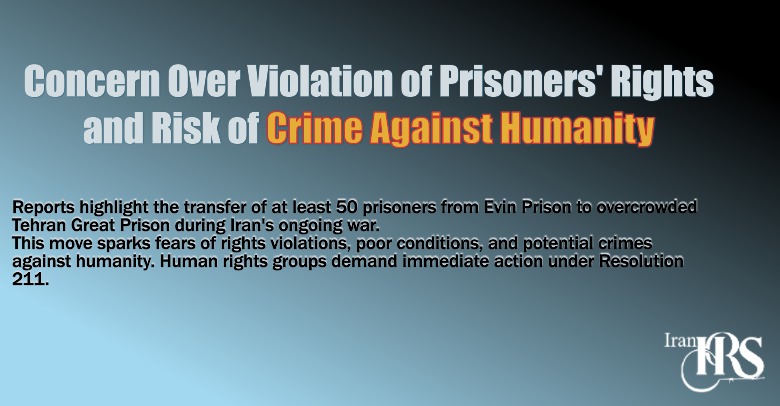
Reports indicate the transfer of at least 50 prisoners from Evin Prison to Tehran Great Prison under wartime conditions; this action has taken place while this prison faces severe overcrowding, food shortages, and poor sanitary conditions. Human rights activists, referring to Resolution 211 and Amnesty International warnings, have demanded the immediate release of prisoners.
Iran Human Rights Society, Sunday, Sunday, March 8, 2026 – While Iran is in a state of war and concerns about the security of prisons have increased, reports indicate the transfer of at least 50 prisoners from Evin Prison to Tehran Great Prison. This action has occurred at a time when various sources report a critical situation, severe overcrowding, and lack of facilities in Tehran Great Prison. At the same time, human rights organizations have warned that continuing to hold prisoners in such conditions could lead to serious human rights violations and even constitute a crime against humanity.
Transfer of Prisoners from Evin Amid War
According to reports received from inside Iran, at least 50 prisoners have been transferred from Evin Prison to Tehran Great Prison. According to an informed source, one of the prisoners held in Hall 2 of Evin Prison was summoned by prison officials and told to go to the office for “matters related to leave.” Afterward, the ward lawyer told this prisoner to collect his belongings and clothes. But it later became clear that these individuals were not taken out of Evin for leave, but for transfer to Tehran Great Prison.
This transfer has taken place while the country is in a state of war and concerns about the security of prisoners have sharply increased. Human rights activists say that transferring prisoners in such conditions, without providing the necessary facilities for their safety and health, is a very dangerous action.
“Catastrophic” Conditions in Tehran Great Prison
Reports from Tehran Great Prison indicate difficult and humanitarian crisis conditions in this prison. Informed sources say this prison is facing severe overcrowding and a large number of prisoners are forced to sleep in corridors and hallways due to lack of space. According to these reports, the sanitary condition of the prison is also very poor and prisoners face a shortage of basic facilities. Some sources have reported shortages of drinking water, medical facilities, and food. It has also been reported that the food distributed in the prison on Wednesday caused poisoning of a number of prisoners. This issue has increased concerns about the quality of food and the health of prisoners. On the other hand, the prison store of Tehran Great Prison, which had been closed for about a week, has recently reopened. However, its reopening has also been accompanied by long queues of prisoners to buy food and basic necessities.
Concern of Prisoners’ Families
Following the publication of the news of the prisoners’ transfer, the concern of families has also increased. According to reports, on Saturday about 500 people from the families of prisoners went to Tehran Great Prison to find out about the condition of their loved ones. According to informed sources, prison officials told the families to wait 48 hours so that “actions” could be taken to address the prisoners’ situation. However, the lack of transparent information about the prisoners’ condition has increased the families’ concern. Families are also worried that transferring prisoners to Tehran Great Prison, which is known as one of the worst prisons in Iran, will make their detention conditions more difficult.
Resolution 211; Legal Obligation in Wartime Conditions
In such conditions, jurists refer to Resolution No. 211 of the Supreme Judicial Council. This resolution, approved on 12 January 1987, is dedicated to emergency conditions resulting from war. According to this resolution, the judiciary is obliged to take action to preserve the lives of prisoners. These actions can include converting the type of bail, granting conditional release, accepting bail or guarantee, and also transferring prisoners to safe places. It is also stipulated in this resolution that if usual measures are insufficient, prosecutor’s offices can proceed with the temporary release of non-dangerous prisoners until the emergency situation is lifted. Legal experts emphasize that in wartime conditions, the implementation of this resolution is not an option, but a legal obligation for the judicial system.
Warning About the Risk of Crime Against Humanity
Human rights organizations have warned that continuing to hold prisoners in prisons that are at risk of military attacks can have serious consequences.
According to international human rights standards, governments are obliged to protect the lives of individuals in their custody. In wartime conditions, this responsibility becomes even heavier, because prisoners have no possibility to leave the place of danger or take shelter.
Human rights activists emphasize that keeping prisoners in such conditions, while there is the possibility of their temporary release, can be considered a deliberate action to endanger people’s lives and even pave the way for a crime against humanity.
Amnesty International’s Call for Immediate Action
In this regard, Amnesty International has also warned about the situation of prisoners in Iran. This organization has stated that prisoners in wartime conditions are at serious risk and Iranian authorities must immediately take measures to protect their lives. Amnesty International has called for the immediate release of all arbitrarily detained prisoners and also the granting of humanitarian release to other prisoners, especially sick prisoners and vulnerable individuals. According to this organization, transferring prisoners to other prisons without providing safe conditions not only does not solve the problem but can create greater risks to their lives.
Increasing Concerns About the Fate of Prisoners
In total, the transfer of prisoners from Evin Prison to Tehran Great Prison while the country is engaged in war has created widespread concerns among families and human rights organizations. Human rights activists emphasize that in such conditions, the main priority should be preserving the lives of prisoners. They believe that implementing Resolution 211 and releasing prisoners, especially political prisoners and sick individuals, can prevent a humanitarian disaster. With the continuation of the war and the increase in security risks, the fate of thousands of prisoners in Iran’s prisons remains shrouded in ambiguity and calls for immediate action for their release are increasing.
Violation of Human Rights in the Transfer of Prisoners to Tehran Great Prison
The reported situation regarding the transfer of prisoners from Evin to Tehran Great Prison in wartime conditions can be in conflict with fundamental human rights principles.
- Violation of the Right to Life – Article 3 of the Universal Declaration of Human Rights: Holding prisoners in prisons that are at risk of military attacks, without taking protective measures or temporary release, can place their lives in direct danger.
- Violation of the Right to Humane Conditions of Detention – Mandela Rules: Severe overcrowding, prisoners sleeping in corridors, food shortages, and poor sanitary conditions are contrary to the minimum international standards for the treatment of prisoners.
- Violation of the Right to Access Health and Adequate Nutrition – Mandela Rules and Article 12 of the International Covenant on Economic, Social and Cultural Rights: Reports of food poisoning and lack of medical facilities in Tehran Great Prison can indicate a violation of prisoners’ right to medical services and healthy food.
- Violation of the Right to Personal Security – Article 9 of the International Covenant on Civil and Political Rights: Transferring prisoners in wartime conditions to a prison with a critical situation, without providing safe conditions, can create a serious threat to their security and health.
- Violation of Legal Obligation in Emergency Conditions – Resolution 211 of the Supreme Judicial Council: Failure to implement legal measures for the temporary release of non-dangerous prisoners or their transfer to safe locations in wartime conditions can be considered a violation of the judicial system’s legal obligations.
Given the continuation of wartime conditions and the transfer of prisoners to prisons with critical situations, concerns about the security and health of prisoners and the possibility of a humanitarian crisis in prisons have increased.
See also the below articles:
- Critical Situation in Qarchak Prison; Shortage of Drinking Water and Prisoners’ Uncertainty in the Shadow of War
- Critical Situation in Tehran Great Prison (Fashafuyeh) Amid War and Food Shortages
Follow Iran Human Rights Society on social networks:
Telegram /Twitter /Instagram / YouTube / Facebook
Join Iran Human Rights Society on Twitter







Discussion about this post