
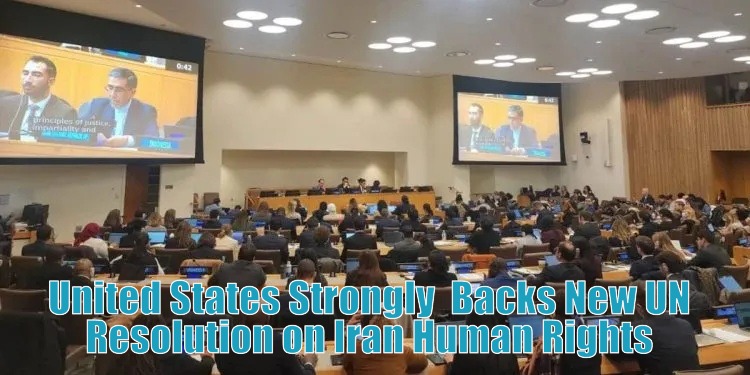
The resolution refers to the UN Special Rapporteur’s report from July 2024, in which political executions over the past three decades were described as “constituting crimes against humanity and genocide.”
Iran Human Rights Society, Tuesday, December 2, 2025 – The United States Department of State issued a statement on X welcoming the adoption of the resolution titled “Situation of human rights in the Islamic Republic of Iran” by the Third Committee of the United Nations General Assembly. The statement emphasized that the United States, along with 78 other countries, voted in favor of the resolution to highlight and condemn the unrestrained repression and widespread executions carried out by the dictatorial regime in Iran against its own citizens. The U.S. State Department described this support as evidence of the “long-standing U.S. commitment to standing with the people of Iran.”
On Wednesday, November 19, the Third Committee of the UN General Assembly adopted a resolution condemning human rights violations in Iran with 79 votes in favor, 28 against, and 63 abstentions. The resolution, introduced by Canada, criticized numerous instances of human rights abuses in Iran. The sharp rise in executions, violations of women’s rights, suppression of protesters, and restrictions on civil liberties were among the main focuses of the resolution.
Serious Concern Over Restrictions on Fundamental Freedoms

The resolution expressed grave concern over restrictions on fundamental freedoms such as freedom of expression, assembly, and civic participation, and highlighted increased pressure by security institutions on activists, journalists, and ethnic and religious groups. Numerous reports of issuance and execution of death sentences—particularly in cases where international fair trial standards are not observed—were assessed as evidence of structural violations of citizens’ fundamental rights.
The resolution stressed the obligation of the leaders of the dictatorial regime in Iran to uphold their international human rights commitments, called for fair trials and the establishment of transparent mechanisms for independent investigation of violations, and urged the regime’s leaders to end all forms of state violence and repression and to cease retaliatory measures against human rights defenders and activists.
Reference to Crimes Against Humanity and the Role of Regime Leaders
The resolution cited the July 2024 report of the UN Special Rapporteur, which described political executions over the past three decades as “constituting crimes against humanity and genocide” and emphasized that many officials involved in those crimes continue to hold senior government positions. This has led numerous opposition organizations to warn about the continued role of high-ranking officials in repression and the systematic use of executions, and to call for international prosecution of these cases.
Political Significance of the Resolution and the Path Ahead
Although the resolution is not legally binding, it serves as an important legal basis for international follow-up actions, judicial proceedings, and requests to refer the matter to the Security Council. Human rights organizations regard this step as significant in formally documenting four decades of human rights violations in Iran. While regime leaders routinely dismiss such reports as politically motivated, the broad international support demonstrates that the human rights situation in Iran has entered a new and more serious phase—one that has drawn unprecedented global attention and elevated the documentation of human rights abuses to an unprecedented level.
Ongoing Human Rights Violations by the Dictatorial Regime in Iran
The execution of death sentences and suppression of activists are clear examples of violations of fundamental human rights. Some of the laws and their violations are listed below:
- § Execution of unlawful death sentences: Issuing and carrying out death sentences without adherence to international fair trial standards threatens citizens’ right to life.
- § Restrictions on freedom of expression and assembly: Arresting civil activists, journalists, and protesters, and restricting freedom of assembly and expression, constitute clear violations of citizens’ basic rights.
- § Suppression of ethnic and religious minorities: Systematic pressure and violence against ethnic and religious groups result in ongoing human rights violations and instill fear in society.
- § Arrest and intimidation of human rights defenders: Threatening and detaining human rights defenders, along with denial of fair trials, represent systematic human rights abuses in Iran.
The resolution, aimed at highlighting violations of fundamental rights, calls on the international community to hold the dictatorial regime accountable to its international obligations and to refrain from using execution and repression as tools to maintain power.
See also the below articles:
- Fatemeh Ziaei Azad’s Health Crisis Worsens: Ill Political Prisoner Faces Imminent Danger in Iranian Prison
- Iran’s Alarming Execution Surge: 9 Prisoners Hanged Across 7 Prisons
Follow Iran Human Rights Society on social networks:
Telegram /Twitter /Instagram / YouTube / Facebook
Join Iran Human Rights Society on Twitter




Discussion about this post