
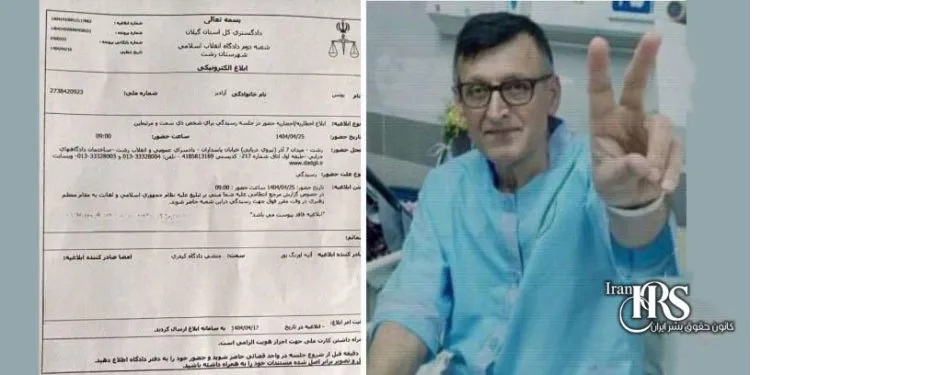
Yunes Azadbar, a retired activist, faces court in Rasht for dissent. Iran’s regime intensifies human rights violations, targeting his health and freedom.
Iran Human Rights Society, Wednesday, July 9, 2025– Yunes Azadbar, a prominent retired activist and former political prisoner, faces another court summons, exposing Iran’s relentless suppression of dissent. On July 16, 2025, Azadbar must appear at Branch 2 of the Rasht Revolutionary Court, confronting charges of “propaganda against the regime” and “insulting Khamenei.” These accusations highlight the regime’s targeting of activists. Despite his fragile health, Azadbar boldly advocates for retirees’ rights, making him a key target for Iran’s repressive judiciary. This article examines his struggle and Iran’s broader human rights violations.

Deteriorating Health Amid Detention and Inhumane Conditions
Azadbar’s health remains critical. He suffers from severe heart disease and epilepsy, worsened by past torture, and relies on a pacemaker. In May 2025, authorities confined him in a 70-square-meter cell with 50 prisoners, many using drugs and tobacco. This environment endangered his life, given his medical conditions. Previously, he secured release on an 8 billion toman bail, a tactic the regime uses to burden activists financially. Denying him proper medical care during detention violates global human rights standards.
Repeated Detentions and Persistent Pressure: A Four-Decade Tale of Resistance
Authorities charge Azadbar with “propaganda against the regime” and “insulting Khamenei,” vague accusations often used to silence dissidents. His leadership in Rasht’s Social Security retirees’ protests has made him a resistance symbol. Despite health struggles, Azadbar demands better conditions for retirees, defying security threats. The Rasht Revolutionary Court’s actions reflect a wider strategy to crush dissent through judicial intimidation, a practice human rights groups frequently condemn.
The Voice of Retirees
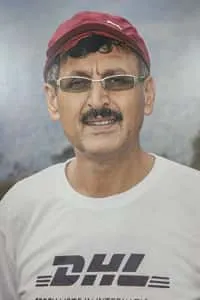
Yunes Azadbar was a prominent figure in the protest gatherings of Social Security retirees in Rasht. Despite his dire health, he consistently took to the streets to demand the rights of his peers, refusing to remain silent despite security threats.
A survivor of Iran’s bloody 1980s, Azadbar spent over 12 years in the regime’s prisons. His persistent presence in protests has once again made him a target of fabricated charges and pressure.
International Responsibility and the Prospect of Ongoing Repression
Yunes Azadbar’s renewed summons to the Rasht Revolutionary Court is part of the regime’s systematic and targeted project to suppress structural dissent—a project that employs security institutions and the judiciary to silence every voice of demand and protest.
Given his critical health condition and advanced age, his life is in serious danger. The responsibility for preserving his health and life lies with the regime’s authorities and security institutions, which have institutionalized human rights violations through repeated repressive tactics.
Human Rights Violations: A Documented List of Breaches Based on International Covenants
The treatment of Yunes Azadbar reveals multiple documented instances of human rights violations, each constituting a breach of Iran’s international obligations:
– Violation of Freedom of Expression (Article 19, ICCPR): His summons and prosecution for expressing views on the regime’s performance clearly violate the right to freedom of thought and expression.
– Violation of the Right to Health and Medical Care (Article 12, ICESCR): Detaining an individual with heart disease and epilepsy in unsanitary conditions alongside high-risk individuals posed a serious threat to his health.
– Inhuman and Degrading Treatment (Article 7, ICCPR): His detention conditions, alongside dozens of ordinary prisoners using drugs, constitute inhuman treatment.
– Violation of the Right to Liberty and Security (Article 9, ICCPR): Repeated detentions without a fair trial or due process are clear instances of arbitrary deprivation of liberty.
– Violation of Fair Trial Principles (Article 14, ICCPR): Holding trials in security courts without the opportunity for a free defense violates the principles of impartial and public judicial proceedings.
Follow Iran Human Rights Society on social networks:
Telegram /Twitter /Instagram / YouTube / Facebook
Join Iran Human Rights Society on Twitter





Discussion about this post